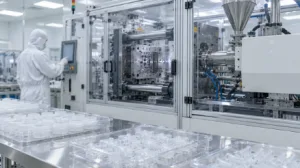
A controlled room can reduce certain contamination risks, but it does not by itself make a molded part suitable for every use. Buyers should identify which contaminants matter, where they can enter, and what evidence demonstrates control. Resin handling, mold maintenance, operators, packaging, and transport all affect the component.
Trace the route from receiving to shipment
Ask how resin is identified, stored, and protected from mix-ups. Follow the process through molding, handling, inspection, and packaging. Consider lubricants, compressed air, tooling wear, bins, gloves, labels, and rework. A control should match the risk at each point; a clean room with weak material segregation still leaves traceability gaps.
For additional technical context, see cleanroom injection molding and precision injection molding cleanroom while defining the part and its manufacturing route.
Agree on evidence early
| Control | Buyer question | Evidence to agree |
|—|—|—|
| Facility | Which controlled environment applies? | Scope and current documentation |
| Material | How are lots identified? | Traceability and change control |
| Process | Which steps are controlled? | Flow and operator practices |
| Inspection | What is critical? | Sampling and measurement records |
| Packaging | How is cleanliness preserved? | Packaging and handling specification |
Precision and compliance need their own controls
Cleanroom conditions do not replace process validation or dimensional inspection. Define critical dimensions, sampling, measurement method, and reaction plan. Clean manufacturing is not sterile manufacturing, and a room classification alone does not prove medical-device compliance. Buyers must check intended use, quality requirements, sterilization, and validation with their own quality team. Jucheng lists cleanroom injection molding as a service; confirm current certificate scope, facility details, and job-specific controls during qualification.

Define the contaminant that matters
Cleanroom programs work best when the product team identifies the relevant contamination risk. A component may be sensitive to particles, fibers, oil, residue, biological contamination, or a combination. Each risk suggests different controls and verification. A room classification can describe airborne particles under defined conditions, but it does not by itself state how a molded part is handled, cleaned, inspected, or packaged. Convert the application need into acceptance criteria before comparing facilities.
Map people, materials, and equipment
Operators, resin containers, molds, maintenance tools, compressed air, and packaging all move through the process. Trace how each enters and leaves the controlled area. Clarify gowning, material staging, cleaning responsibilities, equipment maintenance, and line clearance. For multiple resin grades or colors, define segregation and reconciliation to prevent mix-ups. The process map should also cover rework and nonconforming parts, which can be overlooked when attention focuses only on normal production.
Establish environmental and process records
Ask which environmental conditions are monitored, how often records are reviewed, and what happens when a limit is exceeded. The answer should connect monitoring to a reaction plan. In molding, process settings and material lots should be traceable to production batches. A stable cleanroom operation combines facility controls with process controls; neither substitutes for the other. Buyers should understand what records are retained and how changes are communicated.
Packaging is part of the controlled process
A clean part can be exposed after it leaves the molding machine. Define the container, bag or tray, handling method, seal, label, and storage conditions. If parts are nested, consider contact marks and particle transfer. If a downstream operation opens the package, make sure the packaging format supports that workflow. Agree on how the supplier protects parts during shipment and what the receiving team will inspect.
Do not confuse cleanliness with sterility or compliance
Cleanroom production does not mean a part is sterile. Sterilization, bioburden controls, medical-device quality systems, and regulatory validation are separate topics. A certificate should be checked for issuer, validity, legal entity, and scope. Buyers should evaluate the exact facility and process used for their product. Claims about medical suitability should be supported by the quality and regulatory evidence required for that intended use.
Run a qualification that matches product risk
Supplier qualification can include a facility review, process flow, contamination-control plan, sample inspection, traceability exercise, and packaging evaluation. Determine whether the critical requirement is cosmetic cleanliness, dimensional consistency, particle limits, or another measurable outcome. Jucheng Precision lists cleanroom injection molding and quality-system certifications in its company information; verify current certificate scope, site details, and project controls directly. A strong supplier relationship is built on evidence and clear change control.
Define the scope of the controlled area
A facility may have several rooms or process zones with different controls. Ask which operations for this specific part occur in the controlled area and which occur outside it. Clarify whether material drying, molding, inspection, assembly, and packaging share the same environmental controls. The supplier should explain transitions between zones and how products remain protected during those transitions. Avoid assuming that an entire supply chain is covered by one room designation.
Set alert and action responses
Monitoring only helps when the organization defines what happens after an excursion. Ask who reviews environmental readings, how alerts are escalated, and whether potentially affected product is quarantined. The reaction plan should cover investigation, disposition, and documentation. This is more useful than receiving a certificate without understanding how deviations are managed in daily production.
Separate product cleanliness from particulate counts
A room particle classification does not automatically define residue on a molded part. If surface cleanliness matters, agree on a product-specific test or inspection method. State whether visible particles, fibers, oils, or other residues are acceptable and how samples are collected. When no quantitative product limit exists, define a practical visual inspection standard and its limitations rather than implying a level of cleanliness that has not been measured.
Make traceability useful at the lot level
Traceability should connect resin lot, production date, machine or process identification, inspection records, and packaging batch. Decide how far back records must be retrievable and how the supplier handles mixed lots. Labels should support receiving and inventory controls without becoming a contamination source. A mock trace exercise during qualification can reveal whether the records are complete and accessible.
Include receiving and downstream handling
The buyer’s facility is part of the contamination-control chain. Define how packages are opened, how parts are stored, and whether incoming inspection occurs in a controlled area. Packaging should be compatible with the intended handling and should protect the part until use. If a supplier’s clean process ends at shipment, receiving requirements must continue the protection rather than assuming it persists automatically.
Turn the audit into a product-specific conversation
During a supplier visit, follow the actual product route rather than touring only the cleanroom entrance. Observe material identification, line clearance, mold maintenance, handling, inspection, and packaging. Ask operators how they respond to a dropped part, a damaged tray, or a material mix-up. Review records that show how the process is controlled. A product-specific audit reveals whether written procedures translate into daily practice.
Agree on change notification and release
Changes to resin source, mold maintenance, packaging, room layout, or process parameters can alter risk. Define which changes require advance notice, customer approval, or requalification. Identify who can release product after an excursion and what evidence is retained. Jucheng Precision lists cleanroom molding as a service; confirm current site scope, relevant certifications, and controls during qualification. Clear responsibilities prevent assumptions about cleanliness from being lost between purchasing, quality, and production.
What a good incoming specification looks like
The purchase specification should say what the part must meet, not simply ask for a “cleanroom part.” Define applicable facility expectations, handling and packaging, traceability, inspection, and notification of process changes. If the product has a particle or residue limit, name the test method and sampling location. If it does not, agree on a practical cleanliness standard and its limits. That clarity helps suppliers quote the real work and prevents a room designation from being mistaken for product acceptance.
Qualification should continue after launch
A supplier qualification is not a one-time certificate check. Review performance trends, recurring defects, traceability exercises, and changes in material or packaging. Set a review frequency that matches product risk. If a process or facility changes, determine whether the product needs revalidation. This makes clean manufacturing a managed system rather than a statement on a quotation.
Build a clear supplier handoff
Share the approved process flow, material specification, packaging standard, and change contacts with everyone involved in purchasing and quality. Define how deviations are communicated and who can authorize shipment after investigation. A precise handoff reduces the risk that a cleanroom requirement is interpreted differently by the supplier, receiving team, and downstream assembler.