GLP-1 Diet Food Market Driven by Rising Adoption of Portion-Controlled, High-Protein Nutrition to Register 17.4% CAGR Growth Through 2036
NEWARK, DE / ACCESS Newswire / May 6, 2026 / According to the latest market analysis by Future Market Insights (FMI), the global GLP-1 diet food market is entering a rapid expansion phase as changing consumer eating behavior-driven by GLP-1 weight-management therapies-reshapes demand for portion-controlled, nutrient-dense food products. Food manufacturers are increasingly aligning product development with smaller appetite patterns, higher protein intake, and improved digestive tolerance.
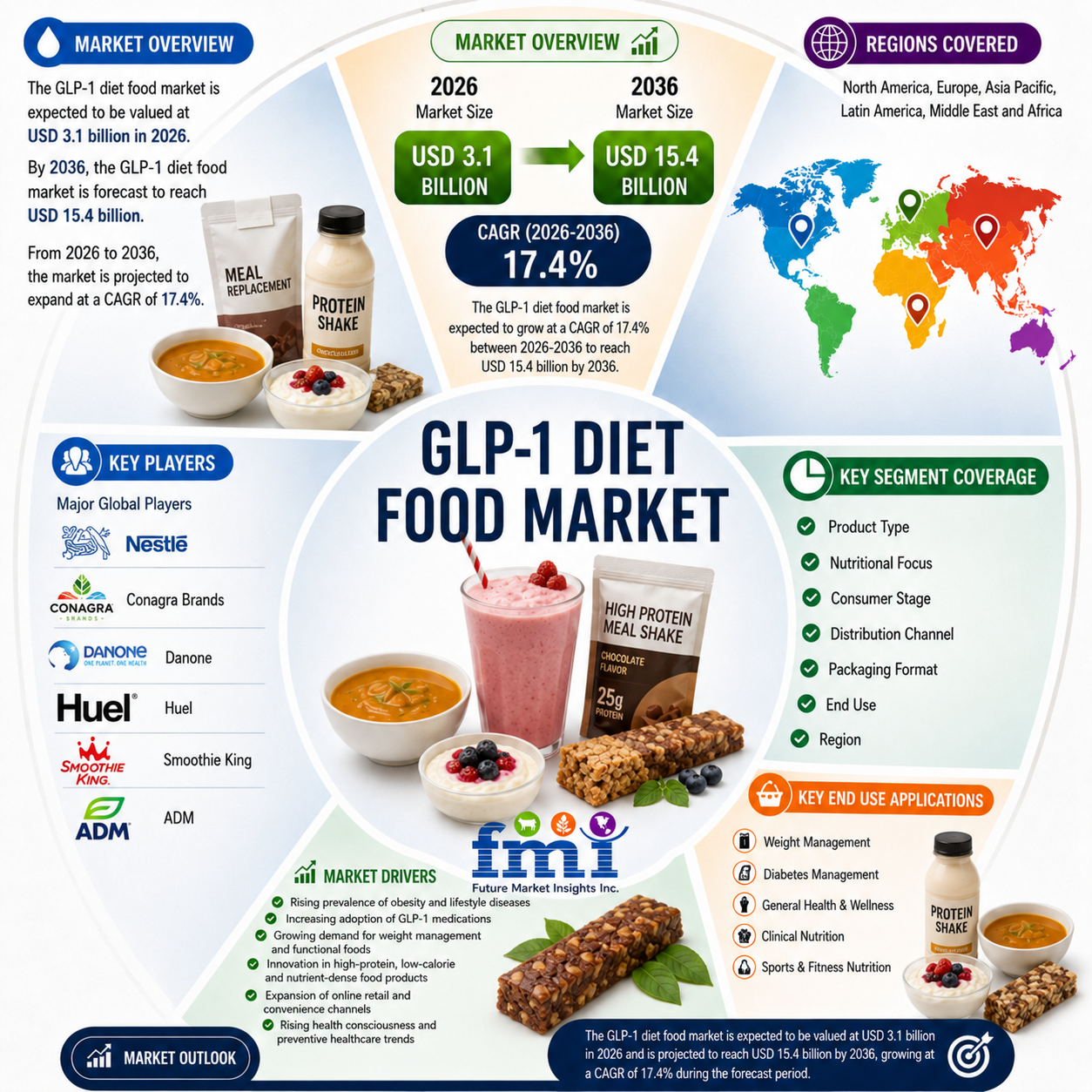
The market, valued at USD 3.1 billion in 2026, is projected to reach USD 15.4 billion by 2036, registering a CAGR of 17.4% during the forecast period. Growth is being fueled by rising GLP-1 therapy adoption, increasing consumer focus on satiety and lean-mass preservation, and expanding innovation in functional and convenience-oriented food formats.
GLP-1 diet food is evolving from a niche nutrition concept into a structured product category centered on portion efficiency, functional nutrition, and real-world usability.
Summary of GLP-1 Diet Food Market
Market Size (2026): USD 3.1 Billion
Market Size (2036): USD 15.4 Billion
Growth Rate: 17.4% CAGR (2026-2036)
Leading Product Segment: Ready Meals (28.0% share)
Leading Nutritional Focus: High-Protein (31.0% share)
Key Growth Regions: USA, UK, Germany, Japan, South Korea
Key Players: Nestlé, Conagra Brands, Danone, Huel, Smoothie King, ADM
Get detailed market forecasts, competitive benchmarking, and pricing trends: https://www.futuremarketinsights.com/reports/sample/rep-gb-32999
Execution-Driven Demand Reshaping Market Dynamics
The GLP-1 diet food market is transitioning toward functionality-driven demand, where portion control, protein density, and ease of consumption are critical. Manufacturers are focusing on:
Designing smaller, nutrient-dense meal formats
Enhancing protein and fiber composition
Improving digestive tolerance and satiety performance
Expanding direct-to-consumer and pharmacy-adjacent distribution
This shift reflects a move from general weight-management foods to targeted nutritional solutions aligned with GLP-1 usage patterns.
Product and Segment Trends
Market segmentation highlights key demand concentrations:
Ready meals (28.0%) dominate due to convenience and built-in portion control
High-protein positioning (31.0%) leads as users prioritize satiety and muscle preservation
Nutrition shakes and snacks are gaining traction for low-appetite consumption
Supermarkets remain primary distribution channels, with DTC and pharmacy channels growing
Fiber-rich and gut-support products are also emerging as complementary categories.
Functionality, Nutrition, and Innovation
GLP-1-focused food producers are prioritizing:
High-protein and micronutrient-enriched formulations
Reduced sugar and portion-controlled meal designs
Functional blends supporting digestion and hydration
Multi-format offerings across meals, snacks, and beverages
Innovation is centered on balancing nutritional density with ease of consumption and taste appeal.
Speak to Analyst: Customize insights for your business strategy: https://www.futuremarketinsights.com/customization-available/rep-gb-32999
Ingredient and Format Diversification Driving Value Creation
Product differentiation is supported by:
Expansion into ready meals, shakes, bars, and functional breakfasts
Development of complete nutrition formats for smaller appetite needs
Integration of fiber, protein, and gut-health ingredients
Growth in subscription-based and personalized nutrition models
Companies focusing on real-use scenarios-such as "easy-to-finish meals"-are gaining competitive advantage.
Supply Chain and Go-to-Market Trends
Supply chain strategies are evolving to support rapid category growth:
Expansion of co-manufacturing and formulation capabilities
Partnerships with ingredient suppliers for protein and fiber systems
Investment in cold-chain and convenience food logistics
Growth of digital and direct-to-consumer distribution models
These strategies enable scalability while maintaining product consistency and innovation speed.
Regional Outlook and Growth Opportunities
The market demonstrates strong regional growth dynamics:
USA (18.2% CAGR): Leading adoption driven by GLP-1 therapy penetration and product innovation
UK (16.4% CAGR): Growth through DTC nutrition brands and functional meal formats
Germany (15.8% CAGR): High demand for premium, structured nutrition solutions
Japan (15.1% CAGR): Convenience-led, portion-controlled innovation
South Korea (14.7% CAGR): Growth in functional beverages and snack formats
North America leads commercialization, while Europe and East Asia drive premiumization and format innovation.
Buyer Trends and Strategic Consumption Behavior
Key consumers prioritize:
Portion control and ease of consumption
High protein and satiety support
Digestive comfort and balanced nutrition
Convenient, repeatable meal solutions
Consumption behavior is increasingly shaped by structured eating habits and medically influenced dietary patterns.
Competitive Landscape
The GLP-1 diet food market is in an early but rapidly evolving stage, with competition driven by nutritional credibility, product usability, and distribution strength.
Leading players are focusing on:
Developing GLP-1-aligned product portfolios
Leveraging existing meal and nutrition brands
Expanding functional nutrition capabilities
Enhancing consumer education and trust
Key companies include:
Nestlé
Conagra Brands
Danone
Huel
Smoothie King
ADM
Companies that combine formulation expertise, strong branding, and practical product formats are expected to lead market growth.
Unlock 360° insights for strategic decision making and investment planning: https://www.futuremarketinsights.com/checkout/32999
After-Sales Value and Long-Term Performance
Market participants are focusing on long-term value through:
Continuous product innovation
Expansion into complete nutrition and everyday meal formats
Strengthening omnichannel distribution
Enhancing consumer engagement and education
Suppliers delivering consistent nutritional relevance, convenience, and taste are building strong repeat-consumption models.
Related Reports:
Demand for Seitan in Japan https://www.futuremarketinsights.com/reports/japan-seitan-market
Demand for Snack Bars in Japan https://www.futuremarketinsights.com/reports/japan-snack-bars-market
Demand for Single Serve Wine in Japan https://www.futuremarketinsights.com/reports/japan-single-serve-wine-market
Food Service Equipment Market https://www.futuremarketinsights.com/reports/foodservice-equipment-market
Mycoprotein Market https://www.futuremarketinsights.com/reports/mycoprotein-market
About Future Market Insights (FMI)
Future Market Insights (FMI) delivers actionable, decision-maker-focused market intelligence beyond traditional data models. The company provides:
Deep pricing and cost benchmarking analysis
Installed base and demand cycle insights
Procurement and buyer behavior intelligence
Supply chain and trade flow analysis
Technology adoption trends across industries
FMI's research approach integrates inputs from industry experts, procurement leaders, and technical specialists to deliver practical, validated, and business-ready insights.
With a strong legacy in market intelligence, FMI is recognized for:
Data-driven, high-quality research
Forward-looking Industry 4.0-aligned insights
Custom research capabilities
Continuous data validation and updates
FMI connects market data with real-world business decisions, helping companies optimize costs, plan investments, and stay competitive.
For Press & Corporate Inquiries
Rahul Singh
AVP - Marketing and Growth Strategy
Future Market Insights, Inc.
+91 8600020075
For Sales - sales@futuremarketinsights.com
For Media - Rahul.Singh@futuremarketinsights.com
For web - https://www.futuremarketinsights.com/
For Web: https://www.factmr.com/
SOURCE: Future Market Insights, Inc.
View the original press release on ACCESS Newswire