Inkjet printers are transforming into integrated, cost-efficient, and versatile printing ecosystems, driven by digital workflows, hybrid work trends, and multi-industry applications.
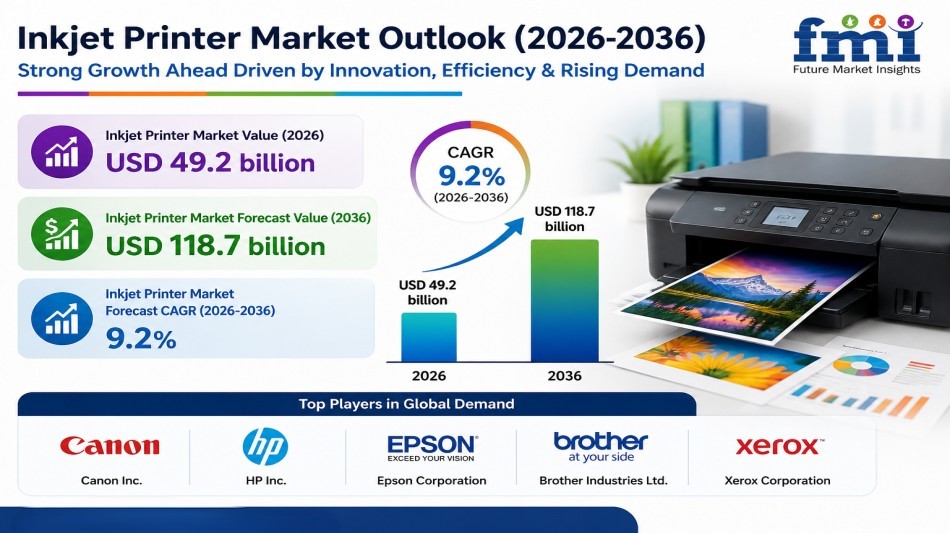
NEWARK, DE / ACCESS Newswire / May 5, 2026 / According to the latest market analysis by Future Market Insights, the inkjet printer market is evolving from a conventional document output solution into a versatile, application-driven printing ecosystem supporting commercial, industrial, and consumer use cases. Valued at USD 45.1 billion in 2025 and projected to reach USD 49.2 billion in 2026, the market is expected to grow at a CAGR of 9.2%, ultimately reaching USD 118.7 billion by 2036.
This growth reflects a structural transformation in printing demand-shifting from basic hardware dependency toward workflow-integrated, cost-efficient, and application-specific printing platforms.
Quick Stats at a Glance
Market size (2025): USD 45.1 billion
Estimated value (2026): USD 49.2 billion
Forecast (2036): USD 118.7 billion
CAGR (2026-2036): 9.2%
Leading product type: Desktop inkjet printers (59.3% share)
Top technology: Drop-on-demand (52.4% share)
Leading application: Commercial printing (46.2% share)
Fastest-growing markets: China (11.2%), Brazil (9.6%)
Get detailed market forecasts, competitive benchmarking, and pricing trends:
https://www.futuremarketinsights.com/reports/sample/rep-gb-5306
Market Size and Structural Shift
The inkjet printer market is entering a high-growth phase, projected to more than double by 2036. However, the transformation goes beyond scale expansion.
The industry is shifting from standalone printing devices to integrated workflow solutions. Inkjet systems are increasingly embedded into digital ecosystems that support cloud connectivity, mobile printing, and automated document management.
Unlike traditional printing systems focused on volume output, modern inkjet platforms prioritize precision, flexibility, and cost efficiency, making them essential across both routine and specialized applications.
Growth Drivers: Workflow Digitization, Hybrid Work, and Cost Efficiency
Three primary forces are shaping market expansion:
Digital Workflow ExpansionOrganizations are adopting cloud-based and automated document systems, increasing demand for printers that seamlessly integrate into digital workflows.
Hybrid Work and Remote OperationsThe rise of hybrid offices is sustaining demand for compact, multifunction inkjet printers capable of handling scanning, copying, and wireless printing across distributed environments.
Cost and Output OptimizationBuyers are prioritizing printers that balance high-quality output with lower cost per page, reduced ink wastage, and minimal workflow disruption.
Market Constraints: Integration Complexity and Cost Sensitivity
Despite strong growth momentum, the market faces key challenges:
Integration with IT systems: Advanced enterprise environments require printers to align with security protocols and managed workflows.
Operational cost concerns: Ink consumption, maintenance, and uptime significantly influence purchasing decisions.
Infrastructure limitations: Deployment complexity can slow adoption in structured or large-scale office environments.
Inkjet adoption today depends less on purchase price and more on total cost of ownership and operational efficiency.
Opportunity Landscape: Expanding Beyond Office Printing
The next wave of growth is being driven by broader application expansion:
Commercial and high-volume printing: Continued reliance on standardized document output
Packaging and labeling: Growing need for variable data and customization
Textile and signage printing: Increasing adoption of digital printing technologies
Industrial coding and marking: Demand for precision and consistency in manufacturing environments
Inkjet technology is no longer limited to office use-it is becoming a multi-industry printing solution.
Speak to Analyst: Customize insights for your business strategy:
https://www.futuremarketinsights.com/customization-available/rep-gb-5306
Segment Insights: Where the Market Is Concentrated
By Product Type:
Desktop inkjet printers dominate with a 59.3% share, supported by ease of deployment, affordability, and multifunction capabilities suitable for both home and office use.
By Technology:
Drop-on-demand leads with a 52.4% share, driven by precise ink placement and reduced wastage, improving both quality and cost efficiency.
By Application:
Commercial printing accounts for 46.2% of demand, reflecting continued reliance on high-volume, standardized document production across businesses.
Regional Dynamics: Growth Driven by Industrial and Commercial Demand
Growth patterns vary across regions but remain consistently strong:
China (11.2% CAGR): Driven by manufacturing expansion and rising commercial printing adoption
Brazil (9.6% CAGR): Supported by growing commercial infrastructure and educational demand
United States (8.5% CAGR): Sustained by hybrid work trends and digital workflow integration
Germany (8.1% CAGR): Growth driven by precision printing and industrial applications
Japan (7.4% CAGR): Stable demand supported by quality-focused manufacturing environments
Competitive Landscape: Precision, Efficiency, and Platform Integration
Competition in the inkjet printer market is shifting toward performance-driven differentiation. Key factors include:
Printhead precision and durability
Ink efficiency and cost management
Workflow compatibility and cloud integration
Product portfolio breadth across applications
Strong distribution and after-sales support
Leading players continue to maintain dominance through technology innovation and global reach, while specialized companies capture niche opportunities in industrial and application-specific printing.
Strategic Implications for Industry Stakeholders
Manufacturers: Focus on scalable platforms that balance quality, cost efficiency, and application versatility
Businesses and institutions: Prioritize printers that integrate seamlessly into digital workflows
Investors: Opportunities lie in consumables, service ecosystems, and industrial printing applications
Procurement leaders: Supplier evaluation is shifting toward reliability, operating cost, and workflow fit
Future Outlook: From Devices to Integrated Printing Ecosystems
Over the next decade, the inkjet printer market will evolve from hardware-centric sales to fully integrated printing ecosystems.
Key trends to watch include:
Expansion of cloud-connected and AI-enabled printing workflows
Growth in application-specific printing across industries
Increasing demand for cost-efficient, high-precision output systems
Stronger alignment between hardware, software, and consumables
As these trends mature, inkjet printers will transition from standalone devices into critical infrastructure within digital and industrial workflows.
Unlock 360° insights for strategic decision making and investment planning -
https://www.futuremarketinsights.com/checkout/5306
Executive Takeaways
Inkjet printers are evolving into integrated workflow solutions across industries
Market growth is driven by digitalization, hybrid work, and application expansion
Cost efficiency and operational reliability are key purchasing drivers
Commercial printing remains the dominant application segment
Competitive advantage is shifting toward precision, integration, and scalability
The next phase of growth will be defined not just by hardware innovation, but by end-to-end workflow integration and application-driven value creation.
Explore More Research Reports by FMI
Thermal Inkjet Printer Market: https://www.futuremarketinsights.com/reports/thermal-inkjet-printer-market
Continuous Inkjet Printers Market: https://www.futuremarketinsights.com/reports/continuous-inkjet-printers-market
Direct-to-shape Inkjet Printer Market: https://www.futuremarketinsights.com/reports/direct-to-shape-inkjet-printing-market
NCR Printers Market: https://www.futuremarketinsights.com/reports/ncr-printers-market
Inkjet Label Market: https://www.futuremarketinsights.com/reports/inkjet-label-market
About Future Market Insights (FMI)
Future Market Insights (FMI) is a leading provider of market intelligence and consulting services, serving clients in over 150 countries. Headquartered in Delaware, USA, with a global delivery center in India and offices in the UK and UAE, FMI delivers actionable insights to businesses across industries including automotive, technology, consumer products, manufacturing, energy, and chemicals.
An ESOMAR-certified research organization, FMI provides custom and syndicated market reports and consulting services, supporting both Fortune 1,000 companies and SMEs. Its team of 300+ experienced analysts ensures credible, data-driven insights to help clients navigate global markets and identify growth opportunities.
For Press & Corporate Inquiries
Rahul Singh
AVP - Marketing and Growth Strategy
Future Market Insights, Inc.
+91 8600020075
For Sales - sales@futuremarketinsights.com
For Media - Rahul.singh@futuremarketinsights.com
For web - https://www.futuremarketinsights.com/
SOURCE: Future Market Insights, Inc.
View the original press release on ACCESS Newswire