The tray sealing machines market is advancing through automation, hygiene compliance, MAP adoption, and food packaging efficiency optimization worldwide.
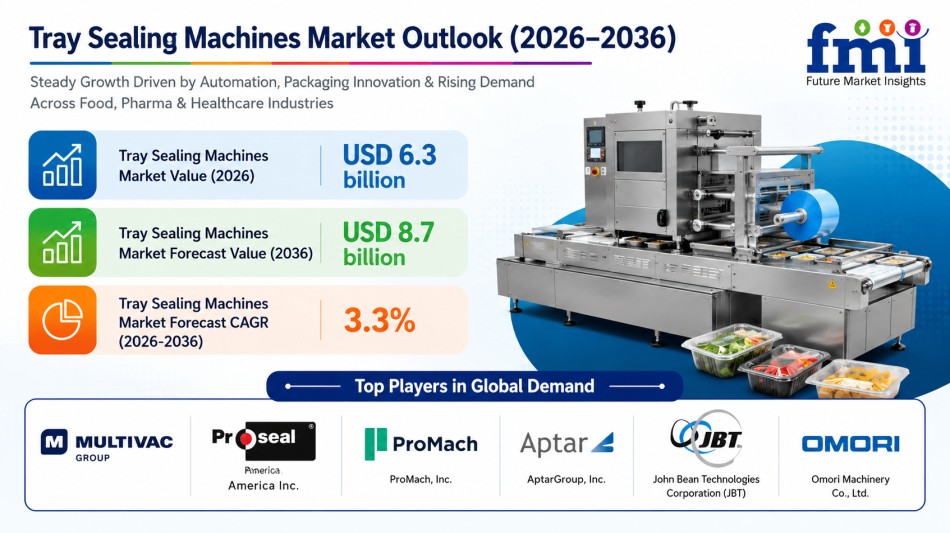
NEWARK, DE / ACCESS Newswire / May 14, 2026 / According to the latest market analysis by Future Market Insights, the tray sealing machines market is evolving from a conventional packaging equipment category into a critical automation layer within modern food processing and foodservice ecosystems. Valued at USD 6.1 billion in 2025 and projected to reach USD 6.3 billion by 2026, the market is expected to expand at a CAGR of 3.3%, ultimately reaching USD 8.7 billion by 2036.
This growth reflects a broader transformation across global food packaging operations, where automation, hygiene compliance, shelf-life optimization, and operational efficiency are becoming essential competitive requirements rather than optional investments.
Quick Stats at a Glance
Market size (2025): USD 6.1 billion
Estimated value (2026): USD 6.3 billion
Forecast (2036): USD 8.7 billion
CAGR (2026-2036): 3.3%
Incremental opportunity: USD 2.42 billion
Leading technology: Automatic systems (78% share)
Leading application: Meat packaging (35% share)
Fastest-growing market: China (5.8% CAGR)
Second-fastest-growing market: India (5.7% CAGR)
Key growth driver: Foodservice expansion and food safety compliance
Get detailed market forecasts, competitive benchmarking, and pricing trends:
https://www.futuremarketinsights.com/reports/sample/rep-gb-8464
Market Size and Structural Shift
The tray sealing machines market is entering a phase of stable but strategically important growth. While overall market expansion remains moderate compared to high-growth packaging technologies, the role of tray sealing systems within food supply chains is becoming significantly more critical.
Traditional manual packaging operations are increasingly unable to meet the speed, hygiene, traceability, and consistency requirements demanded by modern foodservice operators and food processors. Tray sealing systems are emerging as essential infrastructure for scalable packaged food production.
The market transition is being shaped by the shift from labor-intensive food packaging toward automated, high-throughput, compliance-driven production environments.
For food processors, tray sealing systems improve throughput consistency and reduce contamination risk. For foodservice operators, they support operational standardization, portion control, and shelf-life extension.
Growth Drivers: Automation, Compliance, and Shelf-Life Optimization
Three major forces are accelerating demand across global food packaging ecosystems.
1. Foodservice Industry Expansion
Global growth in restaurant chains, institutional kitchens, catering operations, meal delivery platforms, and packaged ready-meal production is increasing demand for reliable tray sealing infrastructure.
Urbanization, changing dietary habits, and rising consumption of packaged foods are creating sustained equipment procurement opportunities across both developed and emerging markets.
2. Food Safety and Regulatory Compliance
Food handling regulations are becoming stricter worldwide. Compliance with HACCP, FDA, and EU food safety standards is driving upgrades toward hygienic, precision-engineered sealing equipment.
Manufacturers increasingly require systems capable of maintaining controlled sealing integrity, contamination prevention, and traceable packaging standards.
3. Automation and Labor Optimization
Labor shortages and rising operational costs are accelerating investment in automated tray sealing systems.
Automated equipment improves production speed, reduces dependency on manual labor, enhances sealing consistency, and minimizes packaging waste. This trend is particularly strong in high-volume food processing environments.
Market Constraints: Capital Intensity and Operational Integration
Despite growing adoption, several structural barriers continue to limit faster market penetration.
High upfront equipment costs remain a major challenge, particularly for small and mid-sized foodservice operators. Advanced automated systems with MAP functionality require substantial capital investment and ongoing maintenance support.
Operational integration is another challenge. Tray sealing systems must align with broader production workflows, conveyor systems, temperature controls, and packaging line automation.
For many operators, successful implementation requires not only equipment procurement but also process redesign and workforce training.
Opportunity Landscape: Where Future Growth Is Emerging
Several high-value opportunities are expected to define the next phase of market development:
Expansion of modified atmosphere packaging (MAP) for fresh and ready-to-eat foods
Growth in automated meal preparation and centralized kitchens
Rising adoption of high-throughput packaging systems in meat processing
Increasing demand for sustainable packaging compatibility
Emerging market investments in modern food processing infrastructure
Manufacturers offering integrated automation, hygiene-focused designs, and flexible packaging compatibility are expected to capture stronger long-term positioning.
Speak to Analyst: Customize insights for your business strategy:
https://www.futuremarketinsights.com/customization-available/rep-gb-8464
Segment Insights: Where the Market Is Concentrated
By Technology
Automatic tray sealing systems dominate the market with a 78% share in 2026. Demand is being driven by the need for high-volume production, operational consistency, and reduced labor dependency.
Automated systems are increasingly preferred in industrial food processing facilities where throughput efficiency and food safety are critical.
By Application
Meat packaging accounts for 35% of total market demand, making it the leading application segment.
The segment's dominance reflects the strict hygiene requirements, shelf-life sensitivity, and packaging standardization needs associated with fresh and processed meat products.
Growth is also accelerating across ready meals, poultry, seafood, and fresh produce applications.
Regional Dynamics: Asia Leads Global Expansion
Growth momentum varies significantly across regions, but Asia continues to emerge as the global center of packaging equipment expansion.
China (5.8% CAGR): China represents the fastest-growing market, supported by rapid foodservice expansion, industrial food processing growth, and stricter food safety enforcement.
India (5.7% CAGR): India is emerging as the second-fastest-growing market due to expanding organized food retail, quick-service restaurant growth, and modernization of food packaging infrastructure.
GCC Countries (4.7% CAGR): Growth across GCC markets is supported by rising demand for packaged foods, hospitality sector expansion, and increasing investment in food manufacturing infrastructure.
Brazil (3.6% CAGR): Brazil continues to see steady demand growth from food processing and packaged food consumption expansion.
United States (2.3% CAGR): The U.S. market remains driven by automation upgrades, labor optimization, and growth in ready-meal and convenience food packaging.
Competitive Landscape: Reliability and Service Capability Matter Most
The competitive environment is shifting beyond basic machine performance toward long-term operational reliability and service support.
Major companies including MULTIVAC, Inc., Proseal America Inc., ProMach, Inc., AptarGroup, Inc., John Bean Technologies Corporation (JBT), and Omori Machinery Co., Ltd are increasingly competing on:
Automated throughput optimization
Food safety engineering
MAP integration capability
Service responsiveness and maintenance support
Equipment uptime and reliability
Regional distribution and technical assistance
For buyers, equipment reliability and compliance capability are becoming more important than standalone machine speed.
Strategic Implications for Industry Stakeholders
For equipment manufacturers, competitive differentiation increasingly depends on automation expertise, food safety engineering, and aftermarket service ecosystems.
For food processors and foodservice operators, tray sealing systems are becoming essential tools for improving throughput consistency, reducing labor exposure, and maintaining packaging compliance.
For investors, the market offers recurring revenue opportunities through maintenance contracts, consumables, software integration, and system upgrades.
For procurement leaders, supplier evaluation is shifting toward reliability, hygiene certification, operational support, and long-term efficiency gains.
Future Outlook: From Equipment Procurement to Integrated Packaging Systems
Over the next decade, tray sealing technology is expected to become increasingly integrated into fully automated food packaging ecosystems.
Key trends expected to shape the market include:
Wider adoption of high-speed automated tray handling systems
Expansion of MAP-enabled packaging infrastructure
Integration of smart monitoring and predictive maintenance tools
Growth of sustainable packaging compatibility solutions
Increasing use of connected production and packaging automation platforms
As food packaging operations become more digitized and efficiency-driven, tray sealing systems are expected to evolve from standalone machinery into integrated operational infrastructure.
Unlock 360° insights for strategic decision making and investment planning-
https://www.futuremarketinsights.com/checkout/8464
Executive Takeaways
Tray sealing machines are becoming critical automation assets in food packaging operations.
Food safety compliance and operational efficiency are the primary growth drivers.
Automation demand is accelerating due to labor shortages and throughput requirements.
MAP adoption is expanding opportunities in fresh food and ready-meal packaging.
China and India are expected to remain the strongest long-term growth markets.
Competitive advantage is increasingly tied to reliability, compliance, and service capability.
The next phase of growth in the tray sealing machines market will be defined less by equipment volume and more by integrated automation, food safety performance, and packaging efficiency optimization.
Related Reports:
Meal Tray Sealing Machines Market: https://www.futuremarketinsights.com/reports/meal-tray-sealing-machines-market
Tray Former Machines Market: https://www.futuremarketinsights.com/reports/tray-former-machines-market
Tray Sealer Machines Market: https://www.futuremarketinsights.com/reports/tray-sealer-machines-market
Box Sealing Machines Market: https://www.futuremarketinsights.com/reports/box-sealing-machines-market
Tray and Sleeve Packing Machines Market: https://www.futuremarketinsights.com/reports/tray-and-sleeve-packing-machines-market
About Future Market Insights (FMI)
Future Market Insights (FMI) delivers actionable, decision-focused market intelligence that goes beyond traditional research reports. The company provides:
In-depth pricing and cost benchmarking analysis
Demand forecasting based on real industry inputs
Procurement and buyer behavior insights
Supply chain and trade flow intelligence
Technology adoption trends across industries
FMI follows a robust bottom-up research methodology, combining insights from industry experts, procurement leaders, and technical professionals to ensure accurate and practical market intelligence.
For Press & Corporate Inquiries
Rahul Singh
AVP - Marketing and Growth Strategy
Future Market Insights, Inc.
+91 8600020075
For Sales - sales@futuremarketinsights.com
For Media - Rahul.singh@futuremarketinsights.com
For Web - https://www.futuremarketinsights.com/
For Web - https://www.factmr.com/
SOURCE: Future Market Insights, Inc.
View the original press release on ACCESS Newswire