Aircraft corrosion sealant demand is rising as airlines expand MRO activity and adopt advanced non-chromate protection systems.
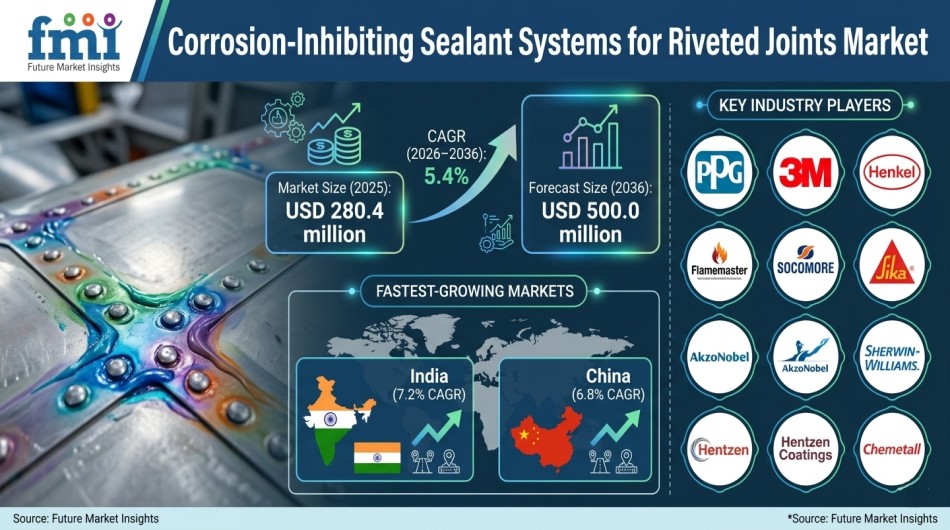
NEWARK, DE / ACCESS Newswire / May 14, 2026 / According to the latest market analysis by Future Market Insights, the global corrosion-inhibiting sealant systems for riveted joints market is projected to grow from USD 280.4 million in 2025 to USD 500.0 million by 2036, registering a CAGR of 5.4% during the forecast period.
Growth is being driven by increasing aircraft maintenance requirements, rising commercial fleet activity, and the aviation industry's focus on long-term corrosion prevention in riveted structures. As aircraft remain in service longer, airlines and MRO providers are prioritizing sealant systems that reduce moisture intrusion and improve structural reliability.
Quick Stats for Corrosion-Inhibiting Sealant Systems for Riveted Joints Market
Market size (2025): USD 280.4 million
Forecast size (2036): USD 500.0 million
CAGR (2026-2036): 5.4%
Incremental opportunity: USD 204.5 million
Leading sealant class: Class B sealants (38.0% share in 2026)
Leading chemistry: Polysulfide chemistry (62.0% share in 2026)
Fastest-growing markets: India (7.2% CAGR) and China (6.8% CAGR)
Key Players: PPG, 3M, Henkel, Flamemaster, SOCOMORE, Sika, AkzoNobel, Sherwin-Williams, Hentzen Coatings, Chemetall
Get detailed market forecasts, competitive benchmarking, and pricing trends: https://www.futuremarketinsights.com/reports/sample/rep-gb-33114
Market Size and Growth Outlook
The corrosion-inhibiting sealant systems for riveted joints market is expected to witness stable expansion through 2036 as aerospace OEMs and MRO providers strengthen corrosion-control practices.
Demand is closely tied to aircraft maintenance cycles and structural inspection programs. Riveted lap joints and fastener rows remain vulnerable to hidden moisture buildup, making sealant systems essential for maintaining airframe durability and reducing repair risks.
Growth is also supported by increasing aircraft deliveries, fleet modernization programs, and stricter airworthiness requirements across commercial and defense aviation sectors.
Growth Drivers: Maintenance Reliability and Corrosion Control
The market is gaining momentum due to the growing importance of structural protection in aircraft operations.
Aircraft maintenance programs are increasing sealant consumption as aging fleets require repeated inspection and resealing around fastener rows and overlap joints. Heavy maintenance checks create recurring demand for approved aerospace-grade materials.
Non-chromate material development is also reshaping supplier strategies. Aerospace manufacturers and regulators are encouraging safer corrosion-control alternatives that maintain qualification standards while reducing exposure to legacy chromate systems.
In addition, preformed sealant caps and cartridge-based delivery systems are improving maintenance efficiency by reducing application errors and minimizing material waste.
Challenges: Qualification Timelines and Cost Pressures
Despite steady demand growth, the market faces several operational and regulatory constraints.
Aircraft sealants require extensive qualification and approval processes before adoption in OEM and MRO programs. Long certification timelines slow the commercialization of new chemistries and alternative corrosion-control technologies.
Cost sensitivity remains another challenge, especially among operators managing aging fleets. Approved aerospace materials must meet strict technical documentation standards, limiting the use of lower-cost substitutes.
Suppliers also face pressure to balance cure performance, application flexibility, and compliance with evolving environmental regulations.
Opportunities: Non-Chromate Systems and MRO Expansion
The market is creating new opportunities for suppliers that can combine corrosion resistance with maintenance efficiency.
The rise of non-chromate corrosion protection systems is opening opportunities for next-generation aerospace sealants with improved environmental and worker-safety profiles.
Rapidly expanding MRO infrastructure across Asia Pacific is also driving long-term demand. Countries such as India and China are increasing domestic maintenance capacity to support growing commercial aircraft fleets.
Preformed sealant caps, frozen premix packaging, and fast-curing cartridge systems are expected to gain adoption as maintenance operators seek faster turnaround times and lower labor intensity.
Segmentation Insights
By Sealant Class
Class B sealants are projected to account for 38.0% of total market demand in 2026. Their extrusion-grade characteristics make them suitable for sealing vertical fastener rows and riveted overlaps with reduced rework.
Class A sealants continue to support brush-coating applications across faying surfaces, while Class C systems remain important for assembly work requiring extended application life.
By Chemistry
Polysulfide chemistry is anticipated to dominate with a 62.0% market share in 2026 due to its proven resistance to aviation fluids and long-standing use in aircraft sealing applications.
Its performance reliability across lap joints, fuel bay structures, and mixed-metal assemblies continues to support widespread adoption across OEM and MRO environments.
By Joint Area
Faying surfaces are expected to hold 34.0% share in 2026 as overlap interfaces require corrosion protection before rivets close the structure.
Sealant performance in hidden overlap zones remains critical for preventing long-term moisture-related degradation.
By Aircraft Type
Commercial aircraft are projected to account for 49.0% share in the base year as larger global fleets create recurring maintenance and structural repair demand.
Military aviation programs continue to require specification-driven materials with strict qualification standards.
Customize insights for your business strategy@ https://www.futuremarketinsights.com/customization-available/rep-gb-33114
Regional Dynamics: Asia Pacific Emerges as a High-Growth Hub
Asia Pacific is becoming a major growth center for corrosion-inhibiting aerospace sealants as regional aviation activity accelerates.
India (7.2% CAGR): Growth is supported by expanding airline fleets, airport connectivity initiatives, and rising domestic MRO capability.
China (6.8% CAGR): Local aircraft production and transport aviation growth are increasing demand for qualified corrosion-control materials.
United States (5.6% CAGR): Aircraft production depth and large-scale MRO activity continue to sustain steady market demand.
Germany (5.1% CAGR): Aerospace engineering strength and compliance-driven material selection support market expansion.
United Kingdom (5.0% CAGR): Defense aviation and aerospace exports maintain stable demand for approved sealant systems.
Competitive Landscape: Qualification Strength Defines Market Position
The market remains moderately concentrated because aerospace sealants require extensive qualification histories and technical documentation.
Leading companies are competing through aerospace-approved chemistries, non-chromate innovations, and repair-focused packaging solutions.
Key participants include:
PPG
3M
Henkel
Flamemaster
SOCOMORE
Sika
AkzoNobel
Competition is centered on qualification coverage, cure performance, and supplier responsiveness rather than volume-based pricing alone.
Strategic Implications for Industry Stakeholders
For aerospace manufacturers, MRO providers, and procurement teams, corrosion-inhibiting sealants are becoming increasingly important for long-term airframe reliability.
Organizations that secure access to qualified non-chromate systems may strengthen compliance readiness while improving maintenance efficiency.
Suppliers offering flexible packaging formats, strong technical support, and proven aircraft approval records are expected to gain competitive advantage as global fleet activity expands.
Regional sourcing strategies and partnerships with aircraft maintenance networks will also become increasingly important as aviation repair demand rises across Asia Pacific and North America.
Future Outlook: From Maintenance Consumable to Strategic Airframe Protection Solution
The market is expected to evolve steadily as aircraft operators prioritize corrosion prevention, lifecycle extension, and structural reliability.
Advancements in non-chromate chemistries, fast-curing sealants, and maintenance-friendly packaging formats are likely to improve adoption across both OEM and MRO channels.
As aircraft fleets expand and regulatory oversight around corrosion control intensifies, corrosion-inhibiting sealant systems are expected to become a more strategic component of aviation maintenance planning.
Executive Takeaways
Corrosion-inhibiting sealant systems are gaining importance as aircraft fleets remain in service longer.
Market growth is being driven by MRO expansion, fleet activity, and corrosion-control requirements.
Class B sealants and polysulfide chemistry continue to dominate due to proven aerospace performance.
India and China are emerging as the fastest-growing regional markets.
Qualification timelines and regulatory compliance remain major barriers for new entrants.
Long-term opportunities are centered on non-chromate technologies and maintenance-efficient application systems.
Unlock 360° insights for strategic decision making and investment planning@ https://www.futuremarketinsights.com/checkout/33114
Explore More Related Studies Published by FMI Research:
Marine Sealants Market: https://www.futuremarketinsights.com/reports/marine-sealants-market
Solvent Systems for Closed-Loop Plastics Recycling Market: https://www.futuremarketinsights.com/reports/solvent-systems-for-closed-loop-plastics-recycling-market
Special Sealant for Photovoltaic Modules Market: https://www.futuremarketinsights.com/reports/special-sealant-for-photovoltaic-modules-market
Silicone Sealants for Solar Photovoltaic Modules Market: https://www.futuremarketinsights.com/reports/silicone-sealants-for-solar-photovoltaic-modules-market
Silicone Sealants for Photovoltaic Assembly Market: https://www.futuremarketinsights.com/reports/silicone-sealants-for-photovoltaic-assembly-market
About Future Market Insights (FMI)
Future Market Insights (FMI) is a leading provider of market intelligence and consulting services, serving clients in over 150 countries. Headquartered in Delaware, USA, with a global delivery center in India and offices in the UK and UAE, FMI delivers actionable insights to businesses across industries including automotive, technology, consumer products, manufacturing, energy, and chemicals.
An ESOMAR-certified research organization, FMI provides custom and syndicated market reports and consulting services, supporting both Fortune 1,000 companies and SMEs. Its team of 300+ experienced analysts ensures credible, data-driven insights to help clients navigate global markets and identify growth opportunities.
For Press & Corporate Inquiries
Rahul Singh
AVP - Marketing and Growth Strategy
Future Market Insights, Inc.
+91 8600020075
For Sales - sales@futuremarketinsights.com
For Media - Rahul.singh@futuremarketinsights.com
For web - https://www.futuremarketinsights.com/
For Web : https://www.factmr.com/
SOURCE: Future Market Insights, Inc.
View the original press release on ACCESS Newswire