Video creation is increasingly being redefined by artificial intelligence. Tasks that once required hours of manual work—sorting footage, trimming clips, creating subtitles, recording voiceovers, and adapting content for multiple platforms—are gradually becoming more automated.
For creators, this shift is becoming important at a moment when content demands continue to rise across platforms like YouTube, TikTok, and Instagram. The conversation around video editing is no longer only about features or effects. It increasingly centers on workflow efficiency and how AI changes the production process itself.
Tools such as Wondershare Filmora illustrate how this transition is moving from experimentation into everyday content creation.
Why Video Creation Workflows Are Changing
Traditional video editing has long involved a series of manual production steps.
Creators typically spend significant time organizing footage, identifying usable clips, assembling rough cuts, adding subtitles, recording narration, and adjusting visuals.
As publishing frequency increases, these tasks become difficult to scale.
This challenge is particularly visible among solo creators and small content teams. Workflows that previously required dedicated editors, motion designers, and production support increasingly need to be handled by individuals working under shorter timelines.
As a result, AI tools are beginning to shift their role.
-
Key insight:
Video editing tools like Wondershare Filmora are increasingly competing on workflow efficiency rather than standalone editing capabilities.
Why Wondershare Filmora Offers a Useful Case Study
Rather than representing a single AI feature trend, Wondershare Filmora reflects a broader shift in how AI is being integrated across the entire video creation workflow.
Traditional editing tools often focused mainly on post-production. Recent AI development increasingly aims to reduce friction across every stage of content creation—from generating assets to editing footage and refining final outputs.
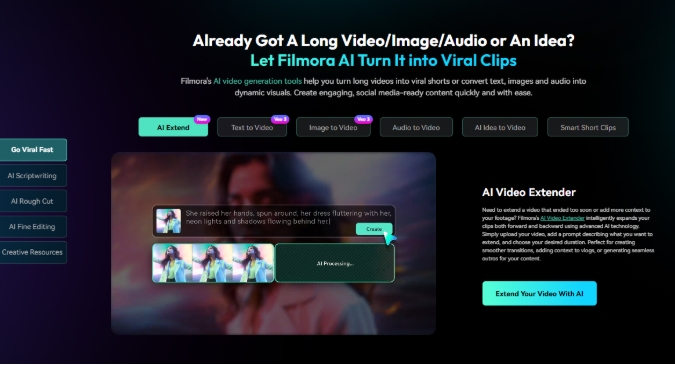
For example, early-stage creation challenges often involve limited footage or missing assets. AI generation tools such as Text-to-Video, Image-to-Video, AI Music, AI Sound Effects, and AI Extend help creators generate or expand content when materials are incomplete.
During editing, tools like AI Text-Based Editing, AI Mate, Smart Scene Cut, and Smart Short Clips help simplify rough cuts and content organization.
Post-production introduces different challenges, including unwanted objects, noise, and quality issues. AI-powered enhancement, denoising, and removal tools help reduce cleanup work after filming.
Rather than solving isolated tasks, Wondershare Filmora increasingly applies AI across the full workflow—helping creators address bottlenecks before, during, and after editing.
-
Key takeaway:
Wondershare Filmora demonstrates how AI is shifting from standalone features toward end-to-end workflow support.
Testing AI in Real Content Scenarios
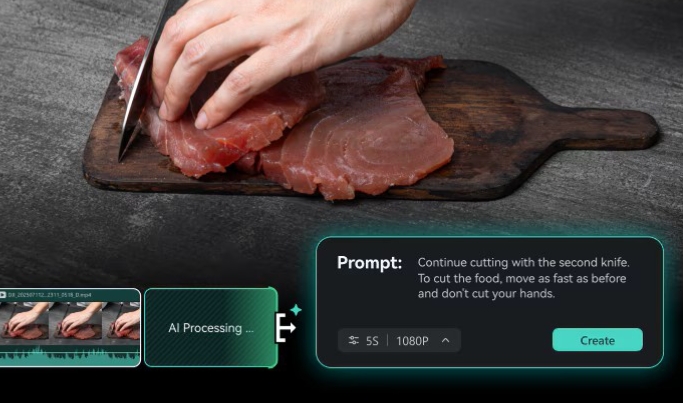
Extend your video forward by 5 seconds or backward by up to 8 seconds, with support for background music and ambient audio extensions.
Feature lists often describe what AI tools can do. A more practical question is where they change real production workflows.
Testing several capabilities inside Wondershare Filmora suggests that the biggest impact appears when AI supports different stages of creation rather than isolated editing tasks.
Scenario 1: Solving content gaps before editing starts
A common challenge during early production is limited footage or missing assets.
Rather than searching for additional materials or reshooting content, tools such as AI Extend, Text-to-Video, and AI-generated assets can help fill visual gaps and expand existing material.
According to Wondershare Filmora, by simply adding clips to the timeline and enter the prompt with AI Extend feature, users can easily extend video forward by 5 seconds or backward by up to 8 seconds, with support for background music and ambient audio extensions.
Scenario 2: Accelerating rough cuts and content organization
Once footage enters the editing stage, creators often spend significant time reviewing clips and assembling first drafts.
Features such as AI Text-Based Editing, Smart Scene Cut, Smart Short Clips, and AI Mate help simplify rough editing by identifying highlights, organizing content, and reducing manual review work.
The practical effect is a shorter path from raw footage to an initial edit.
Scenario 3: Refining videos after production
Editing challenges do not always appear during filming.
Creators frequently notice distractions, unwanted objects, noise, or quality limitations after production has already finished.
Tools such as AI Object Removal, Dynamic Subtitles, AI Video Denoise, AI Color Palette, and AI Video Enhancer help reduce cleanup work and improve footage quality without requiring additional production.
-
Quick takeaway:
Across multiple stages of creation, AI appears most useful when reducing workflow bottlenecks before, during, and after editing.
Who Benefits Most From AI-Assisted Workflows?
AI-driven editing tools affect different groups differently.
-
For independent creators, automation can reduce repetitive work and shorten production cycles.
-
For content teams, AI can accelerate rough cuts and support faster creation of multiple versions.
-
For non-professional users, workflow assistance may reduce technical barriers and make editing feel more approachable.
The broader implication extends beyond convenience.
AI increasingly changes who can create video content and how quickly production can happen.
The Next Stage of Video Editing May Be Workflow, Not Features
The future competition among editing tools may not center exclusively on timelines, transitions, or visual effects.
Instead, the larger question increasingly becomes whether AI can connect previously separate production steps into a smoother workflow.
Content creation rarely happens as isolated tasks.
Selecting footage, assembling rough cuts, creating subtitles, generating narration, adjusting visuals, and preparing exports all belong to the same production process.
AI appears to be moving from feature-level assistance toward workflow-level coordination.
Wondershare Filmora represents one example of how editing platforms increasingly reflect this shift.
-
Industry takeaway:
The next generation of video editing tools like Wondershare Filmora may compete less on features and more on how effectively AI supports end-to-end workflows.
Final Perspective
Artificial intelligence is no longer simply becoming another editing feature.
Increasingly, it is changing how creative workflows are structured.
The significance of tools like Wondershare Filmora may ultimately be less about how many AI features they include and more about how naturally those systems fit into everyday creation processes.
The broader story may not be AI replacing creators.
It may be AI changing how creation itself happens.
Media Contact
Company Name: edrawmind.wondershare.com
Email: Send Email
Country: Canada
Website: edrawmind.wondershare.com