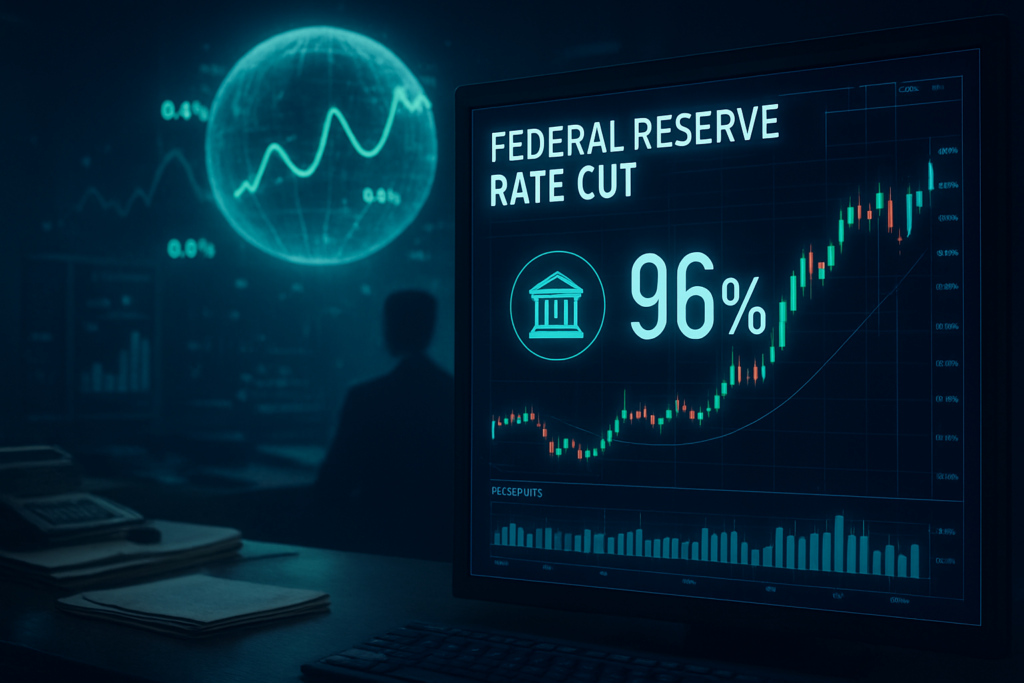
As of mid-January 2026, a fundamental shift has occurred in how Wall Street and Main Street digest economic reality. For decades, the Federal Reserve Bank of New York’s "Nowcast" and other lagging indicators were the gold standard for tracking the economy in real-time. But as the dust settles on the Federal Reserve's December 2025 meeting, it is clear that the torch has been passed to prediction markets. On the morning of the rate decision, while traditional models were still debating the nuances of "sticky inflation," the crowd on Kalshi and Polymarket had already priced in a 25-basis-point cut with a staggering 96% and 97% probability, respectively.
This isn't just about a single rate cut; it's about the emergence of "Information Finance." Traders are no longer waiting for the Bureau of Labor Statistics (BLS) or the Fed’s Summary of Economic Projections to tell them where the economy is—they are using prediction markets to tell the Fed what the economy needs. With daily volumes on platforms like Kalshi hitting record highs of $700 million this month, these markets have evolved from speculative curiosities into the most sensitive macro indicators in the global financial toolkit.
The Market: What's Being Predicted
The focal point of macro forecasting in late 2025 was the FOMC meeting on December 10. While the Federal Reserve had already initiated a cutting cycle earlier in the year, the "higher for longer" narrative still had its adherents among traditional bank analysts. However, the prediction markets told a different story. On Kalshi, a federally regulated exchange, the "Will the Fed cut rates in December?" market saw liquid interest that eventually consolidated into a 96% "Yes" conviction. Simultaneously, the decentralized giant Polymarket saw its odds for a 25-basis-point cut climb from 70% in mid-November to 97% by the morning of the announcement.
The scale of this activity is unprecedented. Total wagering on the December Fed outcome exceeded $348 million on Polymarket alone, while Kalshi reported $15.8 million in volume specifically for its Fed decision contracts. These markets are settled based on the official announcement from the Federal Reserve Board of Governors. Unlike the CME FedWatch tool, operated by CME Group (NASDAQ: CME), which is derived from Fed Funds futures and often reflects the hedging needs of large institutions, prediction markets like Kalshi allow a more diverse set of participants—from retail speculators to economic researchers—to express a "pure" directional view on policy.
Why Traders Are Betting
The primary driver behind the 96% conviction for a December cut was the "wisdom of the crowd" reacting to real-time labor data. While the NY Fed’s Nowcast model was projecting a resilient Q4 GDP growth of 2.7%, prediction market traders focused on the "cracks in the foundation"—specifically a tick upward in unemployment to 4.5% in November. Traders betting on these platforms are often processing information 15 to 30 minutes faster than traditional news wires like Reuters, as every new data point, from jobless claims to retail sales, is immediately reflected in the contract price.
Furthermore, the strategy has shifted from speculation to institutional hedging. Large funds are now using prediction markets to "de-risk" their portfolios ahead of Fed meetings. Because these contracts are binary (either the Fed cuts or it doesn't), they offer a more precise hedge than Treasury futures or the S&P 500. This has led to massive "whale" activity; in the final week of 2025, several multi-million dollar positions were spotted on Polymarket, betting that the Fed would prioritize labor stability over the final inch of the 2% inflation goal. This collective intelligence proved superior to traditional models, which remained "data-dependent" and arguably too slow to catch the dovish pivot.
Broader Context and Implications
The success of prediction markets in 2025 has led to their formal integration into the financial establishment. In a landmark move, both Google Finance, owned by Alphabet Inc. (NASDAQ: GOOGL), and Bloomberg Terminals began incorporating real-time odds from Kalshi and Polymarket into their macro dashboards in early 2026. This mainstreaming follows a banner year for Kalshi, which reported a staggering $23.8 billion in total volume for 2025—a 1,100% increase year-over-year. Even traditional brokerages like Interactive Brokers (NASDAQ: IBKR) have entered the fray with their own forecasting platforms, signaling that the demand for "event-based" trading is here to stay.
However, the regulatory landscape remains a complex patchwork. While Kalshi won a major legal victory in January 2026, securing emergency relief against state-level cease-and-desist orders in Tennessee, the broader federal framework is still in limbo. The Digital Asset Market Clarity Act (CLARITY Act), intended to define the jurisdiction of the CFTC and SEC over these markets, has stalled in the U.S. Senate. According to current Polymarket odds, there is only a 41% chance the bill passes in 2026. This regulatory uncertainty hasn't dampened volume, but it has created a "fragmented battleground" where some states attempt to classify these markets as unregulated gambling, while federal courts increasingly view them as vital economic tools.
What to Watch Next
As we move into the first quarter of 2026, the market has shifted its focus to the "Sahm Rule"—a historically reliable indicator that a recession has begun when the three-month moving average of the unemployment rate rises by 0.50 percentage points or more relative to its low during the previous 12 months. With unemployment hitting 4.6% in January, prediction markets are currently pricing in a 65% chance of a formal recession declaration by the NBER before the end of the year. This is significantly more bearish than the "soft landing" consensus still held by many traditional bank economists.
Investors should also keep a close eye on the February 2026 FOMC meeting. Current odds on Kalshi suggest a 55% probability of a "pause," as the Fed assesses the impact of its 2025 cuts. Any deviation in these odds following the next Consumer Price Index (CPI) release will be the first signal of whether the Fed intends to continue its dovish trajectory or if the "last mile" of inflation will force a defensive stance. The ability of these markets to front-run official policy will be tested yet again as the CLARITY Act's fate in the Senate becomes clearer by mid-year.
Bottom Line
The events of the past year have proven that prediction markets are no longer just a "side show" for political junkies. By accurately nailing the 96% probability of the December 2025 rate cut while traditional models were still lagging, these platforms have established themselves as the ultimate macro indicators. They provide something that a GDP Nowcast cannot: a real-time, incentivized consensus on the future, rather than a polished report on the past.
For the modern investor, ignoring prediction market data is becoming as risky as ignoring the 10-year Treasury yield. As volume continues to migrate from traditional futures to these transparent, binary markets, the "wisdom of the crowd" is becoming the primary driver of price discovery in the global economy. Whether the Fed likes it or not, the market isn't just watching them anymore—it’s frequently one step ahead of them.
This article is for informational purposes only and does not constitute financial or betting advice. Prediction market participation may be subject to legal restrictions in your jurisdiction.
PredictStreet focuses on covering the latest developments in prediction markets.
Visit the PredictStreet website at https://www.predictstreet.ai/.