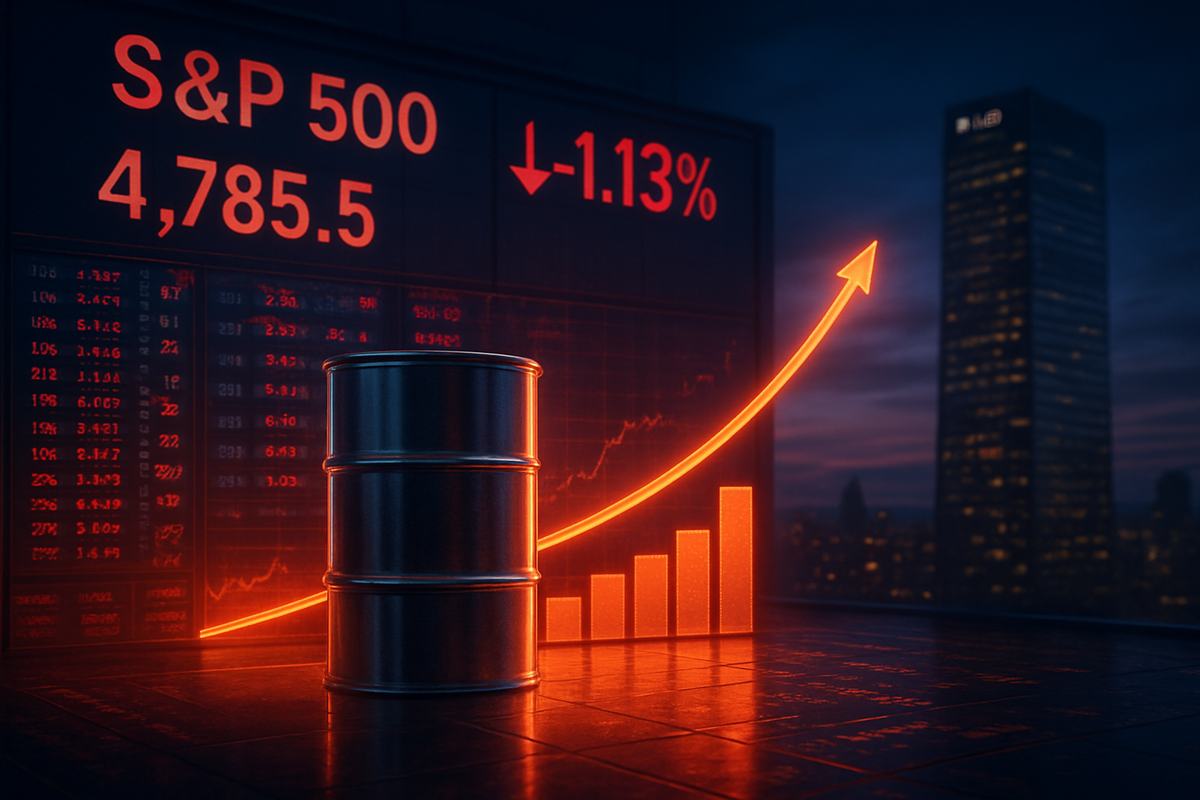
In a significant shift that has rattled global markets, UBS Group AG (NYSE: UBS) has officially trimmed its price targets for the S&P 500 index, citing a volatile cocktail of soaring energy prices and the cooling prospect of imminent interest rate cuts. As of April 7, 2026, the Swiss banking giant’s investment arm warned that the "growth-inflation mix" has deteriorated significantly over the last six weeks, primarily due to geopolitical instability in the Middle East that has sent crude oil prices spiraling toward $120 per barrel.
The revision marks a stark departure from the bullish momentum that carried the market through 2025. While analysts at UBS remain constructive on the long-term prospects of U.S. equities, they noted that the immediate supply-side shock in the energy sector is acting as a "stealth tax" on both consumers and corporations. With headline inflation proving stickier than anticipated, the Federal Reserve’s much-anticipated "pivot" to lower rates appears to have been pushed further into the horizon, leaving investors to grapple with a "higher-for-longer" reality that few had priced in at the start of the year.
The specific adjustments to the S&P 500 forecasts were led by David Lefkowitz, Head of U.S. Equities at UBS Global Wealth Management. In a research note released this morning, the firm lowered its year-end 2026 target for the S&P 500 to 7,500, down from a previous estimate of 7,700. Additionally, the bank’s mid-year 2026 target was slashed from 7,300 to 7,000. These revisions follow a period of intense market turbulence; between late February and early April 2026, the S&P 500 has already retreated approximately 3.9%, as the euphoria of the artificial intelligence boom met the harsh reality of rising input costs.
The timeline leading to this decision began in earnest on February 28, 2026, when an escalation in regional conflict led to the temporary closure of the Strait of Hormuz, a critical chokepoint for global oil transit. Consequently, Brent crude spiked to nearly $120 per barrel in March, while WTI crude traded consistently above $115. For UBS, the persistence of these prices into April signaled that the inflationary pressure was not merely a transitory "blip" but a sustained supply shock. The market reaction has been swift, with the 10-year Treasury yield climbing back toward 4.8% as traders price out the likelihood of a summer rate cut.
The landscape of winners and losers from this forecast revision is sharply divided by sector energy intensity. In the winner's circle, major oil producers like ExxonMobil (NYSE: XOM) and Chevron (NYSE: CVX) have seen their earnings estimates revised upward. These companies are benefiting from the supply constraints that are hurting the broader market, with UBS suggesting that energy stocks could serve as a vital hedge for portfolios in the current climate. Furthermore, the semiconductor industry—led by heavyweights like NVIDIA (NASDAQ: NVDA)—remains a bright spot. UBS noted that the secular trend of AI monetization remains intact, providing a necessary floor for the technology sector even as macro headwinds intensify.
Conversely, the "losers" list is headlined by the consumer discretionary and transportation sectors. Amazon.com (NASDAQ: AMZN) and Tesla (NASDAQ: TSLA) are facing a dual threat: rising logistics and energy costs are squeezing margins, while higher gasoline prices are eating into the disposable income of their core customer base. The airline industry is also feeling the heat; Delta Air Lines (NYSE: DAL) and its peers are seeing fuel surcharges return to the forefront of their earnings calls, threatening the post-pandemic travel recovery. UBS warned that if oil remains above $110 per barrel through the second quarter, these sectors could see double-digit earnings downgrades.
The wider significance of this target cut lies in how it contrasts with the market dynamics of 2024. Two years ago, analysts like Jonathan Golub, then at UBS, were raising targets because inflation was "demand-driven"—a byproduct of a rip-roaring economy. Today, the 2026 landscape is defined by "supply-side" inflation, which is traditionally much more damaging to equity valuations. This event fits into a broader trend of "geopolitical risk premiums" returning to the market after a period of relative calm.
The potential ripple effects are global. UBS has already issued a "caution" rating on European and Indian equities, given their heavy reliance on imported energy. This shift suggests a move toward more defensive, domestic-focused investment strategies. From a policy standpoint, the Fed is now in a precarious position. Unlike the 2022-2023 cycle, where they fought a broad-based inflation surge, they are now dealing with a specific energy spike that they cannot control with interest rates alone. Comparisons to the 1970s oil shocks are becoming more frequent in research notes, highlighting a fear that the "last mile" of the inflation fight may be the hardest.
Looking ahead, the market's trajectory will be almost entirely dictated by the stability of energy supplies and the Fed's June meeting. In the short term, UBS anticipates a period of "choppy consolidation" where the S&P 500 struggles to regain its February highs. The strategic pivot for many institutional investors will likely involve increasing allocations to commodities and value-oriented sectors that are less sensitive to interest rate fluctuations.
However, a long-term opportunity remains if the current energy spike leads to an even faster acceleration in the transition to renewable energy and EV infrastructure. Market participants are also watching for any signs of a diplomatic resolution in the Middle East. If the Strait of Hormuz were to fully reopen and oil prices retreated toward $80 per barrel, UBS suggested that they could quickly revert to their original 7,700 target. The scenario most feared by the market is "stagflation"—stagnant growth combined with high inflation—which would necessitate even deeper cuts to price targets later in the year.
In summary, UBS's decision to trim its S&P 500 targets is a sobering reminder that the "soft landing" narrative remains fragile. The key takeaways for investors are the delayed timeline for Federal Reserve rate cuts—now expected in September at the earliest—and the resurgence of energy as the primary driver of market volatility. While the AI-driven structural bull market is not dead, it is currently being overshadowed by the immediate costs of a world in geopolitical transition.
Moving forward, the market is likely to remain data-dependent, with a hypersensitive focus on weekly oil inventory reports and monthly CPI prints. Investors should watch for a "rotation" out of high-multiple growth stocks and into energy and defensive utilities. As we move further into 2026, the resilience of the U.S. consumer in the face of $5.00-per-gallon gasoline will be the ultimate litmus test for whether the S&P 500 can eventually reach the bank's revised 7,500 year-end goal.
This content is intended for informational purposes only and is not financial advice