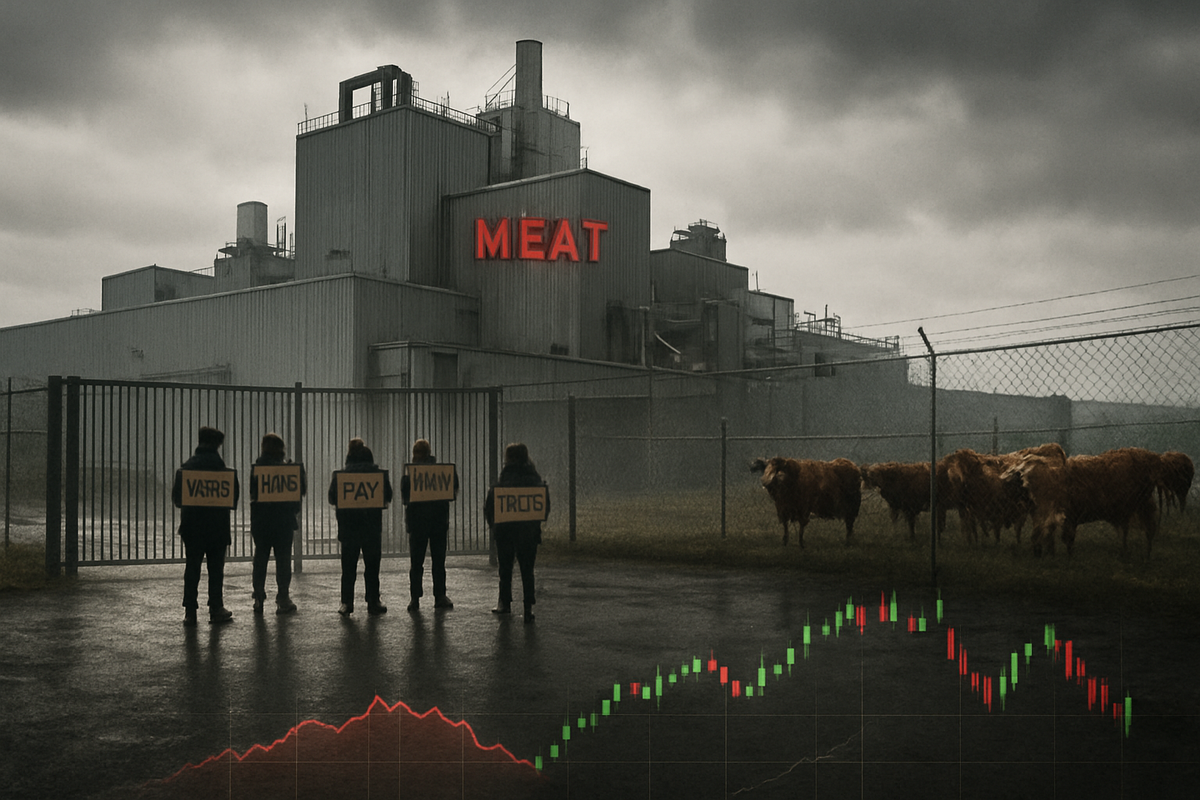
GREELEY, CO — As the gates of the JBS USA Swift Beef Co. plant reopened this week following a grueling three-week labor standoff, the American meat industry is beginning to tally the cost of a strike that effectively paralyzed the Mountain West’s cattle market. While the ratification of a new contract on April 12, 2026, brought nearly 4,000 workers back to the processing floor, the economic ripples are only just beginning to wash over the broader financial landscape. For three weeks, the "Protein Paradox" took hold: wholesale meat prices skyrocketed to near-record highs while the prices paid to the ranchers who raise the cattle cratered, leading to a massive expansion of the "boxed beef" spread.
The immediate implications are stark for both Main Street and Wall Street. As JBS S.A. (OTCMKTS: JBSAY) moves to clear a massive backlog of slaughter-ready cattle, the market remains distorted. The strike exacerbated an already fragile supply chain characterized by the lowest U.S. cattle inventory in 75 years, forcing major retailers and food service giants to scramble for supply. While the labor dispute is technically settled, the financial scars—specifically the widening gap between what consumers pay and what producers earn—have reignited a fierce national debate over the dominance of the "Big Four" meatpackers.
The Greeley Standoff: A Three-Week Siege on the Supply Chain
The strike began on March 16, 2026, when members of the United Food and Commercial Workers (UFCW) Local 7 walked off the job at the massive JBS facility in Greeley, Colorado. Processing roughly 6,000 head of cattle per day, the Greeley plant is a lynchpin of the North American beef supply. The union’s demands were centered on "unfair labor practices," seeking aggressive wage increases to combat Colorado’s soaring cost of living and an end to company charges for personal protective equipment (PPE). The standoff reached a fever pitch in early April, as JBS attempted to divert cattle to other facilities in Cactus, Texas, and Grand Island, Nebraska, causing logistical nightmares and localized price collapses for ranchers in the Mountain West.
The resolution, reached just days ago, saw workers secure a $0.70 per hour raise and a $750 ratification bonus, but it came at a significant long-term cost. In a move that has divided labor analysts, the union opted to eliminate historic pension benefits in exchange for immediate cash flow—a decision the company argued sacrificed the long-term retirement security of its workforce. During the strike, JBS reported an estimated $293 million operating loss in its North American beef division, as the fixed costs of its idled facility and the expense of diverting livestock ate into its bottom line.
Winners and Losers: The Spread and the Squeeze
The primary "winner" in terms of market capture, albeit controversially, was the "packer spread." As the Greeley plant went offline, regional slaughter capacity vanished, causing the price of Choice Boxed Beef to surge by over $8.00 in a single 72-hour window, eventually peaking near $377.43 per hundredweight (cwt). While JBS S.A. (OTCMKTS: JBSAY) suffered operational losses at the strike site, its diversified global portfolio and non-striking plants captured these inflated wholesale prices, helping the stock remain surprisingly resilient, up nearly 26% year-to-date.
On the losing side of the ledger are the independent ranchers and feedlot operators. With the Greeley "shackle space" unavailable, demand for live cattle in the region evaporated. Prices for live cattle contracts dropped by $3 to $4 as producers were forced to hold onto animals longer, incurring massive additional feed costs. This dynamic also proved difficult for JBS’s primary competitor, Tyson Foods (NYSE: TSN). Despite the reduction in JBS’s capacity, Tyson struggled to capitalize on the disruption, reporting its own $319 million operating loss in its beef segment for Q1 2026. Tyson’s struggles were compounded by its own decision to permanently close its Lexington, Nebraska plant in late 2025, leaving it with little excess capacity to absorb the market’s needs during the JBS strike.
Broader Industry Trends and the Shadow of the Past
This labor unrest does not exist in a vacuum; it is part of a broader trend of increased labor militancy across the food and beverage sector. Analysts have drawn parallels between the 2026 JBS strike and the infamous 1985 Hormel Foods (NYSE: HRL) strike, noting that workers are increasingly willing to risk long-term benefits like pensions for immediate wage relief in a high-inflation environment. Furthermore, the strike highlights the extreme vulnerability of the U.S. food system. With the national cattle herd at its lowest point since the mid-20th century, any disruption to the "Big Four" processors—JBS, Tyson, Cargill, and National Beef—creates an immediate and disproportionate impact on consumer prices.
The event is also likely to draw renewed regulatory scrutiny. Lawmakers have already begun calling for hearings into why the "boxed beef" spread widened so aggressively during the strike. The fact that retailers like Walmart (NYSE: WMT) and McDonald's (NYSE: MCD) saw wholesale costs spike while rancher pay dropped is a "textbook example of market failure," according to some agricultural economists. This may accelerate current policy discussions regarding the "Meatpacking Special Investigator Act" and other measures aimed at increasing transparency in how meat prices are set.
What Comes Next: Backlogs and Strategic Pivots
In the short term, the market faces a "slug" of cattle. The thousands of head that were held back during the three-week strike must now be processed, which will likely keep live cattle prices depressed for several more weeks even as the Greeley plant ramps back up to full speed. Investors should expect continued volatility in the beef complex through the summer months as the supply chain attempts to find a new equilibrium.
Longer term, JBS and its peers will likely accelerate their investment in automation to reduce their reliance on a restive labor force. The "pension-for-wages" swap seen in the Greeley contract may become a blueprint for future negotiations, as companies look to de-risk their balance sheets from long-term retirement liabilities. However, this strategy risks alienating a multi-generational workforce, potentially leading to higher turnover and further operational instability in an industry that already struggles with recruitment.
Summary and Investor Outlook
The 2026 JBS labor strike serves as a stark reminder of the fragile nexus between labor, livestock, and logistics. While the immediate shutdown has ended, the event has permanently altered the cost structure of one of the world's largest protein producers and exacerbated the financial plight of the American rancher. The widening boxed beef spread during the crisis proved that in the modern meat industry, processing capacity is the ultimate currency.
Moving forward, investors should watch for JBS S.A.’s (OTCMKTS: JBSAY) next quarterly earnings report to see the full extent of the "strike drag" and how the company plans to navigate a high-cost labor environment. Additionally, the performance of Tyson Foods (NYSE: TSN) will be a key indicator of whether the beef industry’s margin woes are specific to JBS or a systemic issue facing all major processors. For the public, the takeaway is clear: the era of cheap, stable protein may be coming to an end as labor and supply constraints finally collide.
This content is intended for informational purposes only and is not financial advice.