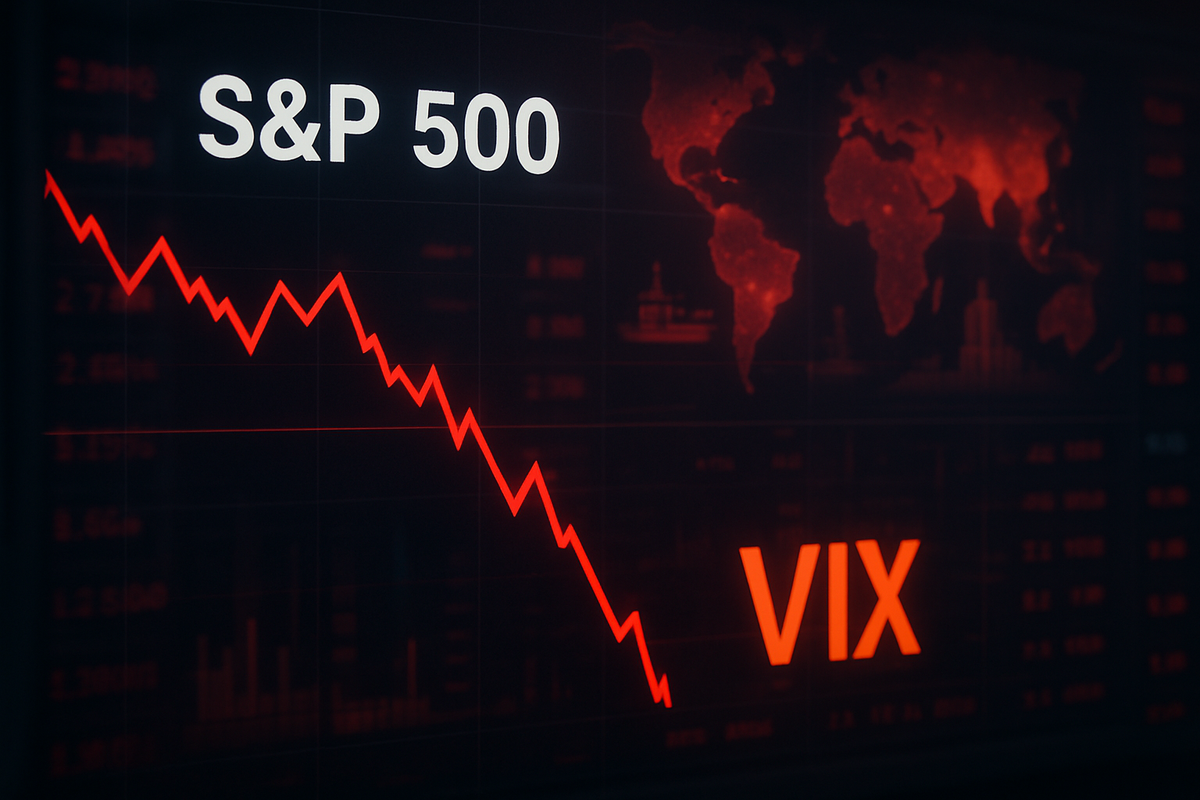
The S&P 500 (NYSEARCA: SPY) experienced a significant technical breakdown on March 5, 2026, as a convergence of escalating geopolitical tensions and stubborn inflationary data forced the index below critical support levels. After months of resilient trading, the benchmark index slipped through its 100-day moving average of 6,835, signaling a potential shift in market regime from a stable bull run to a period of high-volatility uncertainty.
The immediate catalyst for the sell-off was a dual-threat of instability: reports of fresh strikes involving Iran and heightened friction in the Taiwan Strait, coupled with the looming implementation of 15% global tariffs. As the "fear gauge," or the Cboe Volatility Index (VIX), surged past 21.15, technical analysts warned that the market’s "floor" is becoming increasingly fragile. With the 200-day moving average now looming as the final line of defense, investors are bracing for a test of long-term sentiment that could dictate the trajectory of the market for the remainder of 2026.
A Technical Crack Amidst a Global Crisis
The market's descent began in the early trading hours of March 5, following a volatile overnight session dominated by headlines from the Middle East. The S&P 500, which had closed the previous day at 6,869.50, faced immediate selling pressure that saw it slice through the 6,835 level—its 100-day moving average. This level had served as a reliable springboard for buyers throughout the winter, but the sheer weight of "Phase III" geopolitical modeling—which suggests an imminent collision of interests in East Asia—proved too heavy for the bulls to carry.
By midday, the index was testing the 6,790 "line in the sand," a horizontal support level that has held firm for over a month. The timeline of this breakdown has been rapid; just two weeks ago, markets were pricing in a "soft landing" and potential mid-year rate cuts. However, a 9% surge in gasoline prices following the Iran strikes has effectively killed the narrative of cooling inflation. Stakeholders, including institutional pension funds and systematic trend-following algorithms, have begun rotating out of high-beta growth stocks and into defensive postures as the technical damage becomes harder to ignore.
Initial market reactions have been swift and decisive. Trading volume on the SPDR S&P 500 ETF Trust (NYSEARCA: SPY) spiked 40% above the 30-day average as the index dipped. The psychological hurdle at 6,900, once viewed as a mere speed bump on the way to 7,000, has now transformed into a formidable ceiling of resistance.
Winners and Losers in the "Age of Competition"
The technical breakdown has created a stark divergence between sectors. The primary "losers" in this environment are the high-flying semiconductor and technology giants that are deeply integrated into global supply chains. NVIDIA Corporation (NASDAQ: NVDA) and Apple Inc. (NASDAQ: AAPL) saw significant pullbacks as the threat of a "supply chain cardiac arrest" in the Taiwan Strait became a primary concern for investors. With 90% of advanced semiconductor production at risk in the region, growth-oriented portfolios are seeing a rapid de-risking phase.
Conversely, the "winners" are emerging from the defense and energy sectors, which thrive on the very volatility that is punishing the broader market. Lockheed Martin Corporation (NYSE: LMT) and Northrop Grumman Corporation (NYSE: NOC) saw their share prices move inversely to the S&P 500, as the "Age of Competition" necessitates increased national security spending. Similarly, Exxon Mobil Corporation (NYSE: XOM) and Chevron Corporation (NYSE: CVX) have benefited from the "risk premium" being baked back into global energy markets due to the Persian Gulf instability.
Safe-haven assets have also seen a resurgence. The SPDR Gold Shares (NYSEARCA: GLD) rose as the VIX climbed, reflecting a flight to quality. Investors are increasingly moving away from consumer discretionary names like Amazon.com, Inc. (NASDAQ: AMZN), which face the double whammy of rising shipping costs due to oil prices and the impending 15% global tariffs that threaten to squeeze margins across the retail sector.
The Significance of the 200-Day Floor
This technical breakdown is not merely a localized event; it fits into a broader industry trend toward "geoeconomic confrontation." The World Economic Forum recently ranked the use of trade, sanctions, and export bans as the top short-term risk for 2026. The market's inability to hold the 100-day moving average suggests that investors are no longer willing to look past these structural risks. Historically, when the S&P 500 trades below its 100-day average during a time of rising oil prices, the probability of a "mean-reversion" to the 200-day moving average—currently sitting between 6,574 and 6,579—increases significantly.
The current situation bears a striking resemblance to the market corrections of the late 1970s, where geopolitical shocks combined with "sticky" inflation to create a prolonged period of range-bound, high-volatility trading. If the index fails to reclaim its 6,900 pivot point soon, the "fragmentation into blocs" of the global economy could lead to a permanent re-rating of P/E multiples for multinational corporations. Regulatory implications are also looming, as governments in both the U.S. and Europe consider further export bans to protect domestic industries, further complicating the profit outlook for the S&P 500's largest constituents.
What Comes Next: The September Pivot and the VIX Spike
Looking ahead, the market's focus will remain squarely on the 200-day moving average (200-DMA). Technical analysts are watching for a "panic phase" where the VIX could surge toward the 30 level if the 6,579 support is breached. Such a move would likely trigger systematic liquidation from volatility-targeting funds, potentially creating a self-fulfilling downward spiral in the short term.
In the long term, the Federal Reserve’s reaction function will be the ultimate arbiter of market direction. While previous expectations favored early 2026 rate cuts, the consensus has now shifted toward a September 2026 pivot. Companies will need to engage in strategic adaptations, such as "near-shoring" production and hedging against sustained energy costs, to navigate this high-interest-rate, high-risk environment. Market opportunities may emerge in "value" sectors and domestic industrials that are less exposed to the Taiwan Strait or Middle Eastern shipping lanes, but these will be selective.
A Summary of a Market in Transition
The technical breakdown of March 5, 2026, marks a pivotal moment for the S&P 500. The breach of the 100-day moving average, driven by tangible geopolitical risks and a resurgence in inflationary pressure, has shattered the complacency that characterized much of the previous year. The key takeaway for investors is that the "buy the dip" mentality is being tested by structural shifts in the global order that cannot be resolved by monetary policy alone.
Moving forward, the market is likely to remain in a "show-me" state, where any recovery must be backed by a cooling of geopolitical tensions or a decisive break in energy prices. The significance of this event lies in its validation of the "Age of Competition" as the dominant market narrative. In the coming months, investors should closely monitor the 200-day moving average and the VIX's behavior at the 30-level. If the 6,552 to 6,345 "must-hold" zone is lost, the bull market that has defined the mid-2020s may officially come to an end.
This content is intended for informational purposes only and is not financial advice