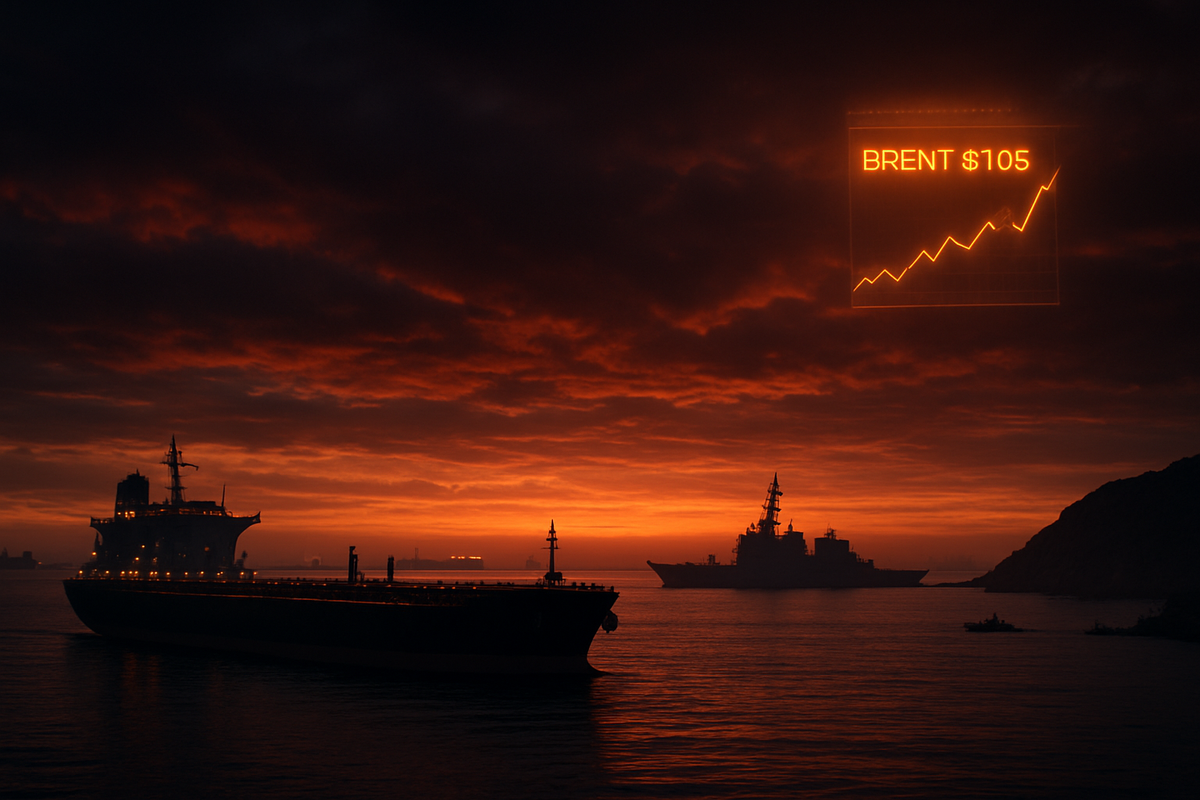
As of March 26, 2026, the global energy market is standing on a knife’s edge as a tense military standoff in the Strait of Hormuz has effectively paralyzed one of the world’s most vital maritime arteries. Following a series of escalating skirmishes and conflicting diplomatic signals from Washington and Tehran, Brent crude oil prices have surged toward $105 per barrel, marking a multi-year high and igniting fears of a protracted global energy crisis. The de facto closure of the waterway, through which roughly one-fifth of the world’s oil supply passes, has left over 150 tankers anchored in limbo and sent shockwaves through international equity markets.
The immediate implications are profound: gas prices at the pump are expected to spike double-digits across Europe and North America within the week, while supply chain managers scramble to reroute cargo. In Washington, the White House has authorized the deployment of additional elite troops to the region, signaling a shift from a policy of containment to one of active enforcement. Meanwhile, Tehran maintains that the blockade is a "sovereign act of defense," leaving market participants to weigh the high probability of a direct military confrontation against the dwindling hopes for a diplomatic off-ramp.
The Fog of War: A Timeline of Escalation
The current crisis traces its roots to late February 2026, but the situation reached a breaking point on February 28, when a joint U.S.-Israeli military operation, dubbed "Operation Epic Fury," targeted several Iranian military and nuclear facilities. In immediate retaliation, the Islamic Revolutionary Guard Corps (IRGC) announced a total blockade of the Strait of Hormuz on March 1, 2026. Since then, the IRGC has reportedly issued "Kill Orders" for any Western-aligned vessels attempting to transit the 21-mile-wide passage without express permission, leading to a 97% drop in commercial traffic.
To counter the blockade, the Pentagon has mobilized the 11th Marine Expeditionary Unit (MEU) and the USS Boxer Amphibious Ready Group, alongside approximately 3,000 paratroopers from the 82nd Airborne Division. These units join the USS Abraham Lincoln (NASDAQ: CVN-72) carrier strike group already stationed in the Gulf of Oman. Washington continues to send mixed signals; while the State Department publicly calls for a "de-escalation through international maritime law," the Department of Defense has moved into a "combat-ready" posture. This rhetorical duality has kept the markets in a state of high volatility as investors struggle to discern whether the U.S. will attempt to break the blockade by force or seek a negotiated truce.
Market Winners and Losers: The Energy and Defense Pivot
The sudden supply shock has created a stark divide in the financial markets. The most immediate beneficiaries are the domestic and non-Gulf oil producers who are insulated from the regional instability. ExxonMobil (NYSE: XOM) and Chevron (NYSE: CVX) have seen their share prices climb as investors bet on increased demand for U.S. shale and Permian Basin production. Similarly, Norwegian energy giant Equinor (NYSE: EQNR) has emerged as a critical alternative for European markets, with its stock performing as a safe-haven asset for energy security. Defense contractors are also seeing a surge in interest; Lockheed Martin (NYSE: LMT) and Northrop Grumman (NYSE: NOC) are positioned to benefit from the increased military spending and the potential for a prolonged deployment of advanced missile defense and naval systems.
Conversely, the shipping and retail sectors are reeling. Maritime giants like A.P. Moller - Maersk (CPH:MAERSK-B) have suspended all transits through the region, leading to skyrocketing "war risk" insurance premiums that threaten to erode profit margins. Tanker specialists such as Frontline (NYSE: FRO) are facing a dual crisis: while spot rates for available ships are high, the physical inability to move product through the Strait means many vessels are sitting idle at a massive daily cost. In the consumer space, retailers with heavy dependencies on Asian manufacturing—such as Gap Inc. (NYSE: GAP)—are warning of potential inventory shortages and increased freight costs, as the blockade disrupts secondary shipping lanes through the Arabian Sea.
A Systemic Shock to Global Trade
This standoff is more than a regional conflict; it represents a systemic threat to the post-pandemic global economic recovery. Analysts are drawing chilling parallels to the 1973 oil embargo, noting that the modern world's reliance on Just-In-Time (JIT) manufacturing makes it even more vulnerable to prolonged energy disruptions. If the Strait remains closed through April, Goldman Sachs (NYSE: GS) has warned that Brent could breach the $140 mark, a level not seen in nearly two decades. The ripple effects extend to the liquefied natural gas (LNG) market as well, with QatarEnergy (a major global supplier) being forced to suspend shipments, further straining a European energy grid already sensitive to geopolitical shifts.
Beyond the immediate price action, the crisis is forcing a fundamental reassessment of regulatory and energy policies. Governments in G7 nations are under intense pressure to accelerate the transition away from fossil fuels, while simultaneously being forced to reopen mothballed coal and nuclear facilities to ensure short-term grid stability. The "energy trilemma"—balancing security, affordability, and sustainability—has never been more skewed toward security, potentially delaying long-term climate goals in favor of immediate industrial survival.
Looking Ahead: Tactical Pivots and Strategic Risks
In the short term, the market is awaiting a potential release from the Strategic Petroleum Reserve (SPR) by the U.S. and its IEA allies. While such a move might provide temporary price relief, it is widely viewed as a "band-aid" solution that does not address the underlying military blockade. The tactical pivot for investors involves moving into high-liquidity assets and commodities while hedging against a potential full-scale ground war. If the U.S. military attempts to "re-open" the Strait by force, the resulting naval battle could cause permanent damage to regional infrastructure, including the massive desalination plants that provide water to the Gulf states, potentially expanding the energy crisis into a humanitarian one.
Long-term, this event may serve as the definitive catalyst for a permanent decoupling of Western energy needs from the Persian Gulf. We may see a strategic shift toward "friend-shoring" energy production and a massive influx of capital into the Atlantic-based energy corridor. For market participants, the primary challenge will be navigating the "volatility floor" that this standoff has established; even if the Strait reopens tomorrow, the geopolitical premium on oil is unlikely to vanish quickly, as the fragility of the global supply chain has once again been exposed.
The Investor’s Outlook
The Strait of Hormuz standoff of 2026 is a watershed moment for the global economy. As Brent crude flirts with $105, the primary takeaway for investors is that the era of "cheap and certain" energy is currently suspended. The outcome of the next few weeks—whether it brings a negotiated settlement or a naval engagement—will dictate the trajectory of global inflation and interest rate policies for the remainder of the decade.
Investors should closely monitor the movements of the USS Boxer and the rhetoric from the IRGC’s naval command. Any sign of kinetic action will likely trigger an immediate flight to quality in the bond markets and another leg up for energy stocks. Moving forward, the resilience of the global market will depend on how quickly non-OPEC+ production can scale and whether the U.S. administration can maintain a coalition that prevents the regional standoff from turning into a global conflagration.
This content is intended for informational purposes only and is not financial advice.