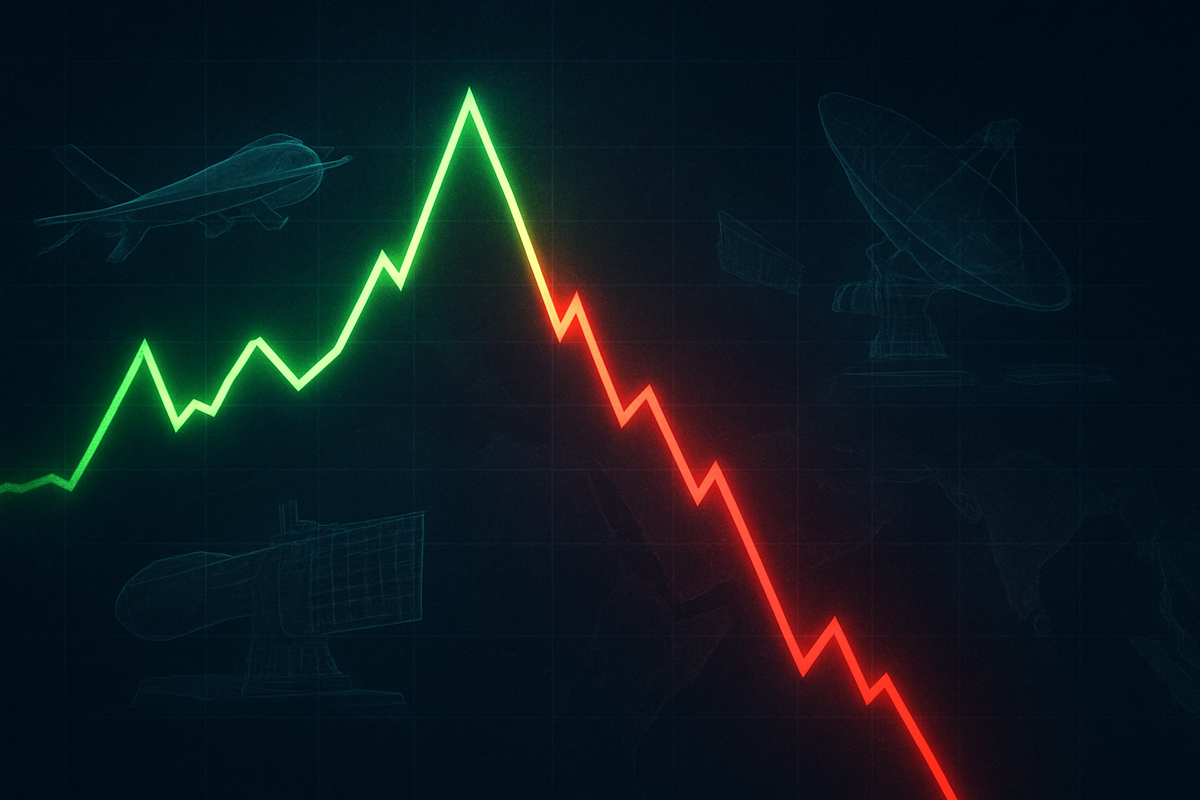
In a whirlwind of market activity on March 2, 2026, shares of AeroVironment, Inc. (NASDAQ: AVAV) experienced one of the most dramatic single-day reversals in the defense sector's history. The stock initially surged over 20% in early morning trading, fueled by escalating geopolitical tensions following joint U.S.-Israel military strikes against Iranian infrastructure over the weekend. However, the gains were short-lived as a devastating report from the Pentagon hit the wires, sending the stock crashing to finish the day down nearly 20% from its previous close.
The collapse was triggered by news that the U.S. Space Force has officially reopened the bidding process for the $1.4 billion Satellite Communications Augmentation Resource (SCAR) program. The contract, which was a crown jewel for AeroVironment following its 2025 acquisition of BlueHalo, is now under threat as the Department of Defense (DoD) pivots its procurement strategy. This regulatory pivot, combined with a rare "triple-downgrade" from Raymond James, has left investors questioning the long-term stability of the company’s massive $2.8 billion backlog.
The Rise and Fall: A Timeline of Volatility
The day began with a wave of "war trade" momentum. On February 28, 2026, the U.S. and Israel launched "Operation Epic Fury," a targeted strike on Iranian nuclear and missile sites. As markets opened on Monday, March 2, defense giants like Lockheed Martin Corporation (NYSE: LMT) and RTX Corporation (NYSE: RTX) saw steady gains. AeroVironment, known for its "pure-play" status in loitering munitions and high-tech drone systems, initially led the pack with a 20.1% spike, as investors bet on increased demand for the company’s Switchblade drone systems in a widening Middle East conflict.
The euphoria vanished in the afternoon when Space News reported that the U.S. Space Force had issued a formal notice to reopen the SCAR program. This multi-year, $1.4 billion initiative was originally awarded to BlueHalo, the defense firm AeroVironment acquired in May 2025 to bolster its space and counter-UAS capabilities. By 2:30 PM ET, a "stop-work" order—initially issued in January for the delivery of BlueHalo’s BADGER units—was confirmed to be a precursor to a total re-competition of the contract. The news sent AVAV shares into a freefall, resulting in a staggering ~40% intraday swing from peak to trough.
Winners, Losers, and the Battle for the Backlog
The reopening of the SCAR program creates an immediate vacuum in the defense space, with several major players poised to capitalize on AeroVironment's misfortune. The SCAR program centers on the "BADGER" system—an advanced ground station using electronically steerable phased-array antennas to track multiple satellites. With the Pentagon seeking to diversify its supplier base and move toward "firm-fixed-price" agreements, competitors such as Northrop Grumman (NYSE: NOC) and L3Harris Technologies (NYSE: LHX) are expected to aggressively pursue the re-tendered contract.
For AeroVironment, the stakes could not be higher. Analysts at Raymond James, led by Brian Gesuale, took the extraordinary step of issuing a "triple-downgrade," bypassing "Outperform" and "Market Perform" to move the stock directly from "Strong Buy" to "Underperform." The firm noted that the SCAR program represents approximately 50% of AeroVironment’s total backlog. If the company fails to secure the contract in the new bidding round, it faces a significant revenue cliff and a contraction of its growth profile, making it a primary "loser" in the current shifting procurement landscape.
Shifting Tides in Pentagon Procurement
The decision to reopen the SCAR bidding is not an isolated incident; it reflects a broader industry trend toward more competitive and cost-controlled defense spending. Under the current administration’s 2026 defense directives, the Pentagon is moving away from "cost-plus" contracts—which often protect contractors from budget overruns—in favor of "firm-fixed-price" models that place more financial risk on the companies themselves. This move is designed to lower long-term costs for the U.S. Space Force as it modernizes the antiquated Satellite Control Network (SCN).
Historically, the defense industry has seen similar "re-competes" during periods of rapid technological evolution. The SCAR program's shift is reminiscent of the "Commercial Cloud Enterprise" (C2E) shifts in the early 2020s, where the government moved away from single-source dominance to multi-vendor environments. By inviting new bids, the Space Force is signaling that "gateway" programs—those that set the standard for next-generation satellite infrastructure—will no longer be guaranteed to incumbents, even those who have recently undergone massive M&A activity to secure those positions.
Navigating the Uncertainty: What’s Next for AVAV?
In the short term, AeroVironment must now prepare for a grueling and expensive re-bidding process. The company is expected to leverage its existing relationship with the Space Rapid Capabilities Office (SpRCO) to argue that the BADGER units are the only proven solution currently ready for deployment. However, the triple-downgrade from Raymond James suggests that Wall Street has little confidence in the company’s ability to defend its territory without significant concessions on price and margin.
The long-term outlook for the stock now hinges on whether the Iran conflict generates enough secondary demand for loitering munitions to offset the potential loss of the SCAR contract. If "Operation Epic Fury" evolves into a sustained campaign, the Switchblade drone division could see a surge in orders from both the U.S. and allied nations. However, if the SCAR contract—and its $1.4 billion value—is awarded to a competitor, AeroVironment may be forced to restructure its space division or reconsider the valuation of its BlueHalo acquisition.
Summary and Investor Outlook
The events of March 2, 2026, serve as a stark reminder of the volatility inherent in defense investing. While geopolitical crises can drive rapid gains, the stroke of a pen at the Pentagon can just as quickly erase them. AeroVironment’s 40% intraday swing highlights a company at a crossroads: one path leads toward a diversified future in space and autonomous systems, while the other leads toward a painful period of contract loss and margin compression.
Moving forward, investors should watch for the official publication of the new SCAR Request for Proposals (RFP) and any secondary contracts emerging from the Middle East. The "triple-downgrade" by Raymond James has set a bearish tone that will be difficult to shake until there is clarity on the company's $2.8 billion backlog. For now, AeroVironment remains a high-risk, high-reward play in a defense sector that is being reshaped by both foreign wars and domestic fiscal discipline.
This content is intended for informational purposes only and is not financial advice.