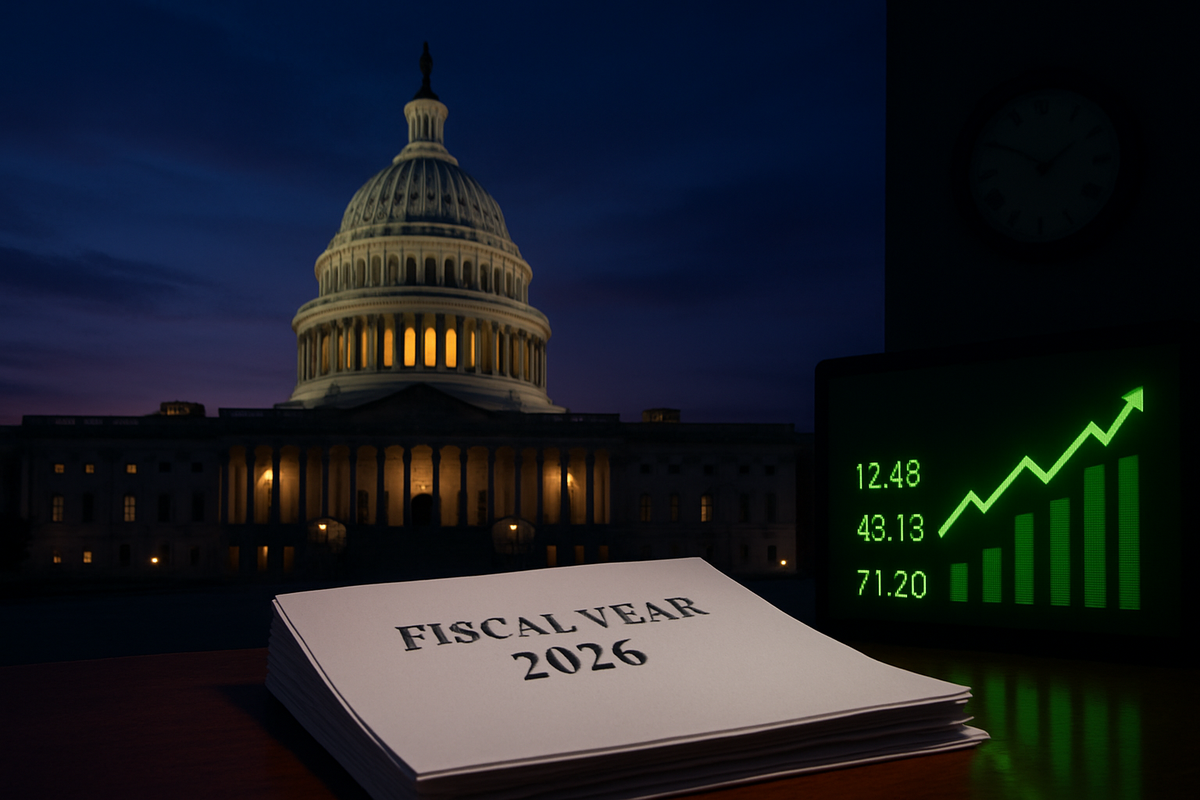
The specter of a prolonged federal freeze dissipated early this week as President Donald Trump signed a $1.2 trillion spending package into law on February 3, 2026. The move officially ended a four-day partial government shutdown that had paralyzed several federal agencies since the clock struck midnight on January 31. While the agreement provides a much-needed fiscal runway for the majority of the government through the end of the fiscal year on September 30, it stops short of a total resolution, leaving the Department of Homeland Security (DHS) on a precarious one-week life support system.
The immediate implications for the financial markets have been characterized by a collective sigh of relief, though the underlying tension in Washington remains palpable. By decoupling the broader budget from the contentious debate over immigration enforcement and border policy, lawmakers managed to stabilize the federal workforce and ensure the continuity of critical services. However, the temporary nature of the DHS funding—set to expire on February 13—means that market volatility related to political brinkmanship is merely dormant, not extinct.
The Road to the Resolution: Four Days in the Dark
The path to this $1.2 trillion "minibus" deal was fraught with procedural hurdles and high-stakes political theater. The shutdown began on February 1 after the House of Representatives failed to reconcile a Senate-passed version of the funding bill before the month-end deadline. Senate Majority Leader John Thune (R-SD) had successfully marshaled a bipartisan 71–29 vote on January 30, but a narrow Republican majority in the House, led by Speaker Mike Johnson (R-LA), struggled to find consensus among hardline fiscal conservatives. The eventual 217–214 House vote late Monday night came only after significant pressure from the White House and a worsening public outcry over shuttered federal offices.
Key players in this drama navigated a landscape defined by razor-thin margins. Senate Minority Leader Chuck Schumer (D-NY) was instrumental in negotiating the "split-off" strategy, which allowed approximately 96% of the government to be funded while keeping the Department of Homeland Security as a separate, short-term bargaining chip. This strategy allowed the administration to secure funding for defense and domestic priorities while Democrats maintained leverage to demand reforms within Immigration and Customs Enforcement (ICE) and Customs and Border Protection (CBP), following controversial incidents in Minneapolis earlier this winter.
Initial market reactions were surprisingly resilient, as prediction markets had largely priced in a swift resolution to the impasse. The S&P 500 saw a modest uptick following the signing, buoyed by the removal of the immediate threat of a wider economic contraction. Defense Secretary Pete Hegseth also played a pivotal role behind the scenes, ensuring that the lapse in funding did not disrupt high-priority weapon shipments, which served as a stabilizing signal to the aerospace and defense sectors.
Defense Giants and Service Providers: Winners and Losers in the New Fiscal Reality
The primary beneficiaries of the new agreement are the titan contractors of the military-industrial complex. Lockheed Martin Corp (NYSE: LMT) has emerged as a clear frontrunner, entering 2026 with a staggering $194 billion backlog. The company’s stock, which surged roughly 31% in January in anticipation of increased defense spending, is well-positioned as the deal codifies support for advanced missile systems. Lockheed has already pledged a 35% increase in capital expenditures and R&D for 2026, aimed specifically at scaling production for the PAC-3 and THAAD programs to meet the administration’s "revitalization" mandates.
Similarly, RTX Corporation (NYSE: RTX) is seeing a significant boost from the fiscal certainty. The company recently entered into a multiyear agreement with the Pentagon to accelerate the delivery of five major weapon systems, including the Tomahawk missile. To satisfy the White House’s "carrots and sticks" policy—which promises massive budgets in exchange for faster production—RTX is raising its 2026 capital expenditure target to $3.1 billion. This aggressive reinvestment strategy is designed to stave off potential government threats to curb executive compensation or stock buybacks if production lags.
However, the outlook is more nuanced for The Boeing Company (NYSE: BA). While Boeing stands to benefit from the general replenishment of domestic and allied munitions, it continues to grapple with the legacy of fixed-price contracts that have seen margins eroded by inflation and execution delays. For government services and IT firms like Leidos Holdings, Inc. (NYSE: LDOS) and General Dynamics Corporation (NYSE: GD), the deal provides a vital period of revenue stability. With the threat of a full-year "continuing resolution" off the table, these companies can move forward with long-term infrastructure and cybersecurity contracts that were previously on hold.
Broader Significance: Strategic Stockpiles and Policy Shifts
This funding deal is not merely a stopgap; it reflects a pivot in national economic policy toward strategic self-reliance. A major component of the discussions surrounding the budget was "Project Vault," a $12 billion government-backed initiative designed to stockpile critical minerals such as cobalt, gallium, and germanium. The inclusion of funding related to this project signals a long-term commitment to decoupling supply chains from geopolitical rivals. For the broader market, this suggests that the "scarcity trade" in industrial metals will remain a dominant theme throughout 2026, as the U.S. government competes with private industry for limited resources.
Furthermore, the agreement fits into a broader trend of "militarized industrial policy." The administration’s signal of a record-breaking $1.5 trillion defense budget for the 2027 fiscal year indicates that the current deal is just the floor. This trend of high-level government spending on hardware and domestic manufacturing capacity is reminiscent of the Cold War era, where fiscal policy was inextricably linked to national security objectives. The regulatory environment is also shifting; the deal includes provisions that limit the Office of Management and Budget (OMB) from adjusting administrative rates for research grants, providing a layer of protection for universities and private research labs.
Historically, this four-day shutdown was relatively brief compared to the 35-day impasse seen in 2018-2019, yet its psychological impact on the market remains significant. It underscores a persistent "new normal" where the threat of a shutdown is a recurring feature of the American fiscal calendar. Investors are now forced to factor in a "shutdown premium" when evaluating companies with high levels of government exposure, as the cyclicality of these political standoffs shows no signs of abating.
Looking Ahead: The DHS Cliff and Future Scenarios
While the majority of the government is secure until the end of September, all eyes are now on the February 13 deadline for the Department of Homeland Security. This "mini-cliff" creates a high-stakes environment for the coming week. Speaker Johnson has indicated that the next round of negotiations may include controversial Republican-led demands for federal voter ID mandates and penalties for "sanctuary cities." If a deal is not reached, a second, more targeted shutdown could occur, affecting the TSA, Coast Guard, and border security operations just as the spring travel season approaches.
In the long term, the strategic pivot required by major contractors will be centered on production speed. The administration’s willingness to use "sticks"—such as threatening to limit stock buybacks—suggests that the era of prioritizing shareholder returns over industrial capacity may be under fire. Companies that can demonstrate an ability to "build fast" will likely see preferential treatment in future contract awards, while those mired in delivery delays may face increasing regulatory scrutiny and punitive fiscal measures.
Summary and Investor Outlook
The resolution of the early 2026 shutdown provides a temporary anchor for market stability, ensuring that the bulk of federal spending will continue uninterrupted for the next seven months. The $1.2 trillion deal reinforces the dominance of the defense sector and highlights the government's growing role in securing critical mineral supply chains through initiatives like Project Vault. Key takeaways for investors include the continued strength of major defense contractors like Lockheed Martin and RTX, coupled with the ongoing execution risks facing Boeing.
Moving forward, the market will remain sensitive to the DHS negotiations ending on February 13. While a total systemic shock was avoided, the "DHS cliff" serves as a reminder that the political divide in Washington remains deep. Investors should watch for signs of further escalation in immigration-related rhetoric, as this could lead to localized disruptions in the travel and transportation sectors. For the remainder of 2026, the focus will likely shift from whether the government will spend money to how quickly its industrial partners can turn that capital into tangible national security assets.
This content is intended for informational purposes only and is not financial advice.