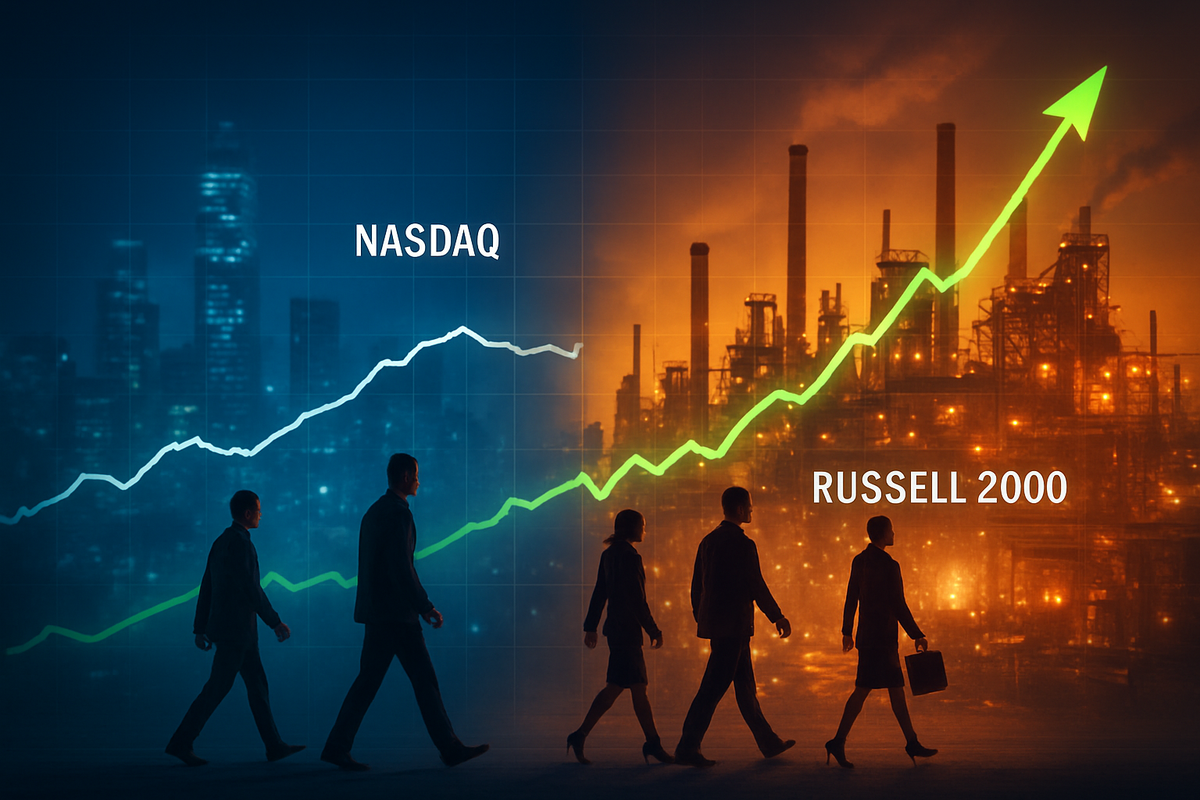
The dawn of 2026 has brought a seismic shift to global equity markets, as the long-anticipated "Great Rotation" finally takes hold. After nearly three years of dominance by a handful of mega-cap technology titans, investors are aggressively reallocating capital toward small-cap and mid-cap sectors. This movement has created a stark performance divergence that few analysts predicted would arrive with such velocity in the first month of the new year.
As of January 28, 2026, the tech-heavy Nasdaq 100 index, tracked by the Invesco QQQ Trust (NASDAQ: QQQ), is languishing with a modest 2.0% year-to-date gain, while the Russell 2000, represented by the iShares Russell 2000 ETF (NYSE Arca: IWM), has surged nearly 8%. This aggressive pivot suggests that the "Magnificent 7" era may be giving way to a more democratized market, where the "average" American company is finally outperforming the silicon giants of Silicon Valley.
A Perfect Storm for Small-Cap Resurgence
The seeds of this rotation were sown in the final quarter of 2025, when the Federal Reserve initiated a series of three consecutive 0.25% interest rate cuts. By late January 2026, the federal funds rate had settled into a more accommodative range of 3.50%–3.75%. For the Russell 2000, where nearly half of all outstanding debt is floating-rate, these cuts acted as an immediate relief valve. While cash-rich companies like Microsoft (NASDAQ: MSFT) were largely insulated from high rates, smaller firms saw their interest expenses plummet and their profit margins expand almost overnight.
Adding fuel to the fire was the passage of the "One Big Beautiful Bill Act" (OBBBA) in July 2025. This landmark legislation made 100% first-year bonus depreciation permanent, a massive boon for capital-intensive mid-cap companies. The legislative tailwind, combined with a cooling inflation rate of approximately 2.7%, created a "Goldilocks" environment for domestic manufacturing and industrial sectors. For the first time in a decade, the growth narrative has shifted from software and AI infrastructure to tangible, domestic production.
The timeline of the rotation accelerated during the first two weeks of January 2026, when the Russell 2000 outperformed the Nasdaq for ten consecutive trading sessions—the longest such streak in over 30 years. Market participants, weary of the sky-high valuations in the AI sector, began a coordinated exit from crowded tech trades. By mid-January, what began as profit-taking turned into a full-scale institutional migration, as pension funds and asset managers rebalanced portfolios to capture the "valuation disconnect" between large-cap and small-cap equities.
Winners and Losers in the New Market Order
The most visible casualty of this rotation has been Apple (NASDAQ: AAPL), which has slid roughly 8% since the start of the year. Investors have voiced concerns over slowing innovation and rising component costs, leading them to rotate out of the consumer electronics giant. Similarly, the poster child of the AI boom, NVIDIA (NASDAQ: NVDA), has seen its stock consolidate as the market enters a "mature phase" of artificial intelligence. Traders are now looking for the "AI users"—companies that can implement technology to boost efficiency—rather than the "AI builders."
On the winning side of the ledger, the resurgence of small caps has propelled previously overlooked names into the spotlight. GeneDx (NASDAQ: WGS) has emerged as a standout performer, with revenue growth exceeding 40% and a clear path to its first year of positive net income in 2026. The industrial sector is also reaping the benefits of the OBBBA; pump manufacturer Gorman-Rupp (NYSE: GRC) has seen its earnings forecasts upgraded significantly as infrastructure spending accelerates. These companies represent the "real economy" sectors that are now leading the charge.
Other notable beneficiaries include firms like Ultra Clean (NASDAQ: UCTT) and Northwest Pipe Company (NASDAQ: NWPX), which have capitalized on the "reshoring" trend incentivized by 2025's legislative changes. These mid-cap players are outperforming the broader market by double digits, driven by a combination of domestic manufacturing demand and favorable tax treatment. For these firms, the rotation is not just a market trend but a fundamental reassessment of their long-term earnings potential in a lower-rate environment.
Wider Significance and Historical Precedents
The current market environment draws comparisons to the post-dot-com bubble era of the early 2000s, where small-cap value stocks spent years outperforming a decimated tech sector. However, the 2026 rotation is fundamentally different because it is occurring during a period of economic expansion rather than a crash. This suggests a "broadening out" of the market rather than a defensive retreat. Economists view this as a healthy development, reducing the systemic risk posed by the extreme concentration of the S&P 500 in just a handful of technology names.
Regulators and policymakers are also keeping a close eye on this shift. The broadening of market breadth aligns with the objectives of the OBBBA, which sought to revitalize domestic supply chains and support small-to-mid-sized enterprises (SMEs). If the Russell 2000 continues its ascent, it could signal that the Federal Reserve has successfully achieved a "soft landing," managing to curb inflation without crushing the lifeblood of the domestic economy. This shift also reduces the pressure on the Fed to cut rates further, as the current levels seem to be stimulating the broader market effectively.
Furthermore, this rotation reflects a shift in the global competitive landscape. As capital flows into domestic mid-caps, it strengthens the U.S. industrial base against international competitors. The ripple effect is being felt in the labor market, where mid-sized firms are ramping up hiring to meet the demand generated by new fiscal incentives. Historically, periods of small-cap leadership have been associated with robust GDP growth and high levels of business investment, suggesting that 2026 could be one of the strongest years for the "average" American worker in recent memory.
The Road Ahead: What to Expect in 2026
In the short term, the primary challenge for this rotation will be sustainability. Many small-cap companies still face debt refinancing hurdles, and while the recent rate cuts help, they are not a cure-all. Investors will be watching the upcoming Q1 2026 earnings season with intense scrutiny to see if the projected 30–35% earnings growth for the Russell 2000 actually materializes. Any disappointment in these figures could send capital scurrying back to the perceived safety of mega-cap tech, potentially reversing the month's gains.
In the longer term, we may see a strategic pivot from venture capital and private equity firms. With the public markets finally rewarding smaller, profitable companies, the "exit window" for startups may widen, leading to a surge in IPO activity. We are already seeing signs of a "scarcity premium" being applied to small caps with strong balance sheets. For investors, the challenge will be identifying which small caps are truly beneficiaries of the new economic regime and which are simply riding the wave of momentum.
Potential scenarios for the remainder of 2026 include a "sideways" year for Big Tech as it digests the massive gains of 2023-2025, while the broader market continues to catch up. If the Russell 2000 manages to sustain its current trajectory, we could see a complete re-rating of the small-cap asset class, which has traded at a historical discount for years. This would mark a permanent end to the "tech-only" investment strategy that dominated the early 2020s.
Summary and Final Assessment
The "Great Rotation" of 2026 represents a pivotal moment in financial history, marking the end of a narrow, tech-led market and the beginning of a broader, more inclusive recovery. Driven by Federal Reserve rate cuts, pro-business legislation, and a dramatic valuation gap, the shift into small and mid-cap stocks is revitalizing sectors of the economy that had been stagnant for years. While the Nasdaq 100 remains a formidable index, its days of unchallenged leadership appear to be over for now.
Moving forward, investors should keep a close eye on the performance of the Russell 2000 relative to the 10-year Treasury yield. If yields remain stable and small-cap earnings continue to accelerate, the rotation could have legs well into 2027. Key takeaways for the coming months include the importance of diversification and the renewed value of fundamental analysis in a market where "everything" is no longer going up in unison.
Ultimately, the significance of 2026 lies in the return of the "hidden" market. By looking beyond the headlines of the "Magnificent 7," investors are discovering a landscape of innovative, resilient, and undervalued companies that are ready to lead the next leg of the bull market. The Great Rotation is not just a change in tickers; it is a change in the very philosophy of American investing.
This content is intended for informational purposes only and is not financial advice.