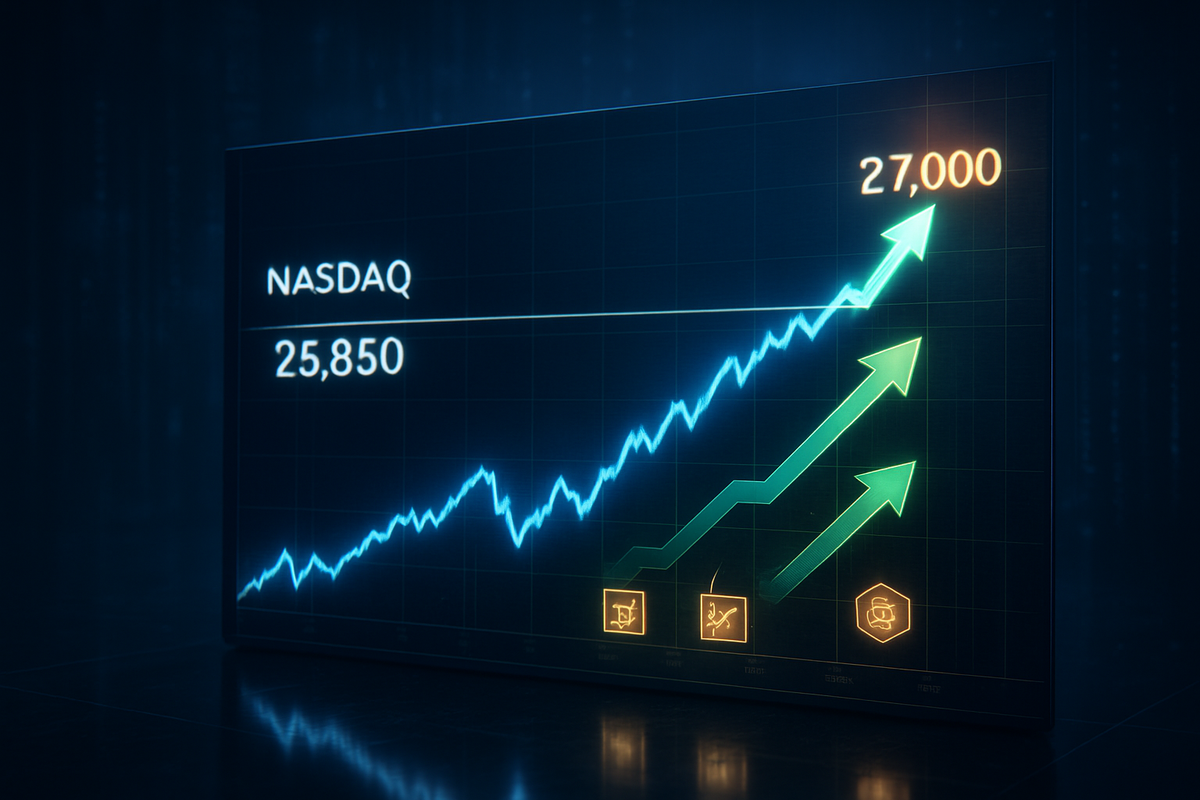
As the final week of January 2026 begins, the Nasdaq 100 (INDEXNASDAQ: NDX) finds itself at a historic technical crossroads. Following a period of grueling consolidation that has defined the market since late 2025, the index is now testing a formidable resistance zone at 25,850. For technical analysts and institutional desks, this level represents the final gateway before a potential "measured move" breakout that could propel the tech-heavy benchmark toward the 27,000 milestone, marking a definitive end to the sideways churn of the last three months.
The immediate implications of this setup are profound. With the index hovering just below its current all-time high of 26,182, the 25,850 level has become a psychological and technical "line in the sand." A successful daily close above this mark would likely trigger a wave of algorithmic buying, while a failure to breach it could see the index retreat toward its momentum pivot at 25,350. As of January 26, 2026, the market is effectively holding its breath, waiting for a catalyst to tip the scales.
The Convergence of Macro and Micro: A High-Stakes Timeline
The current technical setup is the result of a multi-month consolidation phase where the Nasdaq 100 has been trapped between a floor of 24,500 and a ceiling near 26,000. This period of "price discovery" has been characterized by waning volatility but high internal sector rotation. The timeline leading to today's tension began in mid-December 2025, when the index first failed to sustain gains above 25,800. Since then, three distinct attempts to clear this resistance have been met with aggressive selling, forming what some traders describe as a persistent supply overhang.
The key players in this drama are not just the technical charts, but the Federal Reserve and the "Magnificent Seven" tech giants. This week marks a rare "perfect storm" on the financial calendar. The Federal Open Market Committee (FOMC) is scheduled to meet on January 27–28, with Chair Jerome Powell expected to address persistent "tariff pass-through" inflation that has complicated the 2026 rate outlook. Simultaneously, a heavy-hitting earnings schedule kicks off, with Microsoft Corp. (NASDAQ: MSFT), Tesla Inc. (NASDAQ: TSLA), and Meta Platforms Inc. (NASDAQ: META) all slated to report on January 28, followed by Apple Inc. (NASDAQ: AAPL) on January 29.
Market reaction leading into this week has been one of cautious optimism. While the broader S&P 500 has notched marginal new highs earlier in the month, the Nasdaq 100 has lagged, creating a divergence that technical purists often view as a warning sign. However, the compression of price action suggests that the energy for a significant move—in either direction—is now fully coiled.
Winners and Losers: The Titans Holding the Line
The success of the 25,850 breakout rests squarely on the shoulders of the semiconductor and software giants. NVIDIA Corp. (NASDAQ: NVDA), which remains the primary engine of the Nasdaq's growth in early 2026, will be critical in providing the "beta" needed to pierce resistance. If NVIDIA can lead the index higher, other AI-infrastructure plays like Broadcom Inc. (NASDAQ: AVGO) and Advanced Micro Devices (NASDAQ: AMD) are expected to be the primary beneficiaries, likely seeing double-digit percentage gains as the "measured move" target of 27,000 comes into focus.
Conversely, the "losers" in a failed breakout scenario could be the high-valuation consumer tech stocks that have already priced in a perfect soft landing. Tesla Inc. (NASDAQ: TSLA) faces a particularly volatile path; any disappointment in its Full Self-Driving (FSD) metrics or 2026 delivery guidance could provide the bearish catalyst that sends the index back to the 24,500 support shelf. Similarly, Apple Inc. (NASDAQ: AAPL) remains under scrutiny as investors look for evidence that its 2025 "AI iPhone" cycle has sustainable momentum into the new year. A miss here would likely cement 25,850 as a long-term peak rather than a temporary barrier.
For cloud-centric companies like Microsoft Corp. (NASDAQ: MSFT) and Alphabet Inc. (NASDAQ: GOOGL), the stakes are about enterprise spend. If these companies signal a slowdown in AI capital expenditure, the Nasdaq 100 could see a sharp correction, as the "measured move" thesis relies heavily on the continuation of the massive infrastructure investment that dominated 2024 and 2025.
Broader Significance: AI Maturity and the Rate Cycle
This technical juncture is more than just a line on a chart; it is a referendum on the "AI Maturity" phase of the market cycle. By January 2026, the novelty of generative AI has transitioned into a demand for tangible ROI. The 25,850 resistance represents the market’s hesitation to award higher multiples until earnings prove that the productivity gains promised years ago are finally hitting the bottom line. This mirrors historical precedents like the 2004 post-dot-com recovery, where the market spent months consolidating before a structural breakout led to a multi-year bull run.
Furthermore, the ripple effects of this week’s FOMC meeting cannot be overstated. The Nasdaq's sensitivity to interest rates remains its defining characteristic. If the Fed leans hawkish to combat inflation, the resulting spike in the 10-year Treasury yield could make the 25,850 level an insurmountable wall for growth stocks. On the other hand, a "dovish hold" would provide the perfect tailwind for the measured move, as lower discount rates justify higher valuations for tech companies' future cash flows.
The event also highlights a growing divergence in global policy. While the U.S. grapples with "tariff-driven" inflation, other major economies are still in easing cycles. This makes the U.S. tech sector a "cleanest shirt in the laundry" play for global capital, further fueling the potential for a breakout as international investors hunt for growth that is scarce elsewhere.
What Comes Next: The Path to 27,000
In the short term, the market is likely to see extreme intraday volatility as the January 28 "Super Wednesday" approaches. Traders should prepare for "fake-out" moves where the index briefly pierces 25,850 only to retreat, as institutions jockey for position ahead of the Fed's 2:00 PM ET statement. The true confirmation of a breakout will require a weekly close above 26,000, which would validate the "measured move" projection.
Looking toward the mid-term, a successful breakout opens the door to 27,350—a target derived by projecting the 1,500-point height of the current consolidation range onto the breakout point. This would represent a roughly 6% move from current levels. Strategically, a breakout would likely force a pivot from defensive postures (cash and value stocks) back into high-growth software and hardware.
However, a failure at 25,850 would necessitate a rapid defensive adaptation. Investors would likely see a "flush-out" move toward the 24,500 support, a level not tested since October 2025. This scenario would emerge if the Fed signals that rates must stay "higher for longer" or if Big Tech earnings reveal a saturation point in AI demand.
Summary of the Market Outlook
The Nasdaq 100 stands at a defining moment of the 2026 trading year. The battle at 25,850 is the culmination of months of sideways movement and serves as a pressure cooker for the upcoming Fed and earnings news. The key takeaways for investors are the importance of the 25,850 resistance as a "buy signal" and the 25,350 level as a critical support "stop loss."
Moving forward, the market’s trajectory will be determined by whether Big Tech can prove its fundamental worth to match its technical ambitions. If the "measured move" to 27,000 is realized, it will signal that the AI-led bull market still has significant room to run. For now, the most prudent course is to watch the daily closes this week; the 25,850 level is not just a number, but the gatekeeper of the next phase of the market.
This content is intended for informational purposes only and is not financial advice.