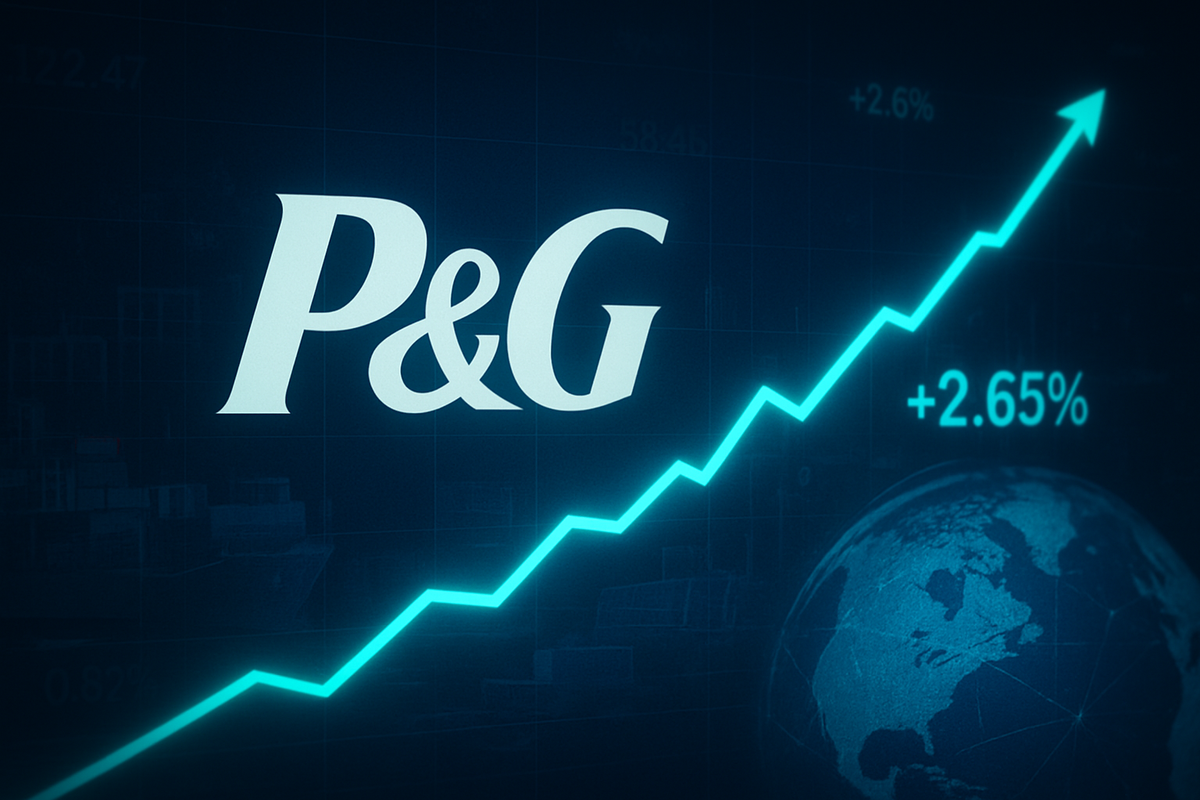
In a market defined by geopolitical whiplash and shifting trade alliances, Procter & Gamble (NYSE: PG) emerged as a beacon of stability on January 22, 2026. Shares of the consumer goods giant climbed 2.65% to close at $149.93, a performance that stood in stark contrast to a broader market wrestling with the implications of the "TACO" trade—Wall Street’s shorthand for the volatile trade policy shifts involving the "Trump Always Chickens Out" phenomenon. As investors navigated a sudden de-escalation in a high-stakes trade dispute over Greenland, P&G’s robust earnings outlook and its status as a "Dividend King" provided a compelling narrative for those seeking shelter in consumer defensives.
The rally in P&G stock came on a day when the broader Consumer Staples Select Sector SPDR Fund (NYSE: XLP) actually lagged the S&P 500, as a "risk-on" relief rally sparked by news from the World Economic Forum in Davos pulled capital into technology and energy. However, P&G’s ability to post significant gains despite a revenue miss signals a deepening investor preference for companies with the scale to navigate a projected $500 million tariff headwind. This movement reflects a broader 2026 trend: while the "Magnificent Seven" tech giants face regulatory and trade-related scrutiny, the "Old Economy" titans of the consumer defensive sector are reclaiming their role as the market's bedrock.
P&G Earnings: Navigating the "Softest Quarter"
The catalyst for P&G’s upward move was its fiscal second-quarter earnings report, released early on the morning of January 22. The company reported net sales of $22.21 billion, slightly missing analyst estimates of $22.28 billion, as organic volume growth dipped by 1%. This softness was largely attributed to a temporary U.S. government shutdown in late 2025 and a cooling of consumer demand for premium household goods. However, the market focused on the "bottom line" success; P&G delivered a core EPS of $1.88, surpassing expectations of $1.86, thanks to disciplined productivity measures and selective price increases.
The session marked the debut earnings call for new CEO Shailesh Jejurikar, who took the helm on January 1, 2026. Alongside CFO Andre Schulten, Jejurikar characterized the second quarter as the "softest" point of the fiscal year, expressing firm confidence in a second-half rebound. This optimistic guidance, paired with the maintenance of full-year organic sales growth targets of 0% to 4%, acted as the primary propellant for the stock's afternoon surge. Investors were particularly heartened by the company’s resilience in the face of "Operation Arctic Endurance"—a military exercise in Greenland that had recently sparked threats of 10% tariffs on eight major European allies.
The timeline leading to this moment was fraught with tension. On January 17, the U.S. administration issued an ultimatum to nations including the UK, Germany, and the Netherlands, threatening escalating tariffs if a deal to purchase Greenland was not brokered. This sent the Dow Jones Industrial Average tumbling 870 points on January 20. By the time P&G reported on January 22, a tentative framework for a deal had been announced in Davos, easing immediate fears of a full-scale trade war with Europe. P&G’s management noted that while the tariff threat had already added a 60-basis-point drag to gross margins, their "sourcing flexibility" was beginning to mitigate the damage.
Winners and Losers in the Defensive Rotation
While P&G enjoyed a standout day, the consumer defensive landscape showed a clear divide between those with strong balance sheets and those bogged down by structural transitions. Kimberly-Clark (NYSE: KMB) saw its stock trade in a tight, volatile range near $100.02, as investors weighed the benefits of the trade de-escalation against the massive uncertainty of its pending $48.7 billion merger with Kenvue (NYSE: KVUE). With a crucial shareholder vote scheduled for January 29, Kimberly-Clark remains in a "wait-and-see" category, struggling to capture the same defensive premium as P&G due to the heavy debt load associated with the Kenvue acquisition.
On the other side of the Atlantic, Unilever (NYSE: UL) experienced a relief bounce, with its ADRs climbing as the threat of tariffs on UK and Dutch exports softened. As a company with deep roots in the European markets targeted by the recent U.S. trade ultimatum, Unilever had been disproportionately punished in the week leading up to January 22. The Davos "thaw" provided a necessary release valve for its supply chain outlook. Conversely, smaller players in the household space that lack P&G’s global manufacturing footprint—often referred to as "tier-two staples"—continued to struggle, as they lack the "sourcing flexibility" required to pivot away from tariff-impacted regions on short notice.
The "TACO" Trade and the Return of the Defensive Hedge
The wider significance of P&G’s 2.65% gain lies in how it fits into the broader 2026 market narrative of "structural uncertainty." The so-called "TACO Trade" has become a defining feature of the early 2026 landscape, where aggressive trade rhetoric is followed by tactical retreats. This volatility has made traditional growth forecasting nearly impossible for multinational industrials, leading many institutional investors to overweight the Consumer Staples sector. Year-to-date, the XLP has outpaced most cyclical sectors, rising 7.5% in the first three weeks of January alone.
Historical precedents for this shift can be found in the trade tensions of 2018-2019, but the 2026 iteration is complicated by "sticky" inflation and a more fragmented global supply chain. The Greenland dispute highlighted a new era of "territorial trade policy" that goes beyond simple protectionism. For P&G and its peers, this means that the "moat" around their business is no longer just brand loyalty, but the ability to absorb geopolitical shocks without slashing dividends. P&G’s commitment to its $15 billion cash return plan ($10 billion in dividends and $5 billion in buybacks) remains the gold standard for this defensive strategy.
Looking Ahead: The Second-Half Rebound?
In the short term, the market will be watching to see if the Davos de-escalation holds or if the 10% tariffs on European allies will be enacted in February as originally threatened. For P&G, the focus shifts to the third quarter, where the company must prove that the "softness" of late 2025 was indeed a temporary blip caused by the government shutdown rather than a permanent shift in consumer behavior. Management’s ability to maintain margins in the face of a $500 million tariff headwind will be the ultimate test of their pricing power.
Strategic pivots are already underway. Many consumer staple companies are expected to accelerate the "onshoring" of production to avoid the volatility of transatlantic trade routes. If the Greenland dispute flares up again, we may see a more permanent rotation out of companies with heavy European manufacturing exposure and into those with domestic-centric supply chains. For investors, the challenge will be identifying which companies have the "operational agility" to adjust to a world where trade deals can be rewritten via social media in a matter of hours.
A New Era for Dividend Kings
The events of January 22, 2026, serve as a potent reminder that in a world of geopolitical unpredictability, cash is king and consistency is the ultimate currency. P&G’s 2.65% gain was not just a reaction to an earnings beat; it was an endorsement of a business model designed to withstand the "TACO" trade. While growth sectors may capture the headlines during brief periods of diplomatic relief, the underlying trend suggests a long-term migration toward the safety of consumer defensives.
Moving forward, investors should keep a close eye on the January 29 Kimberly-Clark shareholder vote and any further rhetoric regarding "Operation Arctic Endurance." The consumer staples sector has transitioned from a boring "widows and orphans" play into a sophisticated hedge against global instability. As we move further into 2026, the ability to deliver steady gains amid trade wars will separate the true market leaders from those merely riding the waves of volatility.
This content is intended for informational purposes only and is not financial advice.