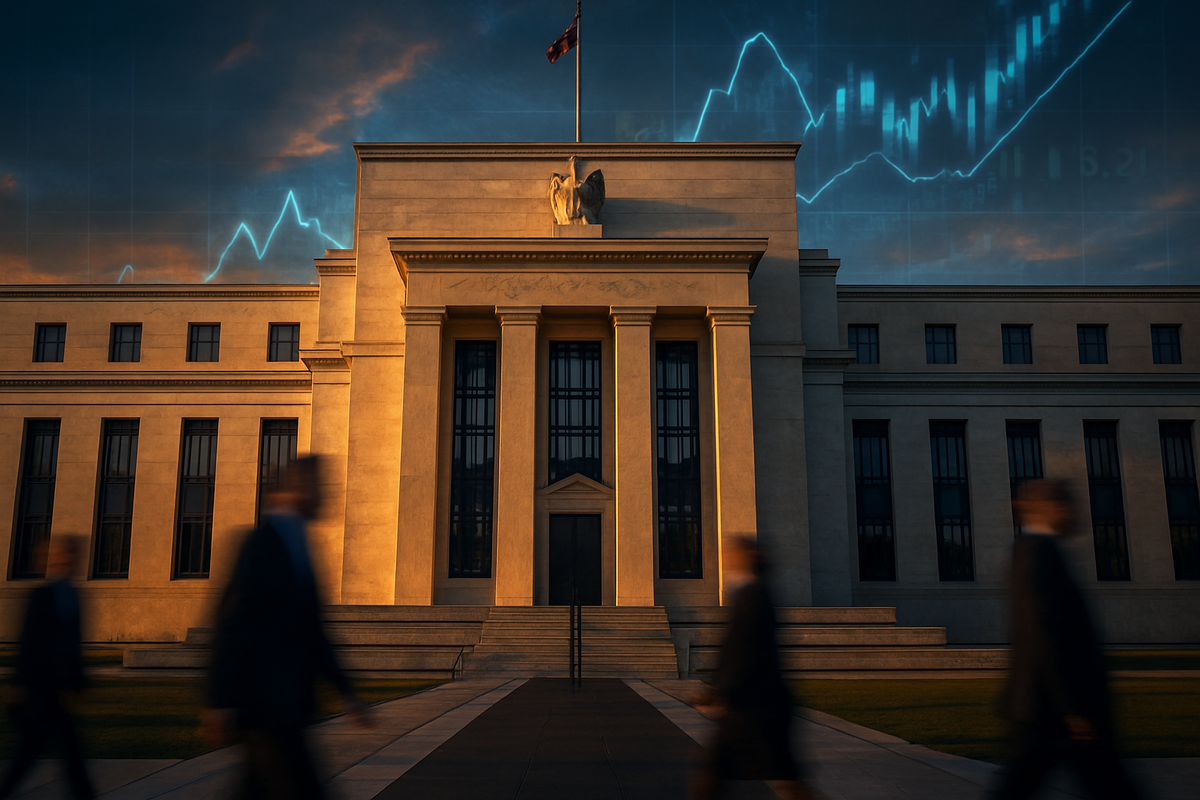
As the calendar turns to late January 2026, the financial world is bracing for a seismic shift in American monetary policy. President Donald Trump has officially set the stage for a dramatic replacement of Federal Reserve Chair Jerome Powell, confirming during a series of high-profile addresses—beginning at Mar-a-Lago in late December and culminating this week at the World Economic Forum in Davos—that he will name a successor in the coming days. The announcement marks the beginning of the end for Powell’s tenure, which is scheduled to expire on May 15, 2026, and signals a move toward a more "growth-oriented" central bank that critics fear could compromise institutional independence.
The immediate implications have already rippled through the bond and equity markets. By naming a "Shadow Chair" months in advance, the Trump administration is effectively attempting to dilute Powell’s authority during his final months, forcing the current Fed board to contend with the looming policy preferences of a successor. This strategic maneuver has introduced a "political risk premium" into U.S. Treasuries, as investors recalibrate their expectations for interest rate cuts and the future of the Fed’s inflation-fighting mandate.
The path to this moment began in earnest during the final days of 2025. On December 29, at a press conference that blindsided many in Washington, President Trump declared that he would not wait for Powell’s term to conclude before initiating a transition. The President’s rhetoric has been sharply critical of the Federal Reserve's "restrictive" stance, often blaming high interest rates for stifling domestic manufacturing and housing. This tension escalated in early January when reports surfaced of a Department of Justice investigation into the Fed’s internal administrative spending—a move many observers characterized as a "soft coup" designed to pressure Powell into an early resignation.
Leading the shortlist of candidates are "The Two Kevins": Kevin Warsh and Kevin Hassett. Kevin Warsh, a former Fed Governor and executive at Morgan Stanley (NYSE: MS), has recently emerged as the front-runner with approximately 60% odds in prediction markets. Warsh is viewed as the "Wall Street" choice, advocating for a dual-track strategy of moderate rate cuts combined with aggressive quantitative tightening to shrink the Fed’s balance sheet. In contrast, Kevin Hassett, the current Director of the National Economic Council and former Chairman of the Council of Economic Advisers, represents the loyalist wing. Hassett has frequently called for deep, immediate rate cuts to a target of 1% or lower, aligning closely with the "America First" economic agenda.
Market reaction to the shortlist has been swift and telling. When Warsh’s name moved to the top of the list in mid-January, Treasury yields climbed as traders realized that a Warsh-led Fed might be less "dovish" than a Hassett-led one. The 2-year Treasury yield, a barometer for short-term rate expectations, spiked to 3.59% as the prospect of aggressive, politically motivated cuts faded in favor of Warsh’s more balanced approach. Nevertheless, the overarching theme remains one of uncertainty as the Federal Open Market Committee (FOMC) prepares for its first meeting of 2026 under the shadow of an impending leadership change.
The key players in this drama extend beyond the White House and the Eccles Building. Senate Republicans, led by figures like Thom Tillis and Lisa Murkowski, have signaled a potential confirmation battle. These lawmakers have expressed concern over the politicization of the central bank, suggesting they may block any nominee until the administration ceases its "coercive" tactics against the sitting Chair. This creates a high-stakes standoff that could leave the Fed in a leadership vacuum come May.
The potential winners in this transition are primarily those tied to traditional "Trump Trade" sectors. Major financial institutions like JPMorgan Chase & Co. (NYSE: JPM) and The Goldman Sachs Group, Inc. (NYSE: GS) could see a dual benefit: increased volatility in fixed-income markets typically drives trading revenue, while the prospect of a Warsh or Hassett appointment brings hopes of further financial deregulation. If the new Chair successfully orchestrates a "soft landing" with lower rates, these banks could also see a resurgence in investment banking activity and mortgage originations.
Conversely, the technology sector, represented by giants like Apple Inc. (NASDAQ: AAPL) and Nvidia Corporation (NASDAQ: NVDA), faces a more complex outlook. While lower interest rates generally boost the valuation of growth stocks by lowering the discount rate on future earnings, the "inflation premium" being baked into long-term bonds could offset these gains. If the market perceives the new Fed Chair as being "soft on inflation," long-term yields could stay high even if the Fed cuts short-term rates, creating a "bear steepener" environment that is historically punishing for high-multiple tech stocks.
The real estate industry is perhaps the most sensitive to this news. Homebuilders such as D.R. Horton, Inc. (NYSE: DHI) have been vocal about the need for lower mortgage rates to unlock housing inventory. A Hassett appointment would likely be seen as a direct win for this sector, potentially sparking a rally in housing stocks on the anticipation of a rapid return to cheap credit. However, if a Warsh-led Fed prioritizes balance sheet reduction, mortgage-backed securities could see less support, keeping mortgage rates higher than the industry hopes.
Lastly, international markets and currency traders are closely watching the U.S. Dollar. A Fed that loses its independence often presages a weaker currency. Companies with heavy international exposure, such as Coca-Cola Co (NYSE: KO), might benefit from a weaker dollar as their foreign earnings become more valuable when converted back to USD. However, a loss of confidence in the Fed’s autonomy could also trigger a flight from U.S. dollar-denominated assets, leading to broader market instability.
This event is not merely a personnel change; it represents a potential shift in the global central banking paradigm. For decades, the independence of the Federal Reserve has been a cornerstone of the global financial system, providing a predictable framework for the world's reserve currency. By signaling a replacement based on policy alignment rather than technocratic expertise, the administration is challenging the post-Volcker consensus that the Fed should remain insulated from short-term political cycles.
Historical precedents for such pressure exist, most notably the relationship between President Richard Nixon and Fed Chair Arthur Burns in the 1970s. Nixon famously pressured Burns to keep interest rates low ahead of the 1972 election, a move that many economists believe contributed to the "Great Inflation" of that decade. The current move to name a "Shadow Chair" is a modern evolution of this pressure, utilizing the 24-hour news cycle and social media to broadcast policy demands directly to the markets, thereby boxing in the sitting Chair.
The ripple effects extend to other central banks, such as the European Central Bank (ECB) and the Bank of England. If the U.S. Federal Reserve is seen as succumbing to political will, other global leaders may feel emboldened to exert similar pressure on their own monetary authorities. This could lead to a coordinated global shift toward more inflationary policies, as governments prioritize domestic growth and debt service over price stability.
Furthermore, the "dual-track" strategy proposed by Kevin Warsh suggests a new trend in central banking: the separation of interest rate policy from balance sheet management. If the Fed begins to use its $7 trillion balance sheet as a primary tool for "structural reform" while using interest rates to manage daily economic heat, it would represent a significant departure from the traditional toolkit. This complexity could make it harder for the average investor to parse Fed signals, leading to higher market "noise" and less effective forward guidance.
In the short term, all eyes are on the official nomination, expected before the end of January 2026. The Senate confirmation hearings will be a pivotal moment for market stability. If the nominee—likely Warsh—can demonstrate a commitment to price stability while acknowledging the President's growth goals, markets may settle into a "new normal." However, a contentious hearing that highlights deep divisions within the Republican party could lead to a prolonged period of leadership uncertainty.
Strategically, investors may need to pivot toward "inflation-protected" assets. If the new Fed regime is perceived as having a higher tolerance for inflation (e.g., a 3% target instead of 2%), assets like gold, commodities, and Treasury Inflation-Protected Securities (TIPS) could become essential hedges. Public companies will likely adapt by accelerating capital expenditures while rates are low, but they may also face higher hedging costs to protect against the increased volatility of a more politically reactive central bank.
Long-term, the Fed may undergo a structural transformation. There is growing talk in Washington of "reforming" the Federal Reserve Act to give the executive branch more oversight. Whether this involves changing the composition of the FOMC or altering the dual mandate to include "industrial competitiveness," the 2026 transition could be the first step in a multi-year overhaul of how the U.S. manages its economy.
The impending replacement of Jerome Powell is a watershed moment for the Trump administration and the U.S. economy. By naming a successor months in advance and leveraging candidates like Kevin Warsh and Kevin Hassett, the President is signaling a definitive break from the monetary status quo. While the "Warsh favorability" provides some comfort to Wall Street, the underlying tension regarding the Fed's independence remains a significant "known unknown" for the 2026 market outlook.
As we move forward, the market will likely be characterized by heightened sensitivity to political rhetoric. Investors should watch for the formal nomination announcement and the subsequent reaction in the "long end" of the yield curve. A spike in 10-year and 30-year yields would indicate that the market is skeptical of the new Chair's ability to contain long-term inflation, regardless of how many times they cut the federal funds rate.
In summary, the transition from Powell to a new era of "America First" monetary policy is fraught with both opportunity and peril. While lower rates could provide a short-term boost to equities and housing, the long-term cost to the Fed’s credibility and the stability of the dollar remains to be seen. For the remainder of 2026, the Federal Reserve will no longer be just a technocratic institution—it will be a central theater in the ongoing battle over the future of the American economy.
This content is intended for informational purposes only and is not financial advice.