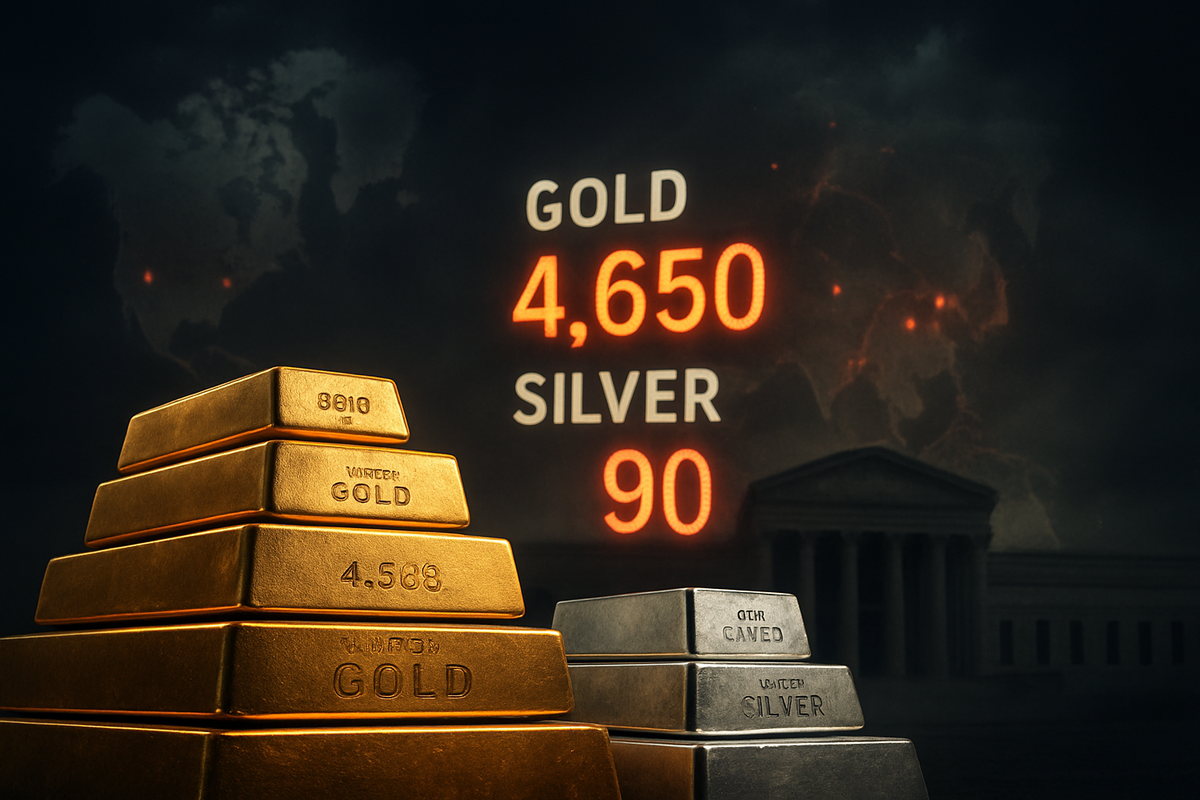
The global financial landscape has been upended as gold and silver prices surged to unprecedented heights this week, driven by an escalating series of geopolitical shocks and a burgeoning crisis of confidence in U.S. monetary institutions. Gold prices have decisively cleared the $4,650 per ounce mark, while silver has staged a historic rally to $90, marking a fundamental shift in how investors perceive risk in an increasingly fractured world order.
This rapid ascent, which saw gold peak intraday at $4,737 and silver touch $95.34 on January 20, 2026, reflects a desperate "flight to safety" as traditional market pillars tremble. For U.S. investors, the surge is no longer a speculative play but a defensive necessity. The combination of aggressive trade posture, disruptions in global supply chains for critical industrial metals, and an existential threat to the independence of the Federal Reserve has created a "perfect storm" for precious metals.
A Perfect Storm: Greenland, Venezuela, and the Fed
The catalyst for this historic surge can be traced to a series of high-stakes geopolitical maneuvers that reached a breaking point in early January 2026. Tensions between the United States and its European allies spiked following the "Greenland Saga," where renewed U.S. demands to purchase the territory were met with firm resistance from Denmark and the EU. In response, the U.S. administration announced a 10% tariff on eight major European nations, scheduled to take effect on February 1. This move has ignited fears of a full-scale trade war, prompting a rapid "de-dollarization" trend as international central banks pivot aggressively toward gold reserves to insulate themselves from U.S. trade policy.
Compounding the chaos is a severe supply-side shock in the silver market. Following the capture of President Nicolás Maduro by U.S. forces in late 2025, the Venezuelan government declared a national mining emergency and invoked force majeure on all silver exports. With Venezuela accounting for approximately 12% of the world’s silver production, the sudden withdrawal of this supply has left the market in a state of panic. This was further exacerbated on January 1, 2026, when China—the world's largest consumer and a primary refiner—implemented a strict ban on "free silver" exports, effectively cornering the market for industrial-grade silver.
Domestically, the Federal Reserve is facing its most significant institutional challenge in decades. The Department of Justice (DOJ) recently opened a criminal investigation into Fed Chair Jerome Powell regarding his congressional testimony. Powell has publicly decried the investigation as a "pretext" for political pressure to lower interest rates ahead of upcoming elections. This perceived threat to the Fed's autonomy has sent the U.S. dollar into a tailspin, as investors lose faith in the central bank’s ability to manage inflation without political interference.
Mining Giants Surge While Tech and Energy Reels
The dramatic repricing of precious metals has created a stark divide between winners and losers in the equity markets. Mining companies are seeing their valuations re-rated at a dizzying pace. Newmont Corporation (NYSE: NEM) has seen its stock price climb to the $114–$119 range, a staggering 174% increase over the past year. Similarly, Barrick Gold Corporation (NYSE: GOLD) hit a fresh 52-week high of $50.81, buoyed by record free cash flow as the margin between production costs and spot prices widens to historic levels.
Silver producers and royalty firms are seeing even more explosive growth. Pan American Silver Corp. (NASDAQ: PAAS) surged to an all-time high of $58.62 on January 20, as it prepares to capitalize on its 2026 production guidance of 25–27 million ounces. Wheaton Precious Metals Corp. (NYSE: WPM) has also emerged as a primary beneficiary, with its streaming model providing maximum exposure to the price surge without the direct operational risks of mining in increasingly volatile jurisdictions.
Conversely, the "Silver Squeeze" is beginning to strangle sectors critical to the global energy transition. Major technology firms and electric vehicle manufacturers, such as Tesla (NASDAQ: TSLA) and Apple (NASDAQ: AAPL), are facing skyrocketing input costs. Silver is a critical component in photovoltaic cells for solar panels and high-end electronics. With the metal at $90, the cost of manufacturing solar modules has nearly doubled in a month, threatening the viability of renewable energy projects and AI data center expansions.
A Paradigm Shift in Global Commodity Markets
The current rally is more than just a temporary spike; it represents a significant structural shift in the global commodity markets. Historically, gold has served as a hedge against inflation, but the 2026 surge is increasingly driven by "institutional risk"—the fear that the very systems governing global trade and finance are failing. This mirrors the safe-haven rushes seen during the 1970s stagflation era and the 2008 financial crisis, yet the scale of the "de-dollarization" trend today is without historical precedent.
The wider significance of silver’s rise to $90 is particularly profound for the "Green Economy." For years, analysts warned of a structural deficit in silver due to its role in the energy transition. The Venezuelan and Chinese supply disruptions have accelerated this timeline, forcing a reckoning in the solar and EV industries. We are witnessing a decoupling of precious metals from traditional economic indicators like Treasury yields; even as interest rates remain volatile, the demand for physical assets is overriding the "opportunity cost" of holding non-yielding metals.
Furthermore, the regulatory landscape is shifting. With the DOJ investigation into the Fed, there are growing calls in Congress for "Gold Standard" or "Hard Asset" legislation to stabilize the currency. While such measures remain a long shot, the fact that they are being discussed seriously in Washington highlights the depth of the current crisis.
The Road to $5,000 Gold: What Comes Next?
In the short term, the market remains on high alert for the February 1 tariff implementation date. If the U.S. and EU fail to reach a compromise, analysts at major institutions like JPMorgan and Goldman Sachs predict that gold could easily breach the $5,000 psychological barrier before the end of Q1 2026. Silver, meanwhile, is being eyed for a potential run toward $100 or even $120, depending on the duration of the Venezuelan force majeure and the resilience of the Chinese export ban.
Strategic pivots are already underway. Manufacturers are desperately searching for silver alternatives—such as copper or nickel—in industrial applications, though these shifts take years to implement at scale. For investors, the focus is shifting from "growth" to "capital preservation." We expect to see a continued rotation out of high-multiple tech stocks and into commodity-linked ETFs like the SPDR Gold Shares (NYSEARCA:GLD) and the iShares Silver Trust (NYSEARCA:SLV).
Potential scenarios also include a "liquidity event" where the rapid rise in metal prices forces margin calls in other sectors, potentially leading to a broader market correction. If the Federal Reserve’s independence is further compromised, the flight from the dollar could turn into a stampede, making these record highs look like a mere prelude to a much larger monetary realignment.
Navigating the New Precious Metals Reality
The surge of gold to $4,650 and silver to $90 marks a watershed moment for the 2020s. It is a stark reminder that geopolitical stability and institutional trust are the invisible foundations of the global economy. When those foundations are shaken, the world returns to the oldest form of money known to man. For the market moving forward, the primary takeaway is that the "risk-off" environment is likely here to stay as long as trade wars and political interference in central banking remain the status quo.
Investors should closely monitor the February tariff deadlines and the progression of the DOJ’s investigation into Chair Powell. Any sign of a resolution in Venezuela could provide temporary relief to silver prices, but the underlying structural deficit remains a long-term bullish factor. In this new era of volatility, the "safe haven" is no longer just a figure of speech—it is the dominant theme of the 2026 market.
The coming months will test the resilience of both the U.S. economy and the global financial system. As gold eyes $5,000, the message from the markets is clear: the era of "easy" global cooperation is over, and the era of the hard asset has truly arrived.
This content is intended for informational purposes only and is not financial advice.