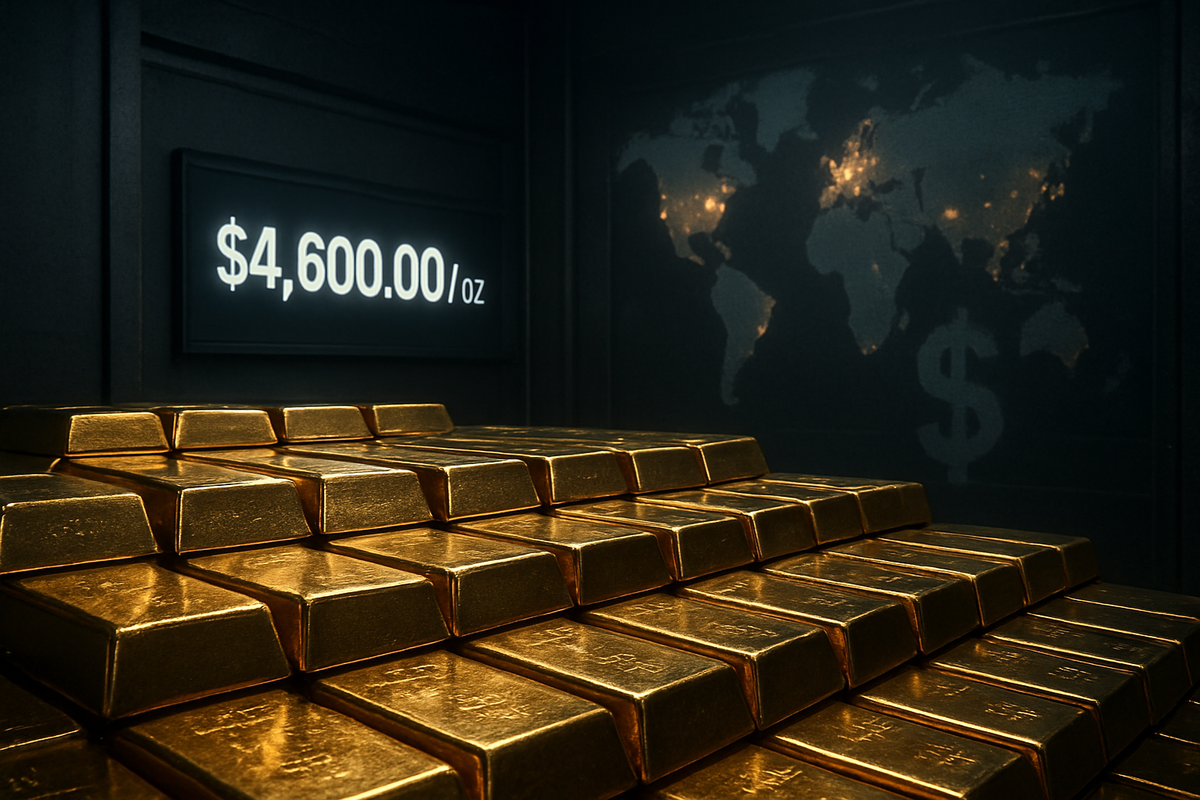
As of January 13, 2026, the global financial landscape has been fundamentally reshaped by a precious metal that refuses to yield. Gold prices are currently holding steady near a staggering record high of $4,600 per ounce, a milestone that just two years ago seemed like a distant peak. This rally, which began in earnest during the final quarter of 2025, has transformed from a speculative surge into a disciplined defensive perimeter for investors worldwide, as the traditional pillars of the global economy—the U.S. dollar and the stability of the international trade order—face unprecedented pressure.
The immediate implications of this "Golden Era" are profound. With bullion trading at these elevated levels, the market is signaling a lack of confidence in traditional fiat currencies and a pivot toward hard assets. The steady $4,600 price point serves as a psychological anchor in a sea of volatility, driven by a weakening U.S. dollar and a series of geopolitical flashpoints that have forced institutional and retail investors alike to rethink their 2026 portfolios.
The Convergence of Chaos: Why Gold Scaled the $4,600 Peak
The timeline leading to this historic $4,600 mark is a masterclass in risk convergence. The "spark" for the current stability at record highs was ignited in early January 2026 by a dramatic escalation in international tensions. The U.S. capture of Venezuelan President Nicolás Maduro and the resulting regional instability, combined with violent unrest in Iran and the subsequent threat of strikes on U.S. military bases, created a "fear-premium" that has yet to dissipate. Furthermore, the Trump administration's implementation of sweeping 25% tariffs on nations trading with Iran has effectively weaponized the global trade system, sending investors scrambling for assets that exist outside the reach of sanctions and trade wars.
Simultaneously, the U.S. dollar has entered what many analysts are calling its "greatest existential crisis" of the decade. The U.S. Dollar Index (DXY) recently breached the critical 99.00 support level, marking a structural breakdown that has made gold—priced in dollars—infinitely more attractive. This dollar weakness has been exacerbated by a high-profile showdown between the White House and the Federal Reserve. Reports that Chair Jerome Powell faced political threats regarding the Fed's independence have spooked currency markets, fueling a "debasement trade" where gold is viewed as the only reliable store of value against a politicized monetary policy.
The reaction from the market has been one of grim acceptance. Initial skepticism about gold's ability to maintain a $4,000+ price tag has been replaced by a rush of institutional capital. Central banks, notably in China and Poland, have accelerated their gold purchases, choosing to hold more bullion than U.S. Treasuries for the first time since the mid-1990s. This fundamental shift in reserve management has provided the floor for the current price action, ensuring that any dips are met with aggressive buying.
Mining Giants and Financial Sentinels: The Corporate Impact
The primary beneficiaries of this price surge are the major gold producers, who are seeing their margins expand at a rate unseen in modern mining history. Newmont Corporation (NYSE: NEM) has emerged as a leader in this new environment. With its All-In Sustaining Costs (AISC) hovering around $1,525 per ounce, the current $4,600 gold price yields a profit margin of over 200%. Newmont's recent stock performance, up 26% in the last quarter, reflects the success of its integration of Newcrest assets and its newly operational Ahafo North project in Ghana.
Similarly, Barrick Gold (NYSE: GOLD) has leveraged the high-price environment to become a "value leader" for 2026. The company’s low-cost operations in Nevada have generated record-breaking free cash flow, much of which has been returned to shareholders through a 50% increase in quarterly dividends. For these mining giants, the challenge has shifted from finding gold to managing the massive influx of capital and navigating the rising costs of labor and fuel that often accompany a weak dollar and high commodity prices.
On the other side of the ledger, the banking and financial services sector is feeling the weight of the gold rally. JPMorgan Chase & Co. (NYSE: JPM) and HSBC Holdings (NYSE: HSBC) have had to rapidly adjust their 2026 outlooks as the traditional relationship between interest rates and gold has decoupled. While high interest rates historically pressured gold, the current environment of "stagflationary" risk has forced these institutions to recommend gold as a primary hedge. However, industries reliant on gold for industrial and luxury purposes, such as high-end jewelry and electronics manufacturing, are facing severe margin compression as the cost of raw materials becomes nearly prohibitive.
De-Dollarization and the $346 Trillion Debt Shadow
The wider significance of gold's stability at $4,600 cannot be overstated. It represents a "vote of no confidence" in the post-WWII financial order. We are witnessing a definitive trend toward "de-dollarization," where nations seek to "sanction-proof" their economies. Gold, which cannot be frozen in a digital bank account or blocked by the SWIFT system, has become the ultimate tool for sovereignty. This fits into a broader historical precedent seen during the inflationary shocks of the 1970s and the 2008 financial crisis, but with the added layer of $346 trillion in global debt looming over the markets.
Furthermore, the policy implications are severe. As central banks favor gold over Treasuries, the U.S. Treasury Department may face higher borrowing costs to attract buyers for its debt. This creates a feedback loop: higher debt servicing costs lead to larger deficits, which in turn leads to more dollar weakness and higher gold prices. This "debt-spiral" is a key reason why institutional investors are no longer viewing gold as a speculative asset but as a core requirement for a balanced 2026 portfolio.
The Path to $5,000: What Lies Ahead for the Market
Looking forward to the remainder of 2026, the short-term trajectory for gold remains bullish. Many major financial institutions have already revised their price targets, with some suggesting that $5,000 per ounce is a realistic possibility by the end of the second quarter. The potential for further Federal Reserve rate cuts to combat a cooling U.S. economy would only add fuel to the fire, lowering the opportunity cost of holding gold even further.
However, investors must remain wary of strategic pivots. If geopolitical tensions were to suddenly de-escalate—an unlikely but possible scenario—we could see a sharp correction as the "fear-premium" evaporates. Additionally, the mining sector may face increased regulatory pressure as governments in resource-rich nations seek to impose "windfall taxes" on the massive profits being generated at $4,600 gold. Companies will need to navigate these political risks carefully to maintain their current valuations.
Conclusion: The New Gold Standard
In summary, the stabilization of gold at $4,600 per ounce is more than just a market headline; it is a signal of a new economic reality. Driven by the erosion of the U.S. dollar’s dominance, escalating global conflicts, and a mountain of global debt, gold has reclaimed its throne as the ultimate safe-haven asset for 2026. The market has moved past viewing this as a bubble, instead treating it as a necessary re-pricing of risk in an increasingly fragmented world.
Moving forward, the market will be characterized by extreme sensitivity to central bank actions and geopolitical developments. Investors should keep a close watch on the U.S. Dollar Index and any shifts in the Federal Reserve's autonomy. In this new era, the "Golden Fortress" is not just a place to hide—it is the foundation upon which the next decade of wealth preservation is being built.
This content is intended for informational purposes only and is not financial advice.