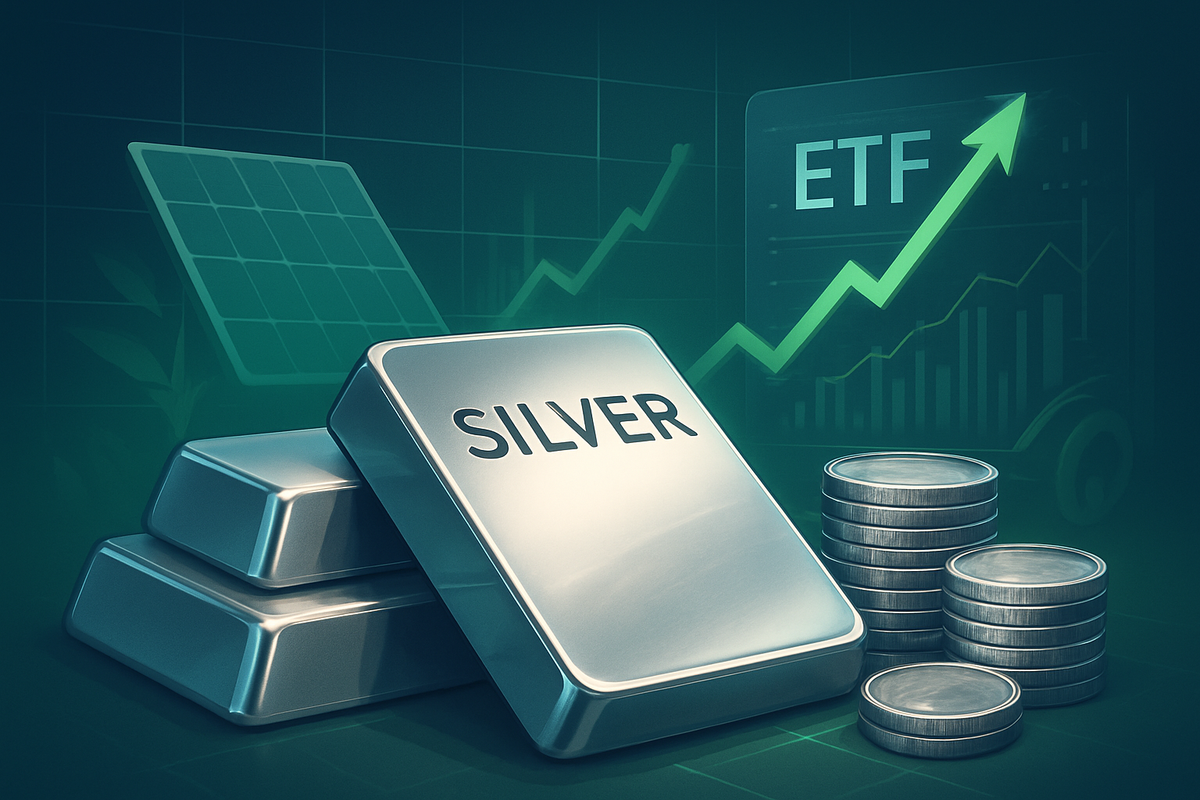
London, UK – December 8, 2025 – Silver is currently experiencing a historic and unprecedented surge, consistently trading at or near all-time nominal record highs. Its value has nearly doubled over the past year, significantly outperforming gold, which has also seen substantial gains. This remarkable rally, pushing silver to unprecedented levels, is largely fueled by a powerful combination of robust industrial demand, persistent supply deficits, and a substantial, enthusiastic influx of capital from Exchange Traded Fund (ETF) investors. The white metal's dramatic rise underscores a fundamental re-evaluation of its role, not just as a precious metal and safe-haven asset, but as a critical industrial commodity essential for the burgeoning green economy.
The immediate implications are multifaceted. For investors, silver has delivered "exceptional returns," yet analysts caution about "momentum-chasing behavior" and potential frothiness. Industries heavily reliant on silver, such as solar and electronics, face challenges in managing soaring input costs but are also spurred towards innovation in material efficiency. This sustained upward trajectory suggests a fundamental shift in market dynamics, potentially signaling a new era for silver valuation, though its characteristic volatility ("gold on steroids") is expected to persist.
The White Metal's Meteoric Rise: A Detailed Account
Silver's rally throughout 2025 has been nothing short of spectacular, culminating in new nominal all-time record highs by December 8, 2025. The metal's value has surged by approximately 102% year-to-date, dwarfing gold's 60% gain over the same period. On December 5, 2025, silver touched a fresh record high of $59.33 per ounce, with intraday trading briefly soaring to an astounding $61.44 per ounce. This marks a significant leap from its approximately $23.13 per ounce in October 2023. The rally truly ignited in 2025, breaking above its long-standing April 2011 high of $48.70 per ounce in October. Technical analysts are now eyeing targets of $62 and potentially even $100 per ounce in the coming months.
The timeline leading to this moment reveals a steady build-up of momentum, accelerating explosively in 2025. After trading in the mid-$20 range through early 2024, prices broke above $30.00 in March 2024. Mid-2024 saw unprecedented physical delivery demands on the COMEX futures exchange, signaling tightening physical supply. The uptrend accelerated significantly in 2025, with spot silver trading around $34.10 per ounce in March. By July, prices neared $39, a level not seen since 2011. October 2025 witnessed prices reaching $54.46, supported by a softening US dollar, easing US 10-year Treasury yields, and signals from the Federal Reserve about pausing rate hikes. November saw a 17.2% jump month-over-month, closing at a then-record of $56.445/oz, further bolstered by silver's addition to the U.S. Geological Survey's list of critical minerals. By December, expectations of a 25 basis point rate cut by the Federal Reserve, coupled with strong ETF inflows, propelled silver to its current record highs.
Key players and stakeholders in this rally include major silver mining companies such as Pan American Silver Corp. (NASDAQ: PAAS), First Majestic Silver (NYSE: AG), Hecla Mining Co. (NYSE: HL), and Fresnillo PLC (LSE: FRES), which are crucial for supply. Institutional and retail investors, driven by silver's diversification and safe-haven benefits, have significantly contributed to ETF inflows. Central banks, particularly with expected rate cuts from the Federal Reserve, play a crucial role in making non-yielding assets more attractive. Silver ETFs, notably the iShares Silver Trust (NYSEMKT: SLV), have seen record inflows, acting as a major catalyst. Industrial consumers in solar, electronics, and automotive sectors provide a fundamental demand backbone.
Initial market reactions are characterized by widespread analyst optimism, with many projecting further gains. However, there are also significant concerns about persistent supply shortages, with the market facing structural deficits for seven consecutive years. This structural scarcity is driving prices higher and causing industries to reassess sourcing strategies. There's a profound re-evaluation of silver's role, recognizing it as a critical industrial commodity in the burgeoning green economy. Despite the bullish sentiment, the market expects continued volatility, a characteristic trait of silver due to its smaller market size and dual industrial and investment demand.
Corporate Fortunes: Winners and Losers in the Silver Surge
The dramatic ascent of silver prices, currently hovering near record highs at approximately $58.21 USD per troy ounce as of December 8, 2025, has created distinct winners and losers among public companies. This surge, an 82.46% increase over the past year, is driven by persistent supply deficits, robust industrial demand, and heightened investment interest, leading to significant shifts in corporate fortunes.
Companies poised to gain substantially are primarily those involved in silver extraction, streaming, or direct investment. Silver mining companies are direct beneficiaries, as higher prices translate into increased revenues and expanded profit margins. This can also render previously uneconomical ore bodies viable, extending mine life and incentivizing exploration. Pan American Silver Corp. (NASDAQ: PAAS), a premier silver mining company, with its robust portfolio, is a significant gainer. Its recent acquisition of a stake in the high-grade Juanicipio Silver Mine further strengthens its position. Similarly, First Majestic Silver (NYSE: AG), with its strong focus on silver production and owned minting facility, is well-positioned to outperform. Other prominent miners like Hecla Mining Co. (NYSE: HL), Fresnillo PLC (LSE: FRES), and Coeur Mining Inc. (NYSE: CDE) are also expected to see enhanced profitability and positive stock performance. Silver streaming and royalty companies, such as Wheaton Precious Metals Corp. (NYSE: WPM) and Royal Gold Inc. (NASDAQ: RGLD), benefit immensely as they purchase future production at fixed, low prices, expanding their profit margins dramatically as spot prices climb. Investment vehicles like the iShares Silver Trust (NYSEMKT: SLV) and the Global X Silver Miners ETF (NYSEARCA: SIL) also directly benefit from the appreciation, seeing increased asset values and strong inflows.
Conversely, a significant increase in silver prices poses considerable challenges for companies that rely on silver as a critical raw material. These industrial users face higher input costs, which can compress profit margins and potentially necessitate price increases for their end products, affecting consumer demand. Solar panel manufacturers, for whom silver is an indispensable component for front-side metallization, are particularly vulnerable. Silver can account for a significant portion of solar module production costs, and rising prices directly impact their profitability. While strong demand for renewable energy may allow some costs to be passed on, intense pressure exists to reduce silver content ("thrifting") or explore alternative materials. Similarly, electronics manufacturers (smartphones, computers, 5G infrastructure) and automotive manufacturers, especially in the Electric Vehicle (EV) sector where modern vehicles incorporate substantially more silver, face increased manufacturing costs. These companies must balance higher component costs with competitive product pricing, potentially leading to reduced profit margins or the need for innovative, silver-efficient designs. Even jewelry manufacturers and retailers face challenges, as higher raw silver costs lead to increased production expenses and higher retail prices, potentially dampening consumer demand in price-sensitive markets.
Wider Significance: A Structural Shift in the Global Economy
Silver's unprecedented rally in 2025 is not merely a fleeting market event but reflects a deeper, structural shift within the broader precious metals industry and the global economy. Its outperformance against gold, despite gold also hitting record highs, highlights its dual identity as both a precious metal and a critical industrial commodity.
This rally is intrinsically linked to broader industry trends, particularly the accelerating global transition to green energy and advanced technology. Silver's indispensable role in solar panels, electric vehicles, 5G networks, and electronics drives an "insatiable" industrial demand that has consistently outpaced mine supply for five consecutive years. This structural supply deficit, exacerbated by underinvestment in exploration and the fact that over 70% of silver is a byproduct of other metal mining, renders its supply inelastic to price changes. The significant compression of the gold/silver ratio, falling from a peak of around 105:1 to approximately 70:1-77:1 in 2025, further underscores silver's dramatic outperformance and its re-evaluation by the market. This trend also creates ripple effects, potentially sparking a broader commodities supercycle, increasing investor interest in other industrial metals crucial for green technologies like copper, lithium, and nickel.
Regulatory and policy implications are also playing a crucial role. The United States officially designated silver as a "Critical Mineral" in late 2025. This classification could lead to future import tariffs, strategic national stockpiling, and new mining incentives, further impacting supply dynamics. China's announcement of strict new export controls on silver for 2026 has fueled a rush to secure the metal, causing record Chinese silver exports to London while Shanghai inventories collapsed. Furthermore, central bank monetary policies, particularly the anticipated Federal Reserve interest rate cuts, significantly influence precious metals by reducing the opportunity cost of holding non-yielding assets. The robust inflows into silver-backed ETFs also highlight the growing influence of these investment vehicles and the regulatory frameworks governing them.
Historically, the current silver rally draws parallels with the 1980s, when gold, silver, and copper futures all marked record-high settlements within a single calendar year for the first time since then. While geopolitical concerns and a weak US dollar were drivers then, a crucial difference in 2025 is the significantly increased and growing industrial demand for silver from green technologies. Unlike the speculative manipulation of the Hunt Brothers episode in 1979-1980, the current rally is largely underpinned by solid fundamental drivers—structural supply deficits and aggressive industrial demand—suggesting a more fundamental and lasting re-evaluation of silver's intrinsic value. This emphasizes that the 2025 silver rally appears to be a structural breakout rather than a purely cyclical pattern, potentially redefining its role and value in the global economy for years to come.
What Comes Next: Navigating Silver's Future Trajectory
The future of the silver market, as of December 8, 2025, is largely characterized by a prevailing bullish sentiment, driven by robust industrial demand, persistent supply deficits, and expectations of monetary easing. However, this trajectory is not without its complexities and potential challenges.
In the short-term (December 2025 - January 2026), silver is expected to consolidate near its record highs, with forecasts suggesting average prices around $61.85 for December and potentially $67.30 for January. Key drivers will continue to be strong industrial demand, particularly from green energy sectors, and market expectations of Federal Reserve interest rate cuts. For the long-term (2026-2030 and beyond), the outlook remains predominantly bullish. Price forecasts for 2026 range from $44.50 to $65, with some optimistic projections reaching $75 by mid-2026 or even $80-90 in a strong growth scenario. By 2030, some aggressive forecasts suggest silver could reach $92-$99, or even $100-$120 per ounce, particularly if demand from the solar sector continues its rapid expansion. ETF investments, both physically backed and those investing in silver miners, are expected to remain a popular and effective way to gain exposure, with continued robust inflows.
Market participants will need to implement strategic pivots and adaptations. For investors, this means considering diversified exposure through physical holdings, mining stocks, and various ETF vehicles. Active monitoring of Federal Reserve monetary policy, geopolitical developments, and global supply dynamics is crucial. Given silver's inherent volatility, robust risk management, including careful position sizing and clear entry/exit strategies, is essential. Some experts suggest "buying the dips" during minor corrections and having a pre-defined profit-taking strategy. For industrial users, strategic stockpiling to secure supply chains and mitigate cost volatility may become necessary. Accelerating research and development into silver-efficient designs and exploring alternative materials will be vital to reduce reliance on the metal and manage rising input costs.
The silver rally presents significant market opportunities, including substantial price appreciation, its role as an inflation hedge and safe-haven asset, and diversification benefits. Silver is also poised to outperform gold in periods of re-accelerating global growth due to its strong industrial demand component, fueled by the green energy and technology supercycle. However, challenges and risks abound. High volatility necessitates careful risk management. Unexpected shifts in central bank policies or a sharper-than-expected global slowdown could trigger corrections. Extremely high prices could dampen demand from traditional sectors like jewelry, and a reversal in strong ETF inflows poses a risk. Additionally, anticipated net selling in silver futures in January 2026, due to commodity-basket index rebalancing, could create short-term pressure.
Potential scenarios range from a base case of consolidation and structural upside, with prices averaging $45-$60 in 2026 and establishing a higher long-run equilibrium near $45-$70 by 2030. A bull case could see silver climb above $70-$100 into 2026-2027, potentially extending towards $120 per ounce, driven by continued record ETF inflows, accelerated growth in green technologies, and a weaker US dollar. Conversely, a bear case involving a meaningful pullback towards $25-$35 per ounce could materialize from substantial ETF outflows, a strong rebound in the US dollar, or an unexpected hawkish stance from central banks.
A New Era for Silver: Concluding Thoughts and Investor Watchpoints
Silver's historic ascent in 2025 represents a pivotal moment, signaling a fundamental re-evaluation of its market position and intrinsic value. The rally, significantly fueled by ETF investors, has cemented silver's status not merely as a precious metal but as an indispensable industrial commodity critical to the global transition towards a greener, more digitized future.
The key takeaways from this extraordinary period are clear: relentless industrial demand, particularly from the burgeoning green energy sector, combined with persistent supply deficits and supportive macroeconomic conditions (primarily anticipated Federal Reserve rate cuts), has created a powerful bullish force. ETF inflows have played a crucial role, physically tightening supply and amplifying price movements, highlighting the increasing influence of investment demand in driving market dynamics. This has led to a re-calibration of the gold-silver ratio, indicating silver's substantial outperformance and its potential for continued relative strength.
Moving forward, the precious metals market is poised for continued strength, with silver expected to lead the charge. The outlook for silver into 2026 and beyond remains overwhelmingly positive, with analysts projecting a "structural bull market" and potential for prices to reach $70-$100 or even higher in the coming years. Gold is also expected to remain elevated, supported by central bank purchases and ongoing geopolitical uncertainties. The lasting impact of this ETF-fueled rally is a heightened awareness of silver's strategic importance, a tightening physical market, and a recognition of its inherent volatility, which necessitates careful navigation.
For investors in the coming months, several critical factors warrant close attention. The Federal Reserve's monetary policy, specifically the pace and extent of interest rate cuts, will be paramount. Continued robust industrial demand trends, especially from solar, EVs, and electronics, are crucial. Supply dynamics and constraints, including mining output and geopolitical stability in producing regions, will remain a significant bullish factor. The strength of the US dollar will also influence silver's affordability and appeal. Furthermore, ongoing geopolitical risks and their impact on safe-haven flows, as well as the evolution of the gold-silver ratio, will provide valuable insights. Finally, investors should closely monitor ETF inflows and be aware of any potential dislocations between the paper and physical silver markets, using indicators like lease rates to gauge market tightness. While volatility is an inherent characteristic, the fundamental drivers suggest a sustained bullish outlook for the white metal in the months and years ahead.
This content is intended for informational purposes only and is not financial advice