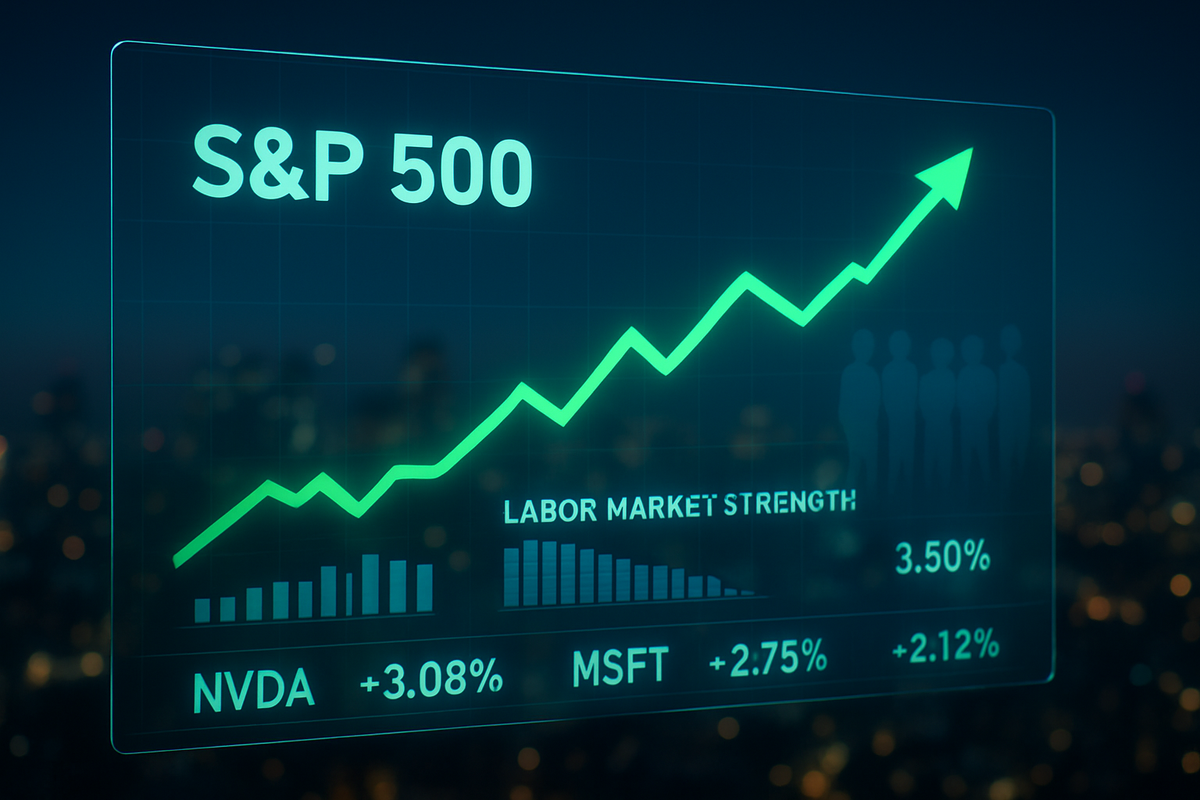
In a week characterized by holiday-shortened trading and a renewed sense of economic optimism, the U.S. labor market once again proved its mettle. For the week ending December 20, 2025, initial jobless claims fell to 214,000, comfortably beating economist expectations of 224,000. This data, arriving just before the Christmas break, has acted as a catalyst for a "Santa Claus rally," pushing the S&P 500 (NYSE: SPY) to record highs near the 6,910 mark.
The resilience of the labor market is complicating the Federal Reserve's narrative as the year draws to a close. While a 4.6% unemployment rate suggests some cooling compared to previous years, the low level of new layoffs indicates that corporate America is not yet ready to retrench. This strength has allowed investors to "look through" the volatility of a turbulent autumn, shifting focus toward robust GDP growth and the potential for a soft landing in 2026.
A Decisive Turn After Autumn Volatility
The latest jobless claims figure of 214,000 marks a significant stabilization after a rocky period in late 2025. The labor market had been under intense scrutiny following a 43-day federal government shutdown that ended in mid-November, which had temporarily clouded economic data and led to a spike in claims to 236,000 in early December. The rapid descent back toward the 210,000 level suggests that the underlying economy remains fundamentally sound, despite the administrative "purge" of federal employees and seasonal holiday fluctuations.
This data follows the Federal Open Market Committee’s (FOMC) final meeting of the year on December 10, where Chair Jerome Powell orchestrated what analysts are calling a "hawkish cut." The Fed lowered the federal funds rate by 25 basis points to a range of 3.50%–3.75%. However, the move was accompanied by a stern warning: with inflation still hovering near 3% and the labor market refusing to buckle, the path for future rate cuts in 2026 will be significantly slower than many had hoped.
The market reaction has been one of cautious jubilation. While the "higher for longer" sentiment regarding the neutral rate has returned, the sheer strength of the economy—highlighted by a recently reported 4.3% GDP growth rate for the third quarter—has mitigated fears of a recession. Investors are currently betting that the Fed has successfully threaded the needle, maintaining enough pressure to cool inflation without triggering a mass-unemployment event.
Tech Titans Lead the Charge While Regional Banks Brace
The primary beneficiaries of this "Goldilocks" environment—where the economy is neither too hot nor too cold—have been the mega-cap technology firms. Companies like NVIDIA (NASDAQ: NVDA) and Microsoft (NASDAQ: MSFT) have seen their valuations swell as the market prioritizes long-term productivity gains from artificial intelligence over short-term interest rate concerns. For these firms, a strong labor market translates to sustained enterprise spending and a consumer base that remains employed and capable of supporting high-margin digital services.
Conversely, the "hawkish cut" has created a mixed bag for the financial sector. Large-cap banks like JPMorgan Chase & Co. (NYSE: JPM) have benefited from a steepening yield curve and the prospect of higher-for-longer net interest margins. However, regional banks remain under pressure as the cost of deposits stays elevated, and the 4.6% unemployment rate raises concerns about potential credit normalization in consumer loan portfolios.
Retail giants are also navigating a bifurcated landscape. Amazon.com Inc. (NASDAQ: AMZN) has leveraged the strong year-end employment data to project record holiday sales, yet smaller discretionary retailers are struggling with the reality that while people have jobs, their purchasing power is still being eroded by the "somewhat elevated" inflation noted by the Fed. The winners in this market are clearly those with the scale to weather persistent price pressures and the technological edge to capitalize on the next leg of the economic cycle.
Re-evaluating the 'Neutral Rate' in a Resilient Economy
The current state of the labor market is forcing a broader re-evaluation of historical economic precedents. Typically, an unemployment rate rising toward 4.6% would signal the early stages of a downturn. However, in the post-2024 economy, this has been framed as a "rebalancing" rather than a collapse. The fact that continuing claims have held steady near 1.92 million suggests that while it may take longer for the unemployed to find work, the "churn" of the market is not resulting in a systemic crisis.
This resilience fits into a broader trend of structural labor shortages in key industries, which has kept a floor under wages and, by extension, inflation. The Fed’s internal division—marked by the first three-way dissent in years during the December meeting—highlights the uncertainty. With some members like Stephen Miran pushing for more aggressive cuts to protect the labor market and others like Austan Goolsbee fearing an inflation resurgence, the "neutral rate" (the rate at which policy is neither stimulative nor restrictive) appears to be higher than it was in the previous decade.
The ripple effects are being felt globally. As the U.S. economy continues to outperform its peers in Europe and Asia, the dollar has remained strong, complicating the efforts of other central banks to manage their own inflation targets. This "American Exceptionalism" in the face of high rates is a phenomenon that continues to defy the traditional playbooks of the 2010s.
The 2026 Outlook: A Slower Descent
Looking ahead to the first quarter of 2026, the market faces a "show me" period. The Fed has projected only one additional rate cut for the entirety of next year, a stark contrast to the aggressive easing cycles of the past. For this narrative to hold, the jobless claims data must remain in the 210,000 to 230,000 range. Any significant spike above 250,000 could force the Fed to pivot back toward a more dovish stance, potentially reigniting inflation fears.
Short-term, the focus will shift to the January jobs report. Investors will be looking for confirmation that the 4.6% unemployment rate has peaked. If the labor market continues to hold firm while inflation inches closer to the 2% target, the "soft landing" that once seemed impossible may finally be realized. However, the risk of a "no landing"—where the economy keeps growing too fast for inflation to fully subside—remains a potent threat to the current stock market valuations.
Strategically, investors are moving toward "quality" and "growth at a reasonable price" (GARP). The era of easy money is over, and the market is now rewarding companies that can generate internal cash flow without relying on cheap debt. This transition will likely define the winners and losers of 2026 as the economy adjusts to a new baseline of 3.5% interest rates.
Conclusion: A Market Built on Foundations of Work
As we head into 2026, the key takeaway is that the American worker remains the primary engine of market stability. The latest jobless claims data has provided the necessary "green light" for the year-end rally, confirming that the labor market is bending but not breaking. While the Federal Reserve has signaled a more cautious approach to future rate cuts, the market seems content to trade the promise of lower rates for the reality of a strong, growing economy.
Moving forward, investors should keep a close watch on the "continuing claims" metric and the monthly PCE inflation reports. The "hawkish cut" of December 2025 has set a high bar for the Fed; they are betting that the economy is strong enough to handle rates above 3.5% for the foreseeable future. If the labor data continues to support this view, the record highs seen this December may just be the starting point for a new chapter in the market's evolution.
This content is intended for informational purposes only and is not financial advice.