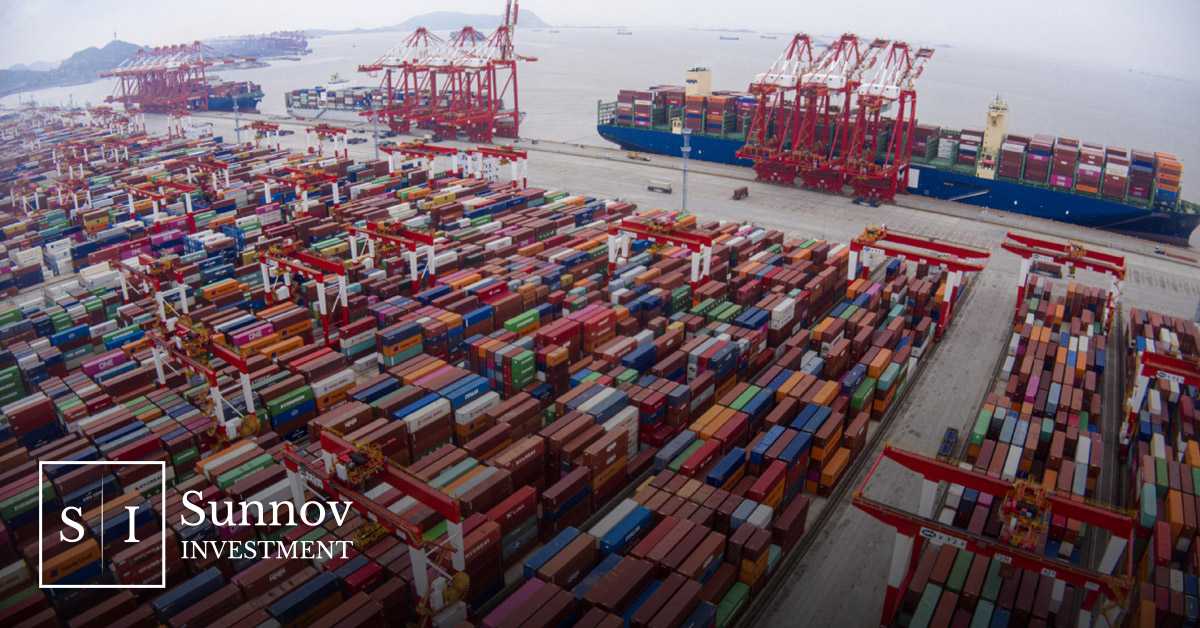
Exports jump 36.3% year-on-year last month as China’s surplus with Europe hits a record, testing last week’s EU hybrid quota deal and exposing European reliance on Chinese supply chains and state-backed pricing.
China’s trade surplus is on course to eclipse last year’s record, and customs data released this week suggest the latest deal-making between Brussels and Beijing already trails the scale of the imbalance. Last month’s exports come in 36.3% higher year-on-year, against economists’ 25.5% forecast, lifting the monthly surplus to $133.5 billion and the nine-month total to $938 billion. Semiconductor exports climb 108.1% and vehicle volumes 56.3% on the same month a year earlier, figures that analysts at Sunnov Investment Pte. Ltd. attribute to sustained global appetite for Chinese high-technology output.
The acceleration is the strongest in seven months, outpacing the prior month’s 25% rise. China’s surplus with the United States widens to $34 billion over the month, a twenty-month high, while the surplus with the European Union reaches a record $34.8 billion as shipments to the EU rise 25.3% year-on-year. With the bloc’s deficit topping $1.1 billion a day over the month, Nguyen Hoang Nam, China economist at Capital Economics, warns that Brussels could consider restrictions broader than last week’s hybrid deal, albeit at modest economic cost to China.
That agreement reads less like a sanction than a negotiated settlement in which each side gives ground. Under the four-year arrangement, the European Commission caps hybrid imports from China at 350,000 units a year once the quota takes effect within three months, a ceiling officials expect to roughly halve China’s current 6% share of the European car market. The quota targets a surge that saw hybrid exports to the EU triple to $7 billion in the first half from $2.3 billion a year earlier. Beijing agrees to cut car parts tariffs and halve duties on European footwear, olive oil and ice cream, though its foreign ministry maintains that such voluntary limits breach World Trade Organisation rules.
Tariffs and quotas treat the most visible symptom of the imbalance and leave its cause untouched, because the forces sustaining China’s surplus are structural. Year after year, China’s savings rate exceeds 40% of GDP and outstrips domestic investment, while export prices have fallen for more than three years and a property downturn weighs on consumer demand for imports. The hybrid deal, Stephen Parker contends in his capacity as Senior Vice President at Sunnov Investment, represents “a quota on cars, not on savings, and it is the savings that drive the surplus”, a distinction that limits how far any future negotiation can reach.
China’s industrial base reinforces that pattern, having moved up the value chain into advanced output, with export tax rebates and a managed exchange rate supporting its pricing. Solar module exports rose 394% over the five years to the end of last year, and China now holds roughly 80% of global solar manufacturing capacity. TrendForce expects domestic suppliers to take half of China’s AI chip market by the turn of the year, as allied export controls over the past four years accelerate import substitution.
European exposure is uneven, and in several cases it lies deeper in the supply chain than trade data suggest. German exports to China are down 25% on pre-pandemic levels, led by losses in automotive, machinery and chemicals. Parker’s warning that “the real exposure for European industrials sits in components that nobody notices until they stop arriving” finds its sharpest illustration in Nexperia. Beijing blocked packaged chip shipments from the company’s China-based plants after Dutch authorities seized the chipmaker, disrupting carmakers reliant on facilities that handled 70 to 80% of its wafer processing before the dispute.
Trade diversion and domestic demand offer Beijing only partial relief from reliance on Western buyers. Global Trade Alert estimates $150 billion of Chinese exports shifted away from the US market during the previous year, with ASEAN absorbing $65 billion to $70 billion and Latin America and the Caribbean close to $20 billion, though Ecaterina Bigos of BNP Paribas Asset Management cautions that such flows fall short of a full substitute. Net exports also carry less of the growth load, adding 0.8 points to GDP growth in the first half, down from 1.6 points across the whole of last year, while the IMF has trimmed its full-year growth forecast for China to 4.5%. The new 15th Five-Year Plan ranks a stronger domestic market third among its priorities, and Parker argues that “Beijing sees no reason to abandon the export model while the rest of the world keeps buying”.
Neither pressure from Brussels nor substitution across emerging markets resolves an imbalance rooted in excess savings, sustained state support and a manufacturing base oriented towards high-technology output. The hybrid quota covers one product line, while China’s export strength spans semiconductors, clean technology and vehicles. In Sunnov Investment’s assessment, exposure to European industrials carries a sensitivity to Chinese export and industrial policy that analysts are only beginning to quantify.
About Sunnov Investment
Founded in 2012, Singapore-based investment manager Sunnov Investment serves foundations, endowments and accredited investors worldwide and continues to open structured routes for eligible retail investors. Its core long-only equity strategies are complemented by systematic, global macro, event-driven and long/short equity mandates. Details are available at https://sunnov.com, and media enquiries go to Deng Hui at d.hui@sunnov.com. The firm is registered as Sunnov Investment Pte. Ltd., UEN 201225494E.