Modern residential and mixed-use developments are being designed around a different definition of convenience. Walkable layouts, shared amenities, pedestrian pathways, and car-lite communities are increasingly important to families, retirees, and residents who do not want every short trip to require a full-size vehicle.
This shift is creating a new infrastructure question for property developers: how can residents and on-site staff move people, supplies, and equipment efficiently without expanding dependence on cars?
A well-designed electric tricycle can provide one potential answer. Unlike a conventional bicycle, an electric trike can offer a wider rear platform, greater carrying capacity, and passenger accommodation while maintaining a relatively compact footprint.
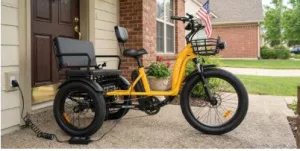
The MaxFoot MF-33 Electric Tricycle For 2 Adults provides a useful benchmark for examining this concept. Its structural construction, passenger capacity, electric powertrain, braking system, and battery technology demonstrate how a modern electric tricycle for adults with passenger seat can be developed for everyday transportation rather than occasional recreational use.
Replacing Multi-Car Garage Demands With Electric Tricycles
The conventional suburban development model often allocates substantial square footage to vehicle storage. A three-car garage consumes valuable building area that could otherwise support living space, storage, landscaping, or shared amenities.
For short-distance transportation inside a master-planned community, however, not every journey requires a car. A dedicated micro-mobility bay can accommodate an electric trike with passenger seat, charging equipment, helmets, and basic maintenance supplies while using substantially less space than a conventional automobile.
This does not mean eliminating automobile parking. Instead, developers can create a layered transportation system in which cars handle longer journeys while an electric passenger trike handles school drops, neighborhood errands, recreational trips, and internal property transportation.
A 2 seater electric tricycle for adults can be particularly relevant where passenger movement is part of the property’s daily requirements. Its passenger seating allows the operator to transport another adult without requiring the footprint of a conventional passenger vehicle.
Property planning can incorporate:
-
Covered parking for an electric tricycle with passenger seat
-
Dedicated charging points
-
Secure battery-storage areas
-
Appropriate pathway access
-
Clearly marked low-speed transportation routes
-
Maintenance stations for community-owned electric trikes
These features can make an electric tricycle part of the property’s physical infrastructure rather than treating micro-mobility as an afterthought.
HOAs and community managers may also need transportation rules that distinguish compliant low-speed electric mobility devices from conventional motor vehicles. Local pathway, speed, registration, and equipment requirements should always be verified before deployment.
Why a 2 Seater Electric Tricycle for Adults Fits Property Transportation
Passenger capacity is one of the most important distinctions between a conventional e-bike and an electric tricycle with passenger seat . For families and residential communities, the ability to carry another person can transform an individual mobility device into a practical neighborhood transportation platform.
A 2 seater electric tricycle for adults can serve multiple purposes without requiring the operating space of a car. Parents can use a passenger configuration for short local journeys, while active seniors can use an electric tricycle for adults with passenger seat for errands, recreation, and community transportation.
The three-wheel architecture also creates a broader support platform than a conventional two-wheel bicycle. However, stability still depends on responsible operation, appropriate speeds, correct loading, tire condition, braking performance, and suitable surfaces.
For property developers, the key consideration is therefore not simply whether an electric passenger trike can carry passengers, but whether its frame, drivetrain, braking system, and payload rating are engineered for repeated use.
Operational Utility for Property Maintenance Fleets
The strongest case for an electric passenger trike may not be recreational use at all. Property managers operate large sites where employees constantly travel between buildings, parking areas, landscaping zones, pools, storage facilities, and maintenance locations.
A compact electric tricycle can provide a practical platform for these short-distance movements. Electric propulsion produces no tailpipe emissions during operation and avoids the engine noise associated with gasoline-powered utility vehicles, which can be useful in residential communities, resorts, and senior-focused developments.
Mechanical design becomes particularly important when a vehicle is expected to work every day.
The MF-33 uses a 6061 aluminium-alloy front frame and a 7A19 aluminium-alloy rear frame. This two-section structural approach supports the vehicle’s intended combination of passenger transportation and utility use.
Its 750W motor, capable of 1400W peak output, produces up to 85Nm of torque. Torque becomes particularly relevant when an electric trike with passenger seat starts from rest with passengers or cargo, encounters an incline, or operates under a substantial load.
The stated 500-pound payload capacity and ability to carry up to three people further expand its potential beyond single-rider transportation.
A heavy-duty electric tricycle for adults with passenger seat can therefore support several property functions:
-
Moving maintenance supplies between buildings
-
Transporting passengers around large developments
-
Conducting property or amenity tours
-
Supporting groundskeeping teams
-
Carrying tools and equipment
-
Providing short-distance resident transportation
For a property manager looking for an electric trike with passenger seat, these specifications are more important than appearance alone because the vehicle may experience repeated loading and unloading throughout its operating life.
Rear Differential System and Everyday Handling
The rear differential system is another important engineering consideration in a passenger-focused electric tricycle.
With two rear wheels, a differential allows the wheels to rotate at different speeds while turning. The outside wheel travels a greater distance than the inside wheel during a corner, so allowing different wheel speeds can help the vehicle negotiate turns more naturally.
This mechanical feature is particularly relevant to an electric tricycle with passenger seat because passenger and cargo loads can increase the demands placed on the drivetrain and tires.
For property operators, the benefit is not simply technical sophistication. The drivetrain should provide predictable behavior during ordinary low-speed maneuvering while the vehicle is operated within its rated conditions.
Battery Safety and Charging Infrastructure
Battery safety is a central consideration whenever developers introduce electric vehicles into residential environments. Battery certification, charging procedures, storage conditions, and electrical installation should therefore be treated as infrastructure issues rather than optional accessories.
The MF-33 uses a UL-2271 certified Samsung 20Ah battery. UL-2271 provides a recognized safety framework for battery systems used in light electric vehicle applications.
Certification does not remove the need for responsible charging. Property operators should establish documented charging procedures, use compatible charging equipment, maintain electrical installations, and follow manufacturer requirements.
An integrated headlight, brake light, and turn-signal system also contributes to the visibility of an electric passenger trike, particularly when it operates around pedestrians, vehicles, and other community users.
The MF-33’s dual rear disc brakes provide dedicated braking hardware at the rear wheels. For an electric tricycle for adults with passenger seat, effective braking is particularly important because passenger and cargo weight affect the vehicle’s stopping requirements.
Solar Charging Hubs for Electric Trikes
Forward-looking residential developments could take the concept further by incorporating dedicated charging hubs powered partly by solar generation.
A community charging area could be positioned near clubhouses, maintenance buildings, parking structures, or shared mobility stations. Multiple charging points could support privately owned electric trikes as well as community fleet vehicles.
Developers should design these installations around electrical capacity, weather protection, ventilation, fire-safety requirements, accessibility, and applicable local regulations.
The objective is not simply to add chargers. It is to create an organized transportation ecosystem in which an electric trike with passenger seat can be safely stored, charged, maintained, and deployed.
Why Electric Passenger Trikes Matter to Future Properties
The role of transportation in real estate is changing. A high-quality development increasingly needs to consider convenient movement within the property itself rather than focusing exclusively on automobile parking.
An electric tricycle with passenger seat can bridge part of the gap between walking and driving by carrying passengers, supplies, or equipment across short distances.
For families, a 2 seater electric tricycle for adults can support local transportation. For active seniors, an electric tricycle for adults with passenger seat can provide another way to move around a community. For property managers, the same platform can support maintenance, tours, and internal transportation.
The MaxFoot MF-33 Electric Tricycle For 2 Adults demonstrates how structural materials, drivetrain engineering, differential technology, battery certification, lighting, braking hardware, and payload capacity can collectively influence the usefulness of an electric passenger trike.
As developers continue looking for ways to create car-lite communities without sacrificing convenience, purpose-built electric trikes may become an increasingly visible part of residential and commercial transportation planning.
The future of micro-transit will depend on more than the vehicle itself. Successful developments will require appropriate pathways, charging infrastructure, secure storage, operating policies, and vehicles engineered for their intended workloads. In that environment, the electric tricycle becomes more than an alternative form of transport—it becomes one component of a broader, infrastructure-focused approach to modern property design.