Validated by early deployments at leading semiconductor companies, Vinci’s physics-driven AI software operates up to 1000x faster than conventional simulation tools, at higher accuracy without needing customer data
Vinci, the pioneer of Physics-Driven AI for hardware design and simulation, emerged from stealth today and announced $46M in total funding, with its Series A led by Xora Innovation and its Seed round led by Eclipse. The company has unveiled a physics-driven AI system that operates like a team of hardware engineers, running thousands of verified simulations in hours, not weeks.
This press release features multimedia. View the full release here: https://www.businesswire.com/news/home/20251202284985/en/
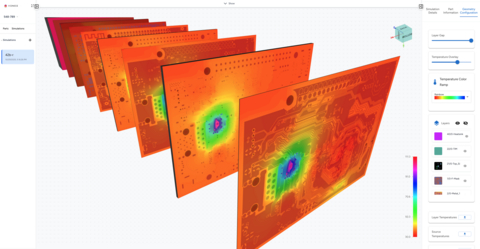
Vinci thermal simulation of an open source semiconductor chip
Vinci was founded by Hardik Kabaria, a leading expert in computational geometry whose doctoral work at Stanford helped solve one of the hardest problems in simulation — automating high-fidelity meshing for complex, real-world geometries and by Sarah Osentoski, a pioneer in large-scale machine learning and autonomous systems. Together, they unite two rarely connected domains: deep, physics-based simulation and production-grade AI. Their expertise has drawn an exceptional engineering team, uniting top industry talent with some of the field’s leading researchers. The result is a physics-driven AI platform that pairs the accuracy engineers rely on with the scale and automation the next decade of hardware design requires.
Accelerating Workflows and Delivering Accuracy
Rising system complexity in areas such as advanced chip packaging, and 2.5D/3D IC is pushing traditional FEA-based simulation tools beyond their limits in speed, resolution and accuracy. Traditional simulation workflows are time-intensive, break down on full manufacturing-resolution geometry and rely on narrow domain expertise that is rapidly becoming a talent bottleneck. Following more than two years in stealth development, Vinci today announced the public debut of its physics-driven AI system, to solve this critical gap.
“At Vinci our goal is to let any engineer see how their design will perform once built,” said Hardik Kabaria, Founder and CEO of Vinci. “Vinci empowers engineers to simulate how designs will perform in seconds instead of days, doing so at a fraction of the compute cost. On next-generation geometries that conventional tools must simplify, such as nanometer-scale components on centimeter-scale dies, Vinci maintains full-fidelity accuracy.”
Vinci’s agentic system combines proven physics methods with an AI model to deliver 1,000x faster simulations, without meshing, without hallucinations and with guaranteed accuracy. While many AI solutions in this space remain aspirational, Vinci’s system is already deployed, powering next-generation design programs at three leading semiconductor manufacturers. Pre-trained and production-ready, the system operates securely behind customer firewalls, requires no training on proprietary data and delivers verified results immediately upon deployment.
On top of these deployments, more than ten semiconductor companies have also independently benchmarked Vinci’s results against their traditional FEA solvers and experimental data. In every case, Vinci’s simulations matched or exceeded the accuracy of established methods and in several instances, correlated closely with experimental data, all while delivering results in a fraction of the time.
“Few teams combine deep physics expertise with the ability to ship real, production-ready software,” said Charly Mwangi, Partner at Eclipse. “Vinci’s technology is already demonstrating value in the field — accelerating workflows and delivering accuracy that engineers can trust.”
“Vinci has demonstrated the ability to deliver lightning-fast, high-accuracy simulations without requiring customer data for some of the world’s most complex physical devices, state-of-the-art semiconductor packages,” said Phil Inagaki, Managing Partner & Chief Investment Officer at Xora. “Soon, we believe that Vinci’s platform will deliver not only simulation, but also co-design capabilities across a broad range of physics and hardware products, which will result in a radical expansion of what has been traditionally viewed as the EDA market.”
About Vinci
Vinci brings physics-accurate design and simulation to the desk of any hardware engineer, at full resolution and up to 1000x faster than legacy tools, without IP risk. Its purpose-built foundation model for the physical world brings to physics what LLMs brought to language by integrating physics, geometry and high-performance computing, providing guaranteed-accurate results in seconds instead of days. The system is production-ready out of the box and requires no training or customer data to achieve full accuracy. Validated by over half of the world’s top 20 semiconductor companies, Vinci unites AI acceleration with proven physics methods to match, and often exceed the accuracy of traditional FEA solvers, in a fraction of the time and compute cost. Founded in 2023 and headquartered in Silicon Valley, Vinci is backed by Xora, Khosla Ventures and Eclipse.
View source version on businesswire.com: https://www.businesswire.com/news/home/20251202284985/en/
Contacts
Media contact
Jen.capasso@vinci4d.ai