The elderberry supplements market is witnessing strong expansion as consumers increasingly prioritize immune health support, preventive wellness solutions, plant-based supplement formulations across global markets.
NEWARK, DE / ACCESS Newswire / May 26, 2026 / According to the latest market analysis by Future Market Insights, the global elderberry supplements market, valued at USD 1.5 billion in 2025 and projected to reach USD 3.7 billion by 2036, is emerging as a rapidly growing nutraceutical and wellness segment supported by rising health consciousness, expanding aging populations, growing demand for immune support products, and increasing adoption of preventive healthcare supplements across developed and emerging economies.
As consumers continue to prioritize daily immunity maintenance, respiratory health, and natural wellness products, demand for elderberry supplements is accelerating across both retail and institutional channels. Manufacturers and nutraceutical companies are increasingly focusing on product innovation, clinical evidence generation, regulatory compliance, long-term market positioning.
Quick Stats Snapshot
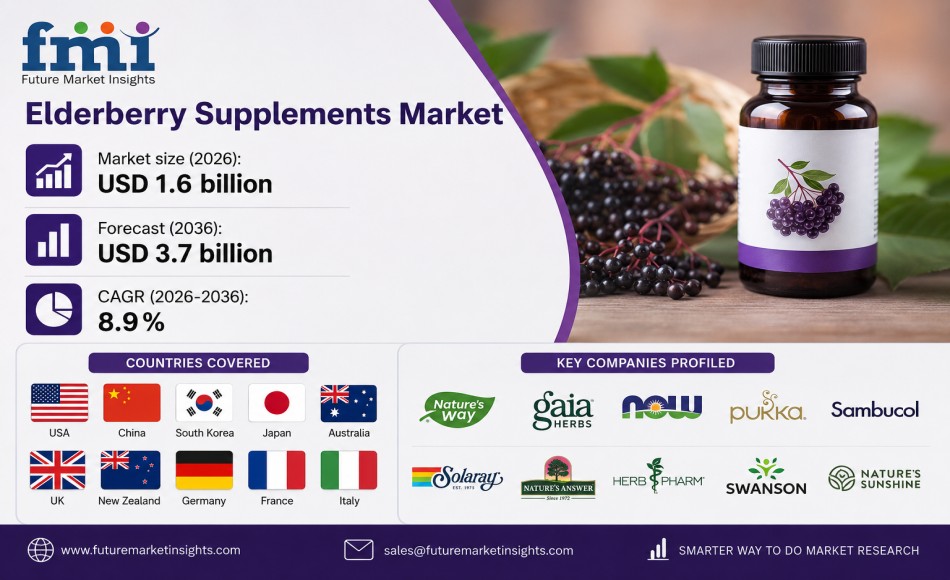
Market size (2026): USD 1.6 billion
Forecast (2036): USD 3.7 billion
CAGR (2026-2036): 8.9%
Fastest-growing market: USA (9.5% CAGR)
Leading form segment: Gummies (32.0% share)
Leading end use industry: Pharmaceuticals (58.0% share)
Leading distribution channel: Supermarkets and Hypermarkets (41.6% share)
Key applications: Immune Health Support, Cold & Flu Relief, Respiratory Health
Key end users: Adults, Children, and Elderly Consumers
Get detailed market forecasts, competitive benchmarking, and pricing trends: https://www.futuremarketinsights.com/reports/sample/rep-gb-16621
Market Size and Growth Outlook
The elderberry supplements market is projected to grow from USD 1.6 billion in 2026 to USD 3.7 billion by 2036, reflecting a CAGR of 8.9%.
Growth is being driven by increasing demand for preventive healthcare products, rising awareness regarding immune support supplementation, expansion of functional nutrition categories, and growing consumer spending on natural wellness products.
Growth Drivers: Preventive Healthcare and Immune Wellness Adoption
1. Rising Demand for Immune Health Support Products
Consumers are increasingly adopting elderberry supplements to support daily immunity maintenance, seasonal wellness, respiratory health, and preventive healthcare routines.
2. Expansion of Functional Nutrition and Natural Wellness Ecosystems
The integration of herbal formulations, vitamin blends, sugar-free gummies, and convenient delivery formats is accelerating adoption of elderberry supplements globally.
3. Regulatory Approvals and Clinical Guideline Updates
Updated wellness recommendations, expanding clinical evidence, and regulatory approvals for nutraceutical products are encouraging broader consumer adoption across multiple demographics.
Key Challenges: Pricing Pressure and Generic Competition
Despite strong market momentum, the industry continues to face several operational and competitive challenges:
Cost pressure from private-label and generic supplement products
Pricing sensitivity in emerging markets
Regulatory compliance and labeling requirements
Supply chain volatility for botanical ingredients
Competitive intensity across online wellness channels
Emerging Opportunities: Personalized Wellness and Digital Retail Expansion
The market is witnessing increasing innovation across personalized nutrition, functional formulations, and omnichannel retail strategies:
Growth of sugar-free and vitamin-blended gummy supplements
Expansion of online supplement subscription services
Increasing demand for plant-based and clean-label products
Rising investment in immune health product portfolios
Greater adoption of personalized wellness protocols
Segmentation Insights: Gummies and Pharmaceuticals Lead Demand
By Form:
Gummies are expected to account for 32.0% of the form segment in 2026, supported by strong consumer preference for convenient and flavored supplement formats.
By End Use Industry:
Pharmaceuticals lead the end use industry segment with 58.0% share due to centralized procurement and formulary-driven supplement distribution across institutional healthcare settings.
By Distribution Channel:
Supermarkets and Hypermarkets are projected to account for 41.6% of distribution channel demand, supported by strong retail visibility and consumer accessibility.
By Application:
Immune Health Support continues to dominate application demand as consumers increasingly prioritize preventive wellness solutions and daily immune maintenance products.
Customize insights for your business strategy: https://www.futuremarketinsights.com/customization-available/rep-gb-16621
Regional Analysis: USA and China Drive Growth Momentum
United States (9.5% CAGR)
High healthcare spending, strong consumer awareness regarding preventive wellness, and established nutraceutical distribution infrastructure continue to support market expansion.
China (7.0% CAGR)
Rapid urbanization, expanding wellness consumption, and growing retail infrastructure are accelerating demand for elderberry supplements.
South Korea (6.3% CAGR)
Healthcare modernization programs, rising chronic disease prevalence, and growing consumer preference for functional nutrition are supporting market growth.
Japan (6.2% CAGR)
An aging population, universal healthcare access, and advanced nutraceutical adoption trends continue to strengthen market demand.
Australia (6.1% CAGR)
Expanding wellness product penetration and increasing consumer awareness regarding immune health solutions continue to drive growth.
United Kingdom (6.0% CAGR)
Established retail distribution channels and increasing demand for preventive health products are supporting steady market expansion.
Competitive Landscape: Product Innovation and Distribution Reach Shape Competition
The market remains moderately fragmented, with global nutraceutical manufacturers and wellness brands competing through product innovation, ingredient quality, distribution expansion, and regulatory compliance capabilities.
Key players include:
Nature's Way
Gaia Herbs
NOW Foods
Pukka Herbs
Sambucol
Solaray
Nature's Answer
Competition is increasingly influenced by clinical evidence generation, clean-label positioning, product differentiation, omnichannel distribution capabilities, and geographic expansion strategies.
Strategic Implications for Industry Leaders
For nutraceutical companies, supplement manufacturers, and wellness distribution partners, key priorities include:
Expanding immune support product portfolios
Strengthening clinical evidence and regulatory compliance capabilities
Enhancing omnichannel distribution infrastructure
Investing in sugar-free and vitamin-enhanced formulations
Improving customer retention through subscription-based wellness ecosystems
Future Outlook: Toward Personalized Immune Wellness Ecosystems
The elderberry supplements market is expected to evolve into a core segment of the global preventive wellness industry driven by rising health consciousness, aging populations, and growing adoption of natural immune support products.
Key future trends include:
Expansion of personalized nutrition and immune wellness platforms
Growth of subscription-based supplement ecosystems
Increasing adoption of clean-label and plant-based formulations
Rising integration with digital wellness applications
Greater use of clinical evidence and health economics data in product positioning
Explore Industry Insights: https://www.futuremarketinsights.com/industry-analysis
Executive Takeaways
Market expected to reach USD 3.7 billion by 2036 at 8.9% CAGR
Gummies remain the leading form segment
Pharmaceuticals continue to dominate end use industry demand
USA and China drive regional growth momentum
Preventive healthcare and immune wellness trends accelerate adoption
Competitive advantage increasingly depends on clinical evidence, product innovation, and distribution reach
In an increasingly wellness-focused and preventive healthcare environment, companies that invest in immune support innovation, clean-label product development, omnichannel retail expansion, and differentiated clinical positioning will be best positioned to strengthen market share and capitalize on long-term growth opportunities in the global elderberry supplements industry.
Explore More Related Studies Published by FMI Research:
Hemp Animal Feed Market: https://www.futuremarketinsights.com/reports/hemp-animal-feed-market
Collagen Market: https://www.futuremarketinsights.com/reports/collagen-market
Herbal Nutraceuticals Market: https://www.futuremarketinsights.com/reports/herbal-nutraceuticals-market
Carbohydrase Market: https://www.futuremarketinsights.com/reports/carbohydrase-market
Berberine Market: https://www.futuremarketinsights.com/reports/berberine-market
Explore In-Depth Food and Beverage Industry Insights: https://www.futuremarketinsights.com/industry-analysis/food-and-beverage
About Future Market Insights (FMI)
Future Market Insights (FMI) is a leading provider of market intelligence and consulting services, serving clients in over 150 countries. Headquartered in Delaware, USA, with a global delivery center in India and offices in the UK and UAE, FMI delivers actionable insights to businesses across industries including automotive, technology, consumer products, manufacturing, energy, and chemicals.
An ESOMAR-certified research organization, FMI provides custom and syndicated market reports and consulting services, supporting both Fortune 1,000 companies and SMEs. Its team of 300+ experienced analysts ensures credible, data-driven insights to help clients navigate global markets and identify growth opportunities.
For Press & Corporate Inquiries
Rahul Singh
AVP - Marketing and Growth Strategy
Future Market Insights, Inc.
+91 8600020075
For Sales - sales@futuremarketinsights.com
For Media - Rahul.singh@futuremarketinsights.com
For Web - https://www.futuremarketinsights.com/
For Web - https://www.factmr.com/
SOURCE: Future Market Insights, Inc.
View the original press release on ACCESS Newswire