Water-based can inks are becoming the global standard as beverage manufacturers shift to low-VOC, sustainable printing and energy-efficient packaging production systems.
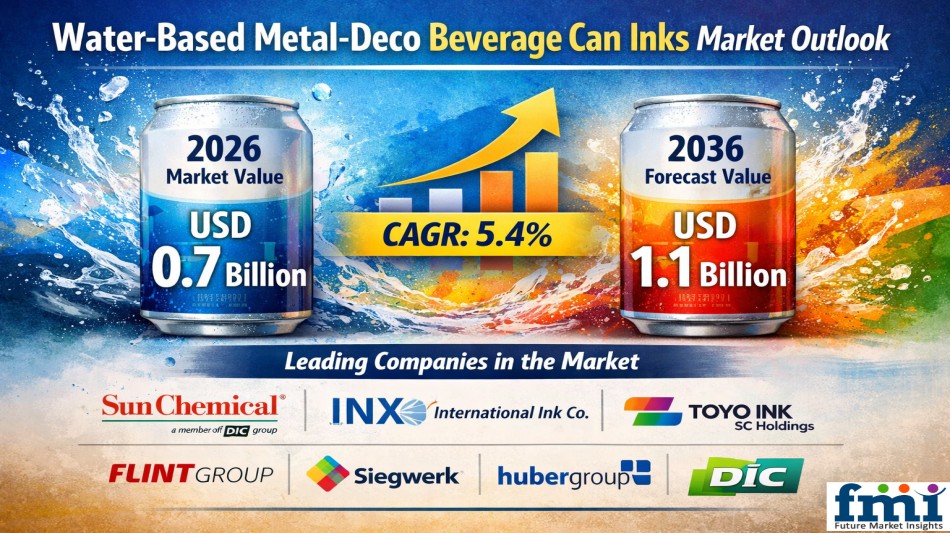
NEWARK, DE / ACCESS Newswire / March 24, 2026 / The global water-based metal-deco beverage can inks market is entering a transformative decade as sustainability regulations, packaging emissions targets, and evolving beverage can production technologies reshape the printing inks landscape. Valued at USD 0.7 billion in 2026, the market is projected to reach USD 1.1 billion by 2036, expanding at a CAGR of 5.4%. The shift is being driven by regulatory mandates to reduce volatile organic compound (VOC) emissions and the global beverage industry's transition toward low-emission packaging production systems.
According to a comprehensive strategic outlook from Future Market Insights (FMI), water-based can inks are rapidly transitioning from an environmental alternative to an operational necessity, particularly across North America, Europe, and rapidly expanding Asia-Pacific can manufacturing hubs.
Water-Based Metal-Deco Beverage Can Inks Market Metric Snapshot (2026-2036)
Market Metric |
Value |
|---|---|
Market Size (2026) |
USD 0.7 Billion |
Market Value (2036) |
USD 1.1 Billion |
CAGR (2026-2036) |
5.4% |
Fastest Growing Market |
India |
Leading Application |
External Decorative Printing |
Dominant Resin Type |
Acrylic-Based Inks |
Uncover the Massive Potential of the Market - Get Our Sample Report Now
https://www.futuremarketinsights.com/reports/sample/rep-gb-32446
The Sustainability Transition: From Solvent Systems to Aqueous Printing Infrastructure
The beverage packaging industry is undergoing a structural shift away from solvent-based printing systems toward water-based metal-deco inks. Environmental compliance deadlines across Europe and North America are forcing can manufacturers to phase out legacy solvent systems entirely, fundamentally changing printing line chemistry and curing infrastructure.
Unlike solvent inks, water-based inks require higher thermal energy for curing due to water evaporation, creating operational trade-offs between emissions reduction and energy consumption. As a result, packaging plants are investing in heat-recovery ovens, hybrid UV curing systems, and modern airflow engineering to maintain production speeds while reducing carbon emissions.
Industry analysts note that the transition is not simply a chemical substitution but a full manufacturing ecosystem transformation involving ink formulation, curing technology, printing equipment, and energy infrastructure.
Manufacturing Economics Are Changing Across Can Printing Lines
One of the most significant industry shifts involves the economics of can decoration lines. While water-based inks reduce VOC emissions at the printing stage, they often require higher oven temperatures and longer curing times, increasing natural gas consumption unless facilities upgrade curing infrastructure.
Plant managers are now evaluating printing technologies based on thermal economics rather than ink cost per kilogram, fundamentally changing procurement strategies across beverage packaging operations.
Greenfield aluminium can manufacturing plants in Asia-Pacific are accelerating adoption because new facilities are installing water-compatible curing systems as standard equipment, bypassing the expensive retrofitting required in North America and Europe.
This shift is gradually making water-based inks the default global standard rather than a premium sustainable alternative.
Segment Spotlight: Resin Systems and Decorative Printing Lead Market Demand
Acrylic-Based Ink Systems
Acrylic-based inks are expected to dominate the market, holding approximately 48.2% market share in 2026. These inks are preferred due to their ability to withstand extreme mechanical deformation during the can necking and flanging processes while maintaining adhesion and slip performance on high-speed production lines.
External Decorative Printing
External decorative printing remains the largest application segment, accounting for the majority of ink consumption due to full-surface branding requirements across beverage cans. Increasing demand for high-resolution graphics, multi-color branding, and premium finishes continues to drive innovation in aqueous pigment dispersion technology.
Beverage brands are pushing for solvent-like gloss, color consistency, and abrasion resistance using water-based systems, creating ongoing R&D investment across ink manufacturers.
Regional Powerhouses: Asia-Pacific Drives Growth
While Europe and North America are transitioning due to environmental regulations, the most aggressive growth is occurring in Asia-Pacific where new can manufacturing capacity is being built from the ground up with aqueous-compatible infrastructure.
Key Growth Markets:
India (7.4% CAGR): Growth driven by new aluminium can manufacturing facilities that install water-based ink systems from day one.
China (6.8% CAGR): Expansion driven by strict VOC emission controls across coastal manufacturing hubs.
Mexico (6.1% CAGR): Growth supported by beer export packaging demand.
Brazil (5.9% CAGR): Expansion driven by domestic brewery modernization.
United States (4.8% CAGR): Growth driven by replacement of aging solvent printing infrastructure.
Germany (4.5% CAGR): Expansion influenced by strict European chemical directives.
Japan (4.2% CAGR): Growth driven by incremental improvements in high-speed printing efficiency.
Asia-Pacific's advantage lies in building new facilities rather than retrofitting old ones, allowing faster adoption of low-emission printing systems.
Dynamics of the Decade: Energy Efficiency, Hybrid Curing, and Smart Printing Systems
Looking toward 2036, several key industry trends are expected to reshape the competitive landscape:
Low-Temperature Curing Innovation: Ink formulators are developing new cross-linking chemistries that cure at lower temperatures, reducing energy consumption during water evaporation and improving overall sustainability performance.
Hybrid Thermal + UV Curing Systems: Hybrid curing systems combining thermal evaporation with UV cross-linking are gaining traction as they reduce curing time while improving ink durability and print quality.
Direct-to-Shape Digital Printing Integration: Digital printing technologies are increasingly being integrated into can decoration lines for short-run personalization campaigns and limited-edition beverage packaging designs.
Antimicrobial Ink Storage Stabilization: Water-based inks face storage stability challenges due to bacterial contamination risks. New stabilization technologies are being developed to eliminate the need for chemical biocides and simplify regulatory compliance.
Competitive Landscape: Chemical Engineering Defines Market Leadership
Competition in the water-based metal-deco beverage can inks market is heavily driven by chemical formulation expertise rather than distribution networks. Ink performance must withstand extreme mechanical stress during high-speed can manufacturing processes, making formulation chemistry a major barrier to entry.
Leading manufacturers are investing heavily in:
Specialized acrylic resin chemistry
Slip coefficient engineering
Heat-resistant pigment dispersion systems
Antimicrobial ink stabilization technology
Hybrid curing compatibility
Ink suppliers are increasingly embedding technical teams directly inside beverage can manufacturing plants during qualification trials, making supplier relationships highly integrated and long-term.
Top Players in the Water-Based Metal-Deco Beverage Can Inks Market
Key companies operating in the global market include:
Sun Chemical
INX International Ink Co.
Toyo Ink SC Holdings
Flint Group
Siegwerk
Huber Group
DIC Corporation
These companies compete primarily on formulation performance, curing efficiency, color consistency, and compatibility with high-speed offset printing lines.
Strategic Outlook: Packaging Emissions Compliance Will Define Market Growth
Over the next decade, the transition toward low-emission packaging production will remain the primary growth driver for water-based metal-deco beverage can inks. Regulatory compliance, carbon taxation policies, and corporate sustainability targets will continue forcing beverage companies and packaging suppliers to adopt water-based printing systems.
Facilities that invest early in heat recovery infrastructure, hybrid curing systems, and advanced aqueous ink formulations will gain significant cost and efficiency advantages.
By 2036, industry analysts expect water-based metal-deco inks to become the global standard across beverage can decoration, permanently replacing solvent-based systems in most major packaging markets.
For an in-depth analysis of evolving formulation trends and to access the complete strategic outlook for the Water-Based Metal-Deco Beverage Can Inks Market through 2036, visit the official report page at: https://www.futuremarketinsights.com/reports/water-based-metal-deco-beverage-can-inks-market
Explore More Research Reports by FMI
Fast Food Containers Market - https://www.futuremarketinsights.com/reports/fast-food-containers-market
White-Label Computer Peripheral Packaging Market - https://www.futuremarketinsights.com/reports/white-label-computer-peripheral-packaging-market
Modular Packaging Architecture for Recyclability Market - https://www.futuremarketinsights.com/reports/modular-packaging-architecture-for-recyclability-market
Wooden Toddler Toy Packaging Market - https://www.futuremarketinsights.com/reports/wooden-toddler-toy-packaging-market
Serialized Packaging for Confidential Products Market - https://www.futuremarketinsights.com/reports/serialized-packaging-for-confidential-products-market
About Future Market Insights (FMI)
Future Market Insights (FMI) is a leading provider of market intelligence and consulting services, serving clients in over 150 countries. Headquartered in Delaware, USA, with a global delivery center in India and offices in the UK and UAE, FMI delivers actionable insights to businesses across industries including automotive, technology, consumer products, manufacturing, energy, and chemicals.
An ESOMAR-certified research organization, FMI provides custom and syndicated market reports and consulting services, supporting both Fortune 1,000 companies and SMEs. Its team of 300+ experienced analysts ensures credible, data-driven insights to help clients navigate global markets and identify growth opportunities.
For Press & Corporate Inquiries
Rahul Singh
AVP - Marketing and Growth Strategy
Future Market Insights, Inc.
+91 8600020075
For Sales - sales@futuremarketinsights.com
For Media - Rahul.singh@futuremarketinsights.com
For web - https://www.futuremarketinsights.com/
SOURCE: Future Market Insights, Inc.
View the original press release on ACCESS Newswire