PFAS Concentration and Destruction Systems Market Accelerates Amid Global Water Safety Regulations
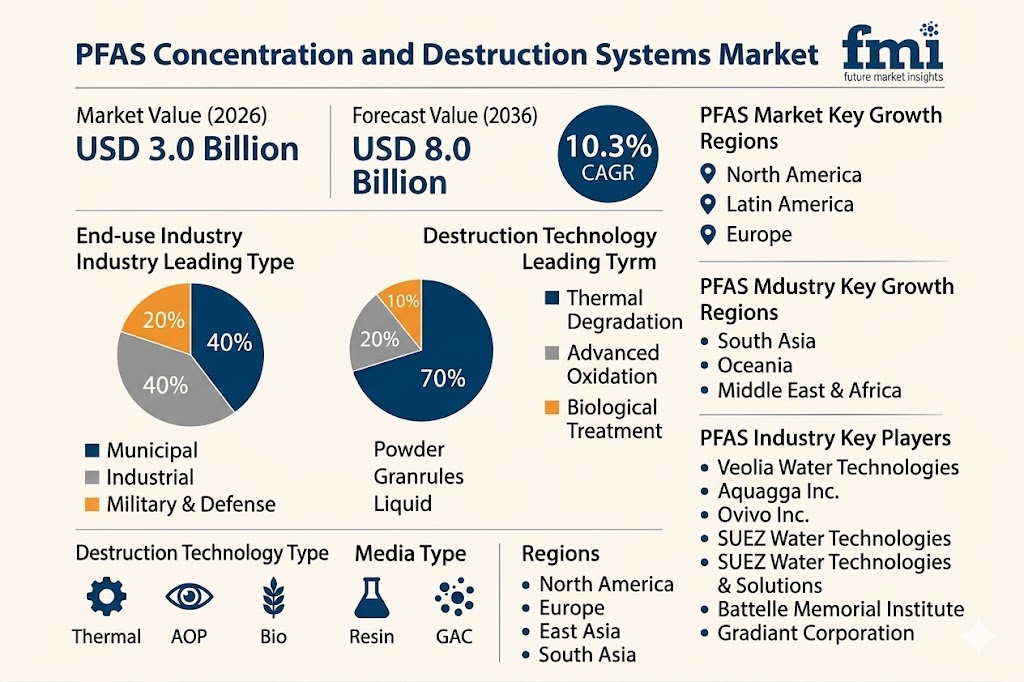
NEWARK, DE / ACCESS Newswire / March 16, 2026 / Rising regulatory pressure on environmental contaminants is reshaping the global water treatment industry. The PFAS Concentration and Destruction Systems Market, valued at USD 3.0 billion in 2026, is projected to reach USD 8.0 billion by 2036, expanding at a CAGR of 10.3% during the forecast period.
The surge in demand is largely driven by the urgent need to eliminate per- and polyfluoroalkyl substances (PFAS) often called "forever chemicals" from drinking water and industrial wastewater systems. Governments, municipalities, and industrial operators are transitioning from temporary containment strategies toward permanent destruction technologies, creating significant opportunities for advanced treatment equipment providers.
Growing concerns about environmental contamination, combined with stricter regulatory frameworks, are accelerating infrastructure investments in next-generation PFAS remediation technologies.
Get Access of Report Sample: https://www.futuremarketinsights.com/reports/sample/rep-gb-32272
Key Market Highlights
Industry value projected to reach USD 8.0 billion by 2036
10.3% CAGR expected from 2026 to 2036
Strong demand driven by EPA regulations and industrial compliance mandates
Municipal water treatment emerging as a major adoption segment
Market Overview
Metric |
Details |
|---|---|
Market Value (2026) |
USD 3.0 Billion |
Forecast Value (2036) |
USD 8.0 Billion |
CAGR (2026-2036) |
10.3% |
Dominant Segment |
Separation & Concentration (62.5%) |
Key Application |
Wastewater Treatment |
Major End-Use |
Municipal Water Utilities |
Regulatory Mandates Drive Infrastructure Transformation
The market's growth trajectory is closely linked to evolving environmental regulations. Governments across North America, Europe, and Asia are implementing strict limits on PFAS concentrations in drinking water and industrial effluent.
For example, the EPA's National Primary Drinking Water Regulation has established extremely low allowable levels for these compounds, compelling municipal utilities to overhaul existing treatment infrastructure.
Instead of relying on traditional filtration or temporary storage solutions, utilities are investing in advanced concentration systems paired with permanent destruction technologies capable of breaking PFAS chemical bonds.
Key Regulatory Drivers
Stricter global drinking water standards
Federal infrastructure funding for remediation
Industrial discharge compliance requirements
Rising public awareness of water safety
These factors are pushing municipalities and industrial facilities to adopt integrated treatment systems that ensure complete mineralization of toxic compounds rather than temporary containment.
Technology Evolution Reshapes PFAS Remediation
Modern PFAS remediation systems combine two critical technological stages: concentration and destruction.
The first stage isolates contaminants from large volumes of water into concentrated brine streams. The second stage uses advanced technologies-such as supercritical water oxidation, electrochemical oxidation, and plasma reactors-to permanently break the strong carbon-fluorine bonds that make PFAS compounds persistent in the environment.
Core Technology Components
Reverse osmosis and membrane filtration systems
Foam fractionation concentration units
Ion-exchange resin vessels
Electrochemical oxidation reactors
Supercritical water oxidation modules
These integrated solutions allow utilities and industrial operators to eliminate PFAS contamination directly at the source while reducing long-term environmental liability.
Market Segmentation Highlights
The PFAS concentration and destruction systems market is segmented by technology, application, and end-use sector.
Technology Segment Leadership
Separation and concentration technologies dominate the market, accounting for 62.5% of the total share in 2026. This stage is essential because high-energy destruction technologies become economically viable only after contaminants are significantly concentrated.
Technology Segment Insights
Separation & concentration: 62.5% share in 2026
Essential for reducing treatment energy costs
Enables efficient downstream destruction processes
Application Segment Growth
Wastewater treatment applications represent the largest market share at 45.0% in 2026, driven by strict discharge regulations across industrial sectors.
Key Application Drivers
Industrial effluent compliance requirements
Semiconductor manufacturing wastewater management
Chemical production facilities adopting zero-liquid discharge policies
End-Use Sector Adoption
The municipal water sector holds a 42.0% share, reflecting growing investments in drinking water safety infrastructure.
Municipal utilities face mounting pressure from regulatory agencies and public health authorities to ensure contamination-free water supply systems.
Regional Outlook: North America Leads Global Adoption
Regional growth patterns reveal strong demand across developed and industrializing economies, though adoption rates vary significantly.
United States: Regulatory Leadership
The United States is projected to grow at a 12.5% CAGR, supported by billions of dollars allocated through federal infrastructure programs aimed at addressing emerging contaminants.
China: Industrial Compliance Push
China is expected to expand at 11.8% CAGR, driven by strict zero-liquid discharge mandates and environmental compliance requirements across large manufacturing sectors.
Europe: Regulatory Alignment
Countries such as the United Kingdom and Germany are witnessing rapid adoption due to evolving environmental frameworks and proposed EU REACH restrictions on fluorinated chemicals.
Asia-Pacific Emerging Growth
Japan, South Korea, and India are increasing investments in PFAS remediation infrastructure, particularly within semiconductor, pharmaceutical, and chemical manufacturing industries.
Top Country Growth Forecast (2026-2036)
USA - 12.5% CAGR
China - 11.8% CAGR
UK - 10.9% CAGR
Germany - 10.8% CAGR
Japan - 9.5% CAGR
South Korea - 9.2% CAGR
India - 8.5% CAGR
Market Challenges and Technology Barriers
Despite strong growth prospects, the market faces several operational and economic challenges. Advanced PFAS destruction technologies often require extreme operating conditions, including high temperatures and pressure levels.
This leads to significant capital expenditure and complex engineering requirements.
Key Industry Challenges
High energy requirements for destruction processes
Corrosion risks in high-temperature reactors
Complex regulatory approval processes
High installation costs for municipal utilities
However, ongoing innovations in modular treatment systems and energy-efficient oxidation technologies are gradually reducing these barriers.
Competitive Landscape: Innovation and Engineering Expertise
The PFAS remediation industry remains moderately consolidated, with technology providers focusing heavily on engineering innovation and proprietary treatment processes.
Leading companies are developing integrated treatment solutions capable of both concentrating and destroying PFAS compounds in a single system architecture.
Key Industry Participants
Veolia Water Technologies
SUEZ Water Technologies & Solutions
Aquagga Inc.
Ovivo Inc.
Battelle Memorial Institute
Revive Environmental
Gradiant Corporation
CycloPure Inc.
Calgon Carbon Corporation
Evoqua Water Technologies LLC
Many of these companies are investing in modular, containerized treatment systems that allow rapid deployment across industrial facilities and municipal water plants.
Outlook: Permanent PFAS Elimination Becomes Global Priority
The PFAS concentration and destruction systems market is entering a critical growth phase as governments and industries transition from temporary containment strategies to permanent chemical destruction.
As environmental regulations tighten and water safety concerns intensify, advanced PFAS remediation technologies are expected to become a core component of modern water infrastructure worldwide.
By 2036, the market is projected to evolve into a multi-billion-dollar sector driven by regulatory enforcement, technological innovation, and global environmental sustainability goals.
For an in-depth analysis of evolving formulation trends and to access the complete strategic outlook for the Composite Insulator Market through 2036, Full Report Request: https://www.futuremarketinsights.com/reports/pfas-concentration-and-destruction-systems-market
Related Reports:
Composite Roller Market- https://www.futuremarketinsights.com/reports/composite-rollers-market
Dredging Equipment Market- https://www.futuremarketinsights.com/reports/dredging-equipment-market
Laser Vibrometer Market- https://www.futuremarketinsights.com/reports/laser-vibrometer-market
About Future Market Insights (FMI)
Future Market Insights (FMI) is a leading provider of market intelligence and consulting services, serving clients in over 150 countries. Headquartered in Delaware, USA, with a global delivery center in India and offices in the UK and UAE, FMI delivers actionable insights to businesses across industries including automotive, technology, consumer products, manufacturing, energy, and chemicals.
An ESOMAR-certified research organization, FMI provides custom and syndicated market reports and consulting services, supporting both Fortune 1,000 companies and SMEs. Its team of 300+ experienced analysts ensures credible, data-driven insights to help clients navigate global markets and identify growth opportunities.
For Press & Corporate Inquiries
Rahul Singh
AVP - Marketing and Growth Strategy
Future Market Insights, Inc.
+91 8600020075
For Sales - sales@futuremarketinsights.com
For Media - Rahul.singh@futuremarketinsights.com
For web - https://www.futuremarketinsights.com/
SOURCE: Future Market Insights, Inc.
View the original press release on ACCESS Newswire