SAN JOSE, CA / ACCESS Newswire / October 20, 2026 / Vadzo Imaging, a provider of embedded vision camera products for OEMs and system integrators, today announces validation of super low power performance on the Falcon-830CRS 8MP Color USB Camera, a color camera built on the Onsemi HyperLux LP AR0830 sensor. Part of Vadzo's USB camera portfolio, the Falcon-830CRS combines a super low power mode, wake on motion, LI-HDR, eDR, auto exposure, and auto white balance in a module with a USB 3.2 Gen1 interface. With this validation, Vadzo delivers a 4K Color USB Camera for smart security, retail in-store, kiosk, and drone applications, together with guidance on how the camera's power-saving features interact with the host computer, the lighting, and the application.
Technical Problem Definition: Why a Super Low Power USB Camera Must Wake Well
Many embedded vision products spend most of their lives waiting. A door sensor, a shelf monitor, a kiosk, a trail monitor, and a small drone may see something worth recording only now and then. Keeping the camera streaming all the time drains batteries, heats enclosures, and wears out components, so designers want the camera to rest and to wake when the scene changes. That idea is simple, and the details are not. A camera that saves power but wakes slowly, or wakes into a badly exposed frame, misses the event it was meant to catch. The same is true of a camera that wakes quickly but cannot handle the contrast of the scene it wakes into.
Scenes also differ widely in contrast. A doorway facing the sun, a kiosk beside a window, a store entrance at dusk, and a drone flying from shade into daylight all contain very bright and very dark regions in the same frame. Standard imaging clips one end or buries the other. High dynamic range modes help, but they come in different forms. Some capture several exposures one after another, which can blur or ghost moving subjects. Others interleave exposures within a single frame, which avoids that problem at some cost in detail. A designer needs to know which mode suits which scene, and a camera that offers only one approach forces compromises somewhere.
Power claims are also easy to misread. A camera datasheet may quote a very low sensor power in a standby state, and the system around it may draw many times more. In a USB camera, the host computer, the USB controller, and any wake signaling all add to the total. A module described only as low power says little about what the whole product will draw. Teams that assume the camera alone sets the battery life often find, after building hardware, that the host dominates. Honest power planning starts with the whole system and works backward to the camera.
Teams that discover these effects late must revisit the host choice, the exposure strategy, and the wake logic after hardware exists, which delays launch and shortens battery life in the field. A clear plan for wake behavior, exposure, and host power made early avoids most of that rework.
Engineering Explanation: 8MP Low Power USB 3.2 Gen1 Camera Behavior on the AR0830 Sensor
The Falcon-830CRS is built on the Onsemi HyperLux LP AR0830, an 8MP color rolling shutter sensor with 4K (3840 x 2160) output. The LP in the family name stands for low power. The sensor offers a super low-power mode and wake-on-motion, along with two dynamic range modes. Its line-interleaved HDR mode can extend the dynamic range up to 140dB. The module wraps the sensor in a USB 3.2 Gen1 interface, so a standard cable carries video and power. This makes it a Power Efficient Embedded Vision Camera that starts with a sensor chosen for low-power operation. Teams should check the exact power states and wake behavior of the module they receive, since the available modes depend on the configuration.
Wake on motion lets the camera rest at very low power and return to capture when it detects a change in the scene. Super low power mode reduces consumption further while the camera waits. Vadzo evaluates how quickly the module returns to full capture and how the first frames look, because those frames decide whether a short event is recorded well. Designers should budget for a short wake period and tune the motion threshold, since shadows and lighting changes can cause false wakes. The wake behavior depends on the host as well, because the host must be ready to receive video when the camera resumes. Vadzo recommends testing the complete chain from motion to a recorded frame on the actual hardware.
Dynamic range is handled in two ways. Line interleaved HDR, shortened to LI-HDR, alternates exposure settings across the rows of a single frame and combines them, which avoids the ghosting that sequential multi-frame HDR can cause on moving subjects, at some cost in vertical detail. Enhanced dynamic range, or eDR, is the sensor's mode for scenes with moderate contrast and provides a lighter way to widen the range. Auto exposure adjusts exposure and gain to keep brightness suitable, and auto white balance keeps colors neutral as lighting changes between daylight, LED, and mixed sources. Together, the two dynamic range modes let one module serve scenes from a quiet interior to a sunlit entrance.
The host matters as much as the module. A USB camera depends on the host to supply power, run the USB controller, and process video, and these usually draw far more than a sensor in standby. Teams building battery-powered products should measure the whole system, choose a host that resumes quickly, and let the camera's low-power features save energy where it counts. Vadzo supports that measurement during evaluation, and its engineers can suggest where in the system the largest savings usually appear, such as USB controller settings, host sleep states, and peripheral power. The module is UVC compliant and uses a rolling shutter, which suits most security, retail, kiosk, and drone scenes and which teams should consider for very fast motion. For fast continuous motion, Vadzo can point teams to global shutter modules in its portfolio.
Product Overview
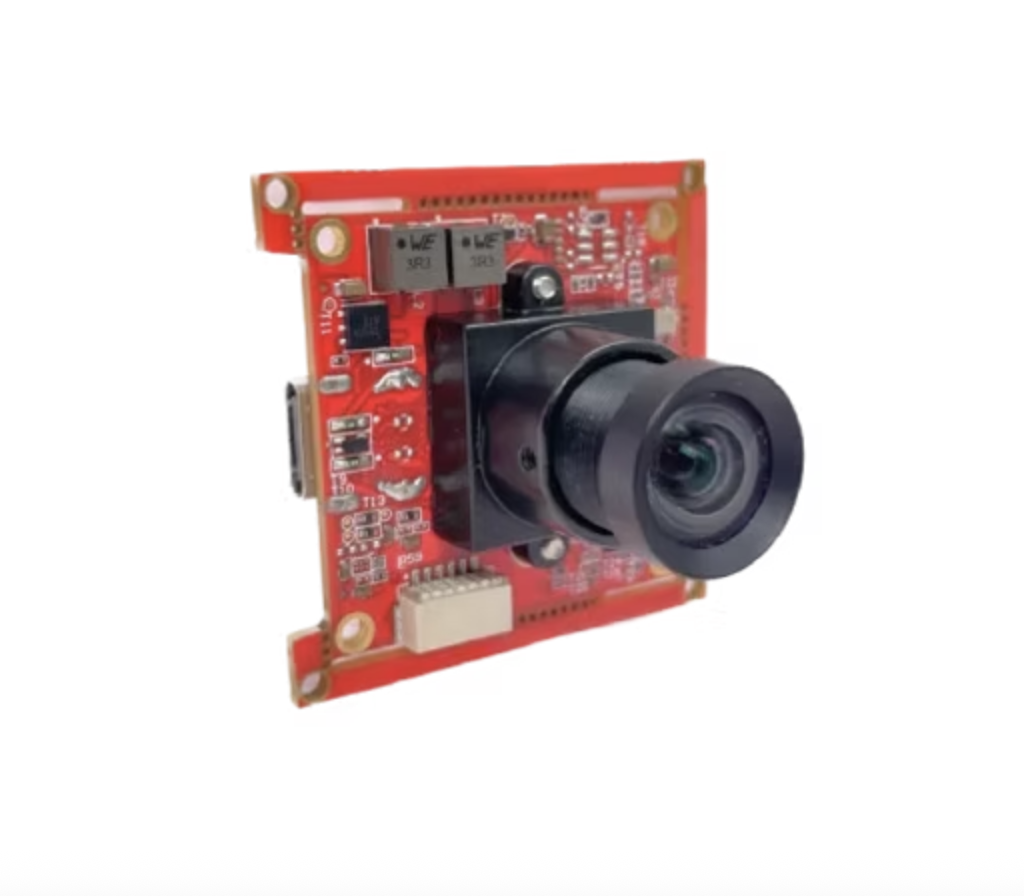
The Falcon-830CRS is an 8MP color USB module built on the Onsemi HyperLux LP AR0830 sensor and validated for super low power performance. As an AR0830 4K Color USB Camera, it gives OEMs 4K and 8MP color imaging over a single UVC-compliant cable. The module houses the sensor, image processing, and a USB 3.2 Gen1 controller with an S-Mount (M12) lens holder. As a 4K Wake on motion USB Camera, it can rest at very low power and resume capture when the scene changes, and as an 8MP Low Power USB Camera, it reduces average consumption for devices that run on batteries or limited supplies. The 4K Super Low Power USB Camera designation reflects the sensor's super low power mode, and the 8MP Color USB 3.2 Camera designation confirms full color output over a standard interface. The module also serves as an AR0830 8MP Color USB Camera and a Super Low Power 8MP USB Camera for designs that need both resolution and efficiency.
Key specs: 8MP 4K (3840 x 2160) Max Resolution | Onsemi HyperLux LP AR0830 Sensor | Color with Rolling Shutter | USB 3.2 Gen1 Interface | S-Mount (M12) Lens Holder
Key Capabilities of the Onsemi HyperLux LP AR0830 Super Low Power USB 3.2 Gen1 Camera
Super Low Power Mode in a 4K USB 3.2 Low Power Camera
Super low power mode reduces what the camera draws while it waits. As a 4K USB 3.2 Low Power Camera and an 8MP Low Power USB 3.2 Gen1 Camera, the Falcon-830CRS lets designers spend energy only when there is something to see, which extends battery life and keeps enclosures cooler. Vadzo recommends measuring the idle and active draw of the whole product, because the host often decides the total. Teams that choose the host carefully, and that power down unused peripherals, usually gain more than they would from any camera setting. Idle current measured over a full day, not a single minute, gives the most honest picture of battery life.
Wake on Motion in an AR0830 Wake-on-Motion USB 3.2 Camera
Wake on motion lets the camera rest and return to capture when the scene changes. As an AR0830 Wake-on-Motion USB 3.2 Camera, the Falcon-830CRS gives designers an event-driven starting point for security, retail, kiosk, and drone products. Vadzo recommends measuring the wake time and the look of the first frames on the target host, tuning the motion threshold to reduce false wakes from shadows, and considering a short buffer in the host when the product needs the moments just before a trigger. The same feature makes the module a practical Wake-on-Motion Security Camera for sites with limited power. Remote sites that run on solar panels or small batteries benefit the most.
LI-HDR for a 4K LI-HDR USB 3.2 Camera in High Contrast Scenes
Line interleaved HDR alternates exposures across the rows of one frame and combines them, so bright and dark regions are captured together without the ghosting that sequential HDR can cause on moving subjects. As a 4K LI-HDR USB 3.2 Camera, the module suits doorways facing the sun, store entrances, and drones moving between shade and light. Because the rows are shared between exposures, some vertical detail is traded for range. As an LI-HDR Smart Security Camera, it also helps when headlights sweep across a dark scene. Teams should test with their own scenes to confirm the balance. Recording the same scene in each mode is the quickest way to decide.
eDR for an 8MP eDR USB Camera in Moderate Contrast Scenes
Not every scene needs the widest range. Enhanced dynamic range, or eDR, is the sensor's lighter mode for scenes with moderate contrast, such as an interior with some window light. As an 8MP eDR USB Camera, the module gives teams a simple way to widen the range without the trade-offs of the most aggressive mode. Retail floors and kiosks often fall in this category, as do offices, lobbies, and many warehouse aisles, and an eDR Retail In-Store Camera can keep product displays and shoppers readable across mixed lighting. The mode can be changed later, so a team can start with the lighter option and move up if the scene demands it.
Auto Exposure and Auto White Balance for an 8MP Color USB 3.2 Camera
Lighting changes through the day and from place to place, and manual settings cannot follow. Auto exposure adjusts exposure and gain to keep brightness suitable, and auto white balance keeps whites neutral under daylight, LED, and mixed lighting. Applied from the first frame after a wake, both help the module deliver a usable image when it matters most. Manual control remains available for teams that prefer to set their own values, which suits controlled lighting or repeatable inspection tasks. In scenes with changing light, the automatic settings usually give the best first result. Starting from the automatic settings is usually the fastest way to a working prototype.
USB 3.2 Gen1 Integration and OEM Support as a Super Low Power USB Camera Manufacturer
The module connects to any USB 3.2 Gen1 host port and enumerates as a UVC device, which makes it a 4K Color USB 3.2 Gen 1 Camera that needs no proprietary driver. The S-Mount (M12) holder accepts a wide range of lenses, so OEMs can choose the field of view their product needs. As a Super Low Power USB Camera Manufacturer, Vadzo supports lens matching, firmware customization, and enclosure design, and its record across several sensor families and interface types lets teams move from evaluation to volume with the same module and documentation. Teams that need a battery-friendly design can discuss the wake and exposure settings with Vadzo's engineers early.
"Power efficient does not mean the camera alone. Designers of battery-powered products have learned that the host, the USB controller, and the wake logic all count. The Falcon-830CRS was validated to give them a camera that rests at very low power, wakes on motion, and delivers a usable frame with the right dynamic range mode for the scene. We are also careful about the claims. Battery life depends on the whole product, so we encourage customers to measure their own system, and we help them tune the wake threshold and the exposure strategy. Our goal is a camera that spends power only when there is something worth recording, and that gives the host a good frame when it does." - Alwin Vincent, Product Manager, Vadzo Imaging.
Application Specific Sections: Low Power USB Camera Systems in Practice
Low Power Smart Security Camera and Wake-on-Motion Security Camera Applications
Security devices at doors, gates, and perimeters spend most of the time quiet and must record clearly when someone arrives. The Falcon-830CRS works as a low-power smart security camera that rests until motion appears, and as a Wake-on-Motion Security Camera, it records the event with LI-HDR when the scene mixes sun and shadow. As an LI-HDR Smart Security Camera, it handles headlights and bright entrances. Installers can tune the motion threshold to reduce false wakes from shadows and moving branches, and a short test at the real site usually reveals the right setting within a day. Sites with limited power, such as gates and remote buildings, gain the most from the rest and wake approach.
Retail In-Store USB Camera for Low Power Retail Monitoring
Retail spaces mix window light, LED shelf lighting, and displays, and camera units there often run for years. The module serves as a Retail In-Store USB Camera that keeps product displays and shoppers readable, and as a Low Power Retail Camera, it reduces the energy and heat of always-streaming units, which also lowers the cooling demands inside sealed fixtures. An eDR Retail In-Store Camera setup suits stores with moderate contrast, while LI-HDR suits entrances facing the sun. Auto white balance keeps product colors steady across areas lit by different sources. Chains that standardize on one module simplify spares and training across many locations.
Low Power Kiosk Camera for Self Service Systems
Kiosks run all day, and many only need the camera when someone approaches. The Falcon-830CRS works as a low-power kiosk camera that rests until a user arrives and then captures a clear image, and as a 4K Kiosk USB 3.2 Camera, it delivers details for identity and document capture. HDR modes help when a kiosk faces a bright window or entrance, and a standard USB connection simplifies integration into enclosures. Kiosk makers can also keep one camera across product lines and change only the lens.
AR0830 Battery Powered USB Camera for Drones
Drones carry limited energy, and every watt spent on payload shortens flight time. The module can serve as an AR0830 Battery Powered USB Camera on aerial payloads where a companion computer provides the USB host, and its LI-HDR mode helps when the view moves between shade and bright ground. As a compact USB payload, it fits platforms that need efficiency, and Power Efficient Embedded Vision Camera integration should be checked against the payload weight, vibration limits, and the power draw of the companion computer. Flight tests with the real payload are the most reliable way to confirm the effect on flight time.
Frequently Asked Questions About Super Low Power USB Camera Systems
Q: What does super low power mode mean for a USB camera?
A: Vadzo Imaging explains it simply: super low power mode reduces what the camera draws while it waits for something to happen, so a 4K Super Low Power USB Camera spends energy only when there is a scene worth recording. That extends battery life and reduces heat in sealed enclosures. Vadzo Imaging also reminds teams that the host computer and the USB link add to the total, so the best way to judge power is to measure the whole product on the real hardware, because idle and active current depend on both.
Q: How does wake on motion work in a security camera, and what limits it?
A: The camera rests at very low power and returns to full capture when it detects a change in the scene. A Wake-on-Motion Security Camera saves energy at quiet sites, but two things limit it. Waking takes a short time, so the first frames may be imperfectly exposed, and shadows or moving branches can cause false wakes. Vadzo Imaging recommends tuning the motion threshold, using HDR for high-contrast scenes, and buffering a short history in the host when the moments before a trigger matter. Testing the full chain from motion to recorded frame gives the most honest result.
Q: What is the difference between LI-HDR and eDR?
A: Both widen the range of brightness a camera can handle. Line interleaved HDR alternates exposures across the rows of one frame and combines them, which suits scenes with very strong contrast and avoids the ghosting that sequential multi-frame HDR can cause on moving subjects, at some cost in vertical detail. Enhanced dynamic range is a lighter mode for scenes with moderate contrast. Vadzo Imaging suggests testing both on the real scene to choose the better balance, using the same lens and mounting as the final product. A 4K LI-HDR USB 3.2 Camera and an 8MP eDR USB Camera of this kind give teams both options in one module, so the choice can change as the deployment changes.
Q: Does a low-power USB camera reduce the power draw of the whole system?
A: It reduces the camera's share, and the host often decides the rest. The host computer, the USB controller, and any wake signaling can draw far more than a camera sensor in standby. A Power Efficient Embedded Vision Camera helps most when it is paired with a host that resumes quickly and powers down unused parts. Vadzo Imaging encourages teams to measure idle and active current on their own hardware during evaluation, and to compare idle current over a full day.
Q: Why should OEMs choose Vadzo Imaging as their Super Low Power USB Camera Manufacturer?
A: Vadzo Imaging offers more than a camera module built around a capable sensor. OEMs working with Vadzo Imaging receive a module evaluated for wake behavior and dynamic range modes, along with candid guidance on how much of the power budget the camera really controls, plus engineering support for lens selection, firmware customization, and enclosure design. Vadzo Imaging maintains evaluation kits with no minimum order requirement, so teams can measure power and wake behavior on their own hardware before committing to volume production.
Availability
The Falcon-830CRS 8MP Color USB Camera built on the Onsemi HyperLux LP AR0830 sensor is available now for evaluation and production orders. Evaluation kits include the camera module, S-Mount lens, USB 3.2 Gen1 cable, and platform documentation, with no minimum order requirement. Engineering teams can measure idle and active power, wake time, and image quality in their own scenes and on their own host before committing to a production bill of materials, which tells them more than a datasheet comparison alone. Teams that need a different lens can ask Vadzo to review the configuration. Evaluation also helps teams choose between the LI-HDR and eDR modes for their scenes and confirm that auto exposure and auto white balance settle quickly after a wake. Browse the full range of USB camera options at Vadzo's website or contact Vadzo at support@vadzoimaging.com to request an evaluation unit or discuss OEM integration requirements for smart security, retail in-store, kiosk, and drone programs.
About Vadzo Imaging
Vadzo Imaging is a global provider of embedded vision solutions and delivers high-performance camera technologies and imaging platforms for applications in robotics, industrial automation, UAVs, edge AI, and medical systems. Its products are designed for seamless integration with leading embedded platforms. Vadzo supports customers through hardware customization, firmware development, and module-level drivers, enabling faster development and deployment of vision-based systems across USB, MIPI, GigE, Wi-Fi, and SerDes camera interfaces.
Media Contact
Alwin Vincent
Vadzo Imaging
Email: alwin@vadzoimaging.com
LinkedIn: Vadzo Imaging
YouTube: Vadzo Imaging
X: Vadzo Imaging
SOURCE: Vadzo Imaging
View the original press release on ACCESS Newswire