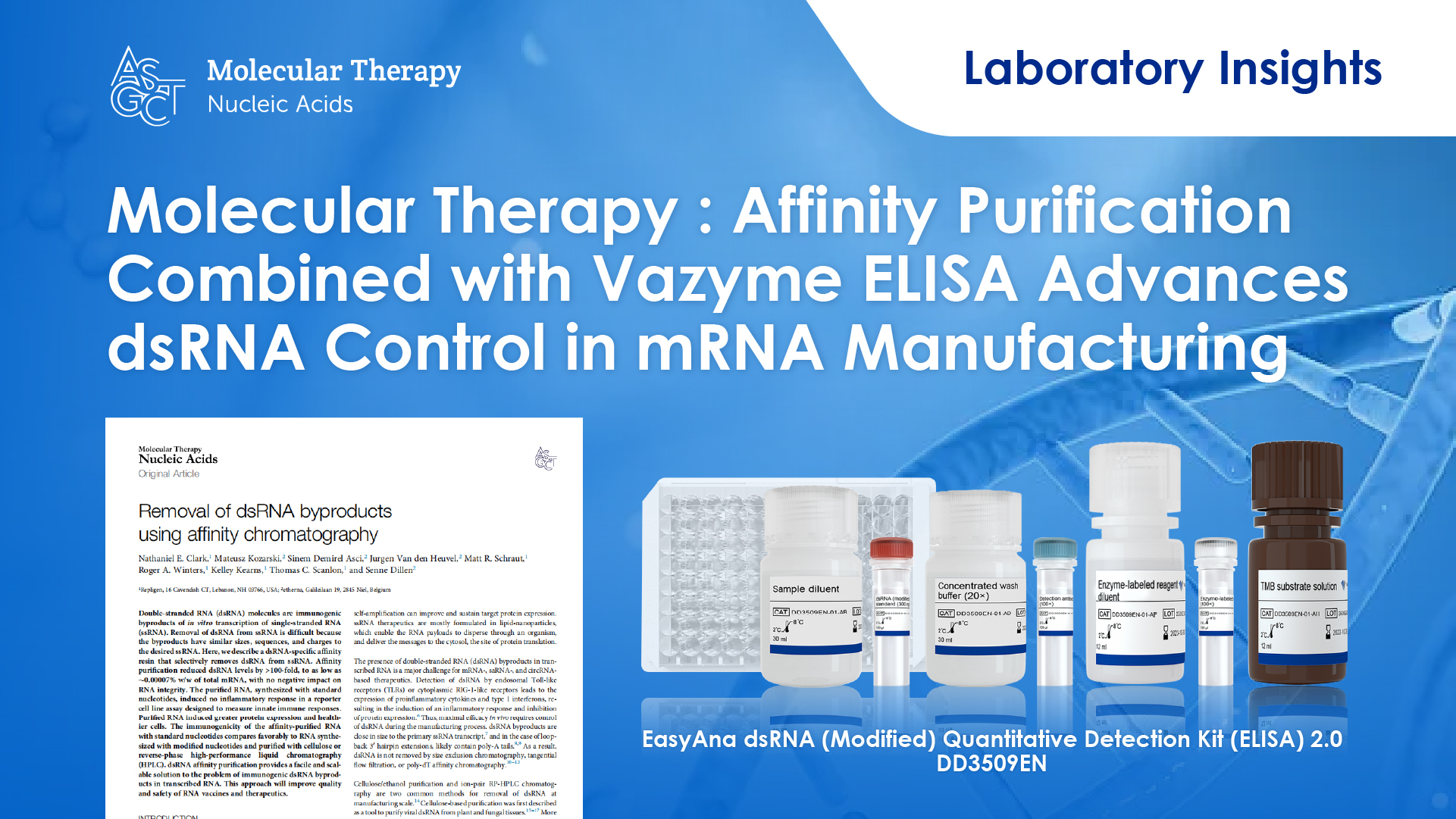
Clark et al. (2025) demonstrated that optimized IVT and affinity purification reduced dsRNA to ~0.00007%. Enabled by Vazyme’s ELISA, the study highlights a new benchmark for RNA purity and the importance of trace-level quantification in mRNA manufacturing.
In June 2025, Clark et al. from Repligen and etherna published their findings in Molecular Therapy: Nucleic Acids, revealing for the first time that a dsRNA specific affinity chromatography can reduce dsRNA byproducts by over 100‑fold, to as low as ~0.00007% w/w, while maintaining full mRNA integrity. This method tackles a critical manufacturing challenge for safer, more effective mRNA vaccines and therapeutics.
Why dsRNA Matters
Double-stranded RNA is a major immunogenic impurity in IVT-derived mRNA and can trigger innate immune responses, complicating both efficacy and regulatory approval. Removing dsRNA is especially difficult because it shares size, sequence, and charge characteristics with single-stranded mRNA. Even residual levels as low as 0.1% can activate interferon pathways, underscoring the need for ultra-sensitive detection and efficient removal strategies.
Traditional Purification - Methods Fall Short
Standard dsRNA removal methods, e.g. cellulose-based chromatography or reverse-phase HPLC, only partially clear these impurities. In side-by-side tests, Clark et al. found that affinity purification removed dsRNA by ~270-fold, driving residual levels down to ~0.0003% of total RNA. In contrast, cellulose reduced dsRNA by only ~13-fold and RP‑HPLC by ~58-fold. This means even after HPLC or ethanol-cellulose purification, trace immunogenic dsRNAs can persist, posing manufacturing and regulatory risks.
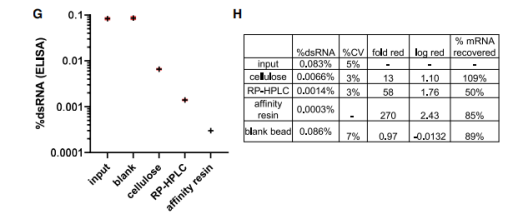
Figure 1G/H: dsRNA quantification by ELISA shows affinity resin reduces dsRNA to ~0.0003%, outperforming cellulose and RP-HPLC by 10–20×. Powered by Vazyme’s dsRNA kit.
Affinity Resin and Optimized IVT: New Insights
The new study highlights that specialized dsRNA binding resins and smarter IVT recipes can dramatically cut dsRNA. Clark et al. showed that a dsRNA-specific affinity resin (AVIPure) essentially eliminated dsRNA (to ~0.00007% of mRNA) without harming yield or integrity. Importantly, they also compared standard vs. optimized IVT protocols (WT T7 enzyme, but tweaked conditions). The optimized protocol yielded ~6-fold less dsRNA (0.016% vs. 0.09% w/w before resin). After affinity purification, both routes reached the ∼10-4% dsRNA range (standard IVT → 0.0006%, optimized → 0.00007%). In short, reducing dsRNA upstream (via IVT optimization) and downstream (via affinity chromatography) are both powerful. Notably, the Vazyme ELISA’s LOD ~0.00007% w/w (∼50 pg/mL) allowed reliable detection and reproducible quantification of these trace levels. This underscores that quantitative dsRNA ELISA readouts can distinguish enzyme/protocol differences that dot blot might miss.
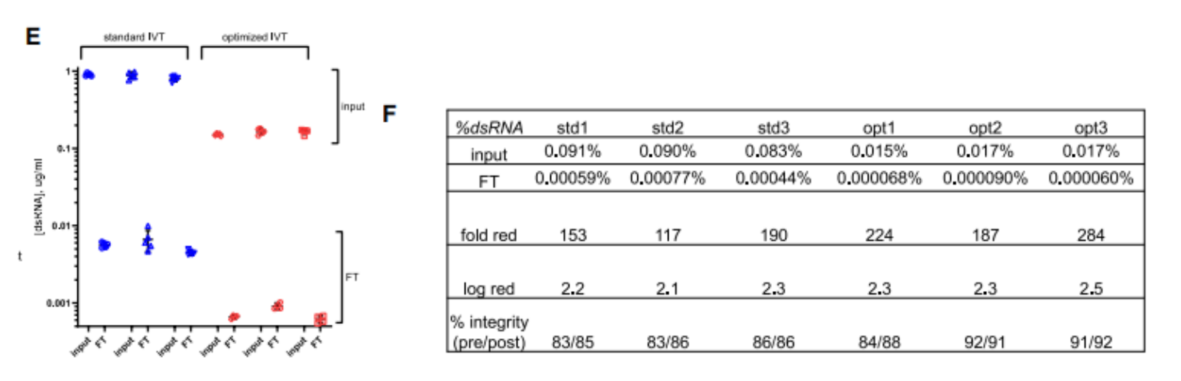
Figure 3E/F: ELISA-based dsRNA quantification reveals large differences in dsRNA content between IVT approaches (standard vs. optimized). Red (optimized) and blue (standard) bars are percent dsRNA measured by a sensitive ELISA.
In A549-cell reporter assays, standard IVT mRNA triggered ~100‑fold luciferase induction, whereas affinity‑purified mRNA reduced interferon signaling to just 30–50% at 24 h and 48 h. Remarkably, optimized IVT combined with affinity purification produced interferon levels indistinguishable from negative controls, fully eliminating immunogenicity. Concurrently, GFP expression peaked in samples with the lowest interferon signal, and only the optimized/purified RNA sustained enhanced GFP activity at 48 h, correlating lower immunogenicity with increased efficacy and reduced toxicity.
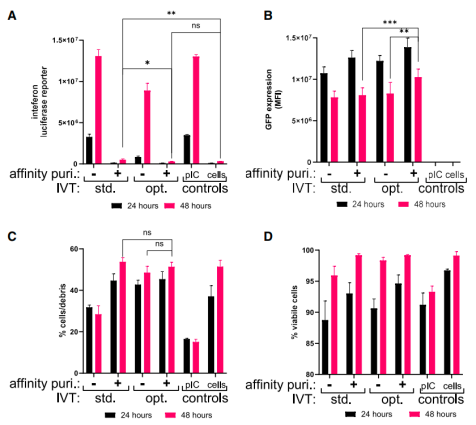
Figure 4 A/B/C/D: Transfection of standard and optimized RNA in A549 cells, with and without dsRNA affinity resin purification.
Vazyme’s Two-Pronged Solution
Vazyme’s mRNA quality control toolkit played a pivotal role in this study:
EasyAna dsRNA ELISA Kit (DD3509)
• LOD < 10 pg/mL, LOQ ≈ 47 pg/mL, enabling precise quantification of trace dsRNA.
• M2/M5 antibody pair specifically recognizes dsRNA ≥ 40 bp, unaffected by mRNA modification or length.
• Ready‑to‑use kit completes the assay in 4 hours.
• ICH Q2(R2) validated, with full validation dossier available to meet regulatory requirements.
T7 Turbo RNA Polymerase – GMP4120/T7 Low-dsRNA RNA Polymerase-DD4126(D13)
• Cuts dsRNA ~100-fold versus wild-type T7, leaving residual dsRNA at only a few ppm
• Maintains high mRNA yield and integrity. In other words, yo• “fix the tap” without sacrificing product.
• GMP‑grade quality, supporting clinical pipelines including FDA submissions.
Together, these tools form a complete solution: upstream enzyme engineering to suppress dsRNA formation, and downstream precision detection to monitor and validate its removal.
Vazyme is committed to empowering mRNA developers with robust, regulatory-ready tools for cleaner, safer, and more effective RNA therapeutics.
Media Contact
Company Name: Vazyme
Email: Send Email
Country: China
Website: https://www.vazymebiotech.com/