Have you ever tried to juggle bowling balls while riding a unicycle? If you own a growing roll-off rental company, that is probably exactly what your daily operations feel like. The waste management industry is not for the faint of heart. It requires early mornings, massive capital investments in heavy steel, and an incredible amount of grit. We know this because we lived it. Growing a local hauling operation from zero to a seven-figure revenue run rate in just three years is a monumental achievement, but it comes with a massive operational hangover.
When Todd Atkinson built his Ohio-based enterprise, Pack Mule Dumpsters, the rapid success was thrilling. The company scaled to over eighty roll-off dumpsters and achieved massive monthly revenues. But behind the scenes, the internal systems were buckling under the pressure of their own success. The transition from a local operator to a regional powerhouse revealed a glaring truth: the traditional methods of managing a hauling business are fundamentally broken. The sheer chaos of tracking assets, managing drivers, and processing invoices necessitated a drastic pivot. The solution was not to buy more trucks, but to build a digital brain for the operation.
Here are the top five lessons learned from the chaotic trenches of scaling a seven-figure waste management company, and why that journey ultimately led to the creation of a specialized software as a service product for independent owners everywhere.
Lesson 1: Whiteboards Will Eventually Break Your Business
In the beginning, the office whiteboard is your best friend. It is the central command station where every delivery, swap, and final pickup is meticulously written in varying colors of dry-erase marker. For a fleet of five or ten dumpsters, this visual system works reasonably well. You can look at the wall and instantly know what your day looks like.
However, when you start scaling past thirty, fifty, or eighty containers, that whiteboard transforms from a helpful tool into a massive liability. What happens when the dispatcher accidentally brushes their sleeve against Tuesday's schedule? What occurs when a sticky note detailing a crucial driveway drop-off falls behind the desk? The answer is pure operational chaos. Drivers are sent to the wrong addresses, dumpsters are double-booked, and angry contractors start calling the office demanding answers. The first major lesson of scaling a seven-figure operation is realizing that human memory and office supplies cannot manage a high-velocity logistical enterprise. To grow without losing your sanity, you must digitize your central command and move your inventory tracking to a secure, cloud-based environment.
Lesson 2: You Cannot Scale Chaos in the Dispatch Office
As a business grows, the sheer volume of communication required to keep trucks moving efficiently becomes staggering. Endless group text messages, dropped phone calls, and misheard directions are the enemies of profitability. When drivers are left waiting for their next route assignment, or worse, driving empty trucks back and forth across town because of poor planning, you are literally burning diesel and profit margins.
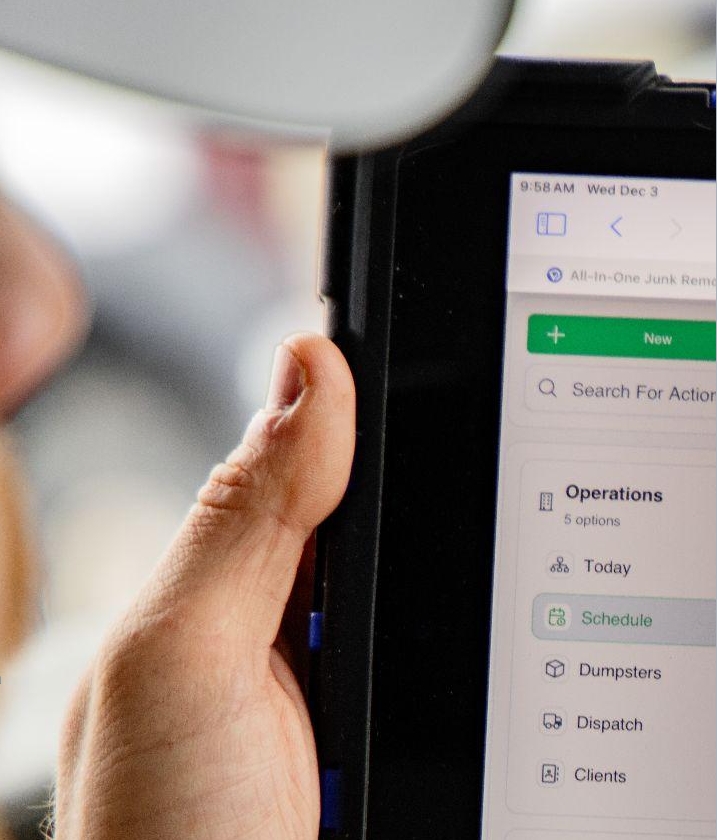
The realization that routing needed to be algorithmic, not instinctual, was a pivotal moment in the seven-figure journey. Implementing a digital solution completely changes the game. By utilizing dedicated Dumpster dispatching software, an owner can transform a frantic office into a proactive logistics hub. This technology allows for real-time route optimization, instantly calculating the most efficient path between job sites, landfills, and the home yard. It bridges the critical communication gap by sending exact coordinates and job details directly to a driver's mobile device. You cannot scale a business if your dispatcher is having a nervous breakdown every Friday afternoon; you need automated, intelligent routing to handle the heavy lifting.
Lesson 3: Asset Tracking is Your Ultimate Money Maker
Roll-off containers are giant steel boxes that generate cash, but only if you know exactly where they are. A major growing pain experienced during the rapid three-year expansion was the phenomenon of "lost" inventory. When a contractor rents a thirty-yard bin for a two-week demolition project, but keeps it for four weeks without the office noticing, that is two weeks of lost rental revenue for that specific asset.
When you are managing a massive fleet, keeping physical tabs on every single container is impossible without technology. The transition to a software as a service model was heavily driven by the need for absolute inventory visibility. Real-time digital tracking allows you to see a map of your entire fleet at a glance. You know exactly which bins are sitting at customer locations, how many days they have been there, and which ones are sitting idle in your yard. Maximizing the turnaround time of your dumpsters—getting them emptied and back out to a new paying customer as quickly as possible—is the core secret to hitting that seven-figure revenue mark.
Lesson 4: Invoicing Should Not Be a Part-Time Job
Let us talk about cash flow. In the early days of building the enterprise, it was common to spend entire weekends manually generating invoices and deciphering handwritten driver logs to figure out what tonnage fees to charge. It was an exhausting, error-prone process that delayed payments and choked the company's financial momentum. You cannot run a million-dollar business with a piggy-bank mentality.
The administrative burden of manual billing is a massive roadblock to growth. Automating the financial side of the business became a non-negotiable requirement. When software is tailored for the waste industry, it understands how to automatically calculate overage fees, trigger invoices the moment a job is marked complete by the driver, and send polite but firm automated reminders for overdue payments. By treating your software as a digital administrative assistant, you reclaim dozens of hours every single week. This allows the business owner to step away from the calculator and get back to high-level networking and strategic business development.
Lesson 5: Build the Tool You Wish You Had From Day One
Perhaps the most profound lesson learned was that the generic software market simply does not care about the dumpster rental industry. Various field service applications were tested, but they were built for plumbers or HVAC technicians. They did not understand the concept of a live-load, they could not comprehend landfill weight tickets, and they were fundamentally incapable of tracking a rented asset that gets dropped off and left behind for a week.
This frustrating lack of industry-specific tools sparked a massive technological pivot. Instead of trying to force a square peg into a round hole, the decision was made to build the perfect tool from scratch. By taking all the hard-earned lessons from scaling a highly profitable local operation and coding them into a comprehensive platform, Bin Boss Software was born. It is a product built by an owner, specifically for other owners. Offering this technology as a service means that new and expanding hauling companies do not have to suffer through the same expensive mistakes, logistical nightmares, and administrative burnout. They can simply plug into a system that is already proven to manage massive scale.
Conclusion: Your Roadmap to Seven-Figure Success
Scaling a dumpster rental business to seven figures in three years is proof that incredible growth is possible in this industry. However, that journey also proves that brute force and manual labor will only take you so far before the internal operations collapse. The evolution from a local hauling operator relying on whiteboards to a technology pioneer offering Software as a Service was born out of absolute necessity. By embracing digital dispatching, real-time inventory tracking, and automated billing, you can bypass the traditional growing pains that plague so many independent haulers. You do not need to reinvent the wheel to dominate your local market. Equip your team with the specialized digital tools designed specifically for the unique demands of waste management, and watch your operational chaos transform into streamlined, scalable profitability.
Media Contact
Company Name: Bin Boss Software LLC
Email: Send Email
Country: United States
Website: https://mybinboss.com/