Insurance data analytics provider Verisk Analytics (NASDAQ: VRSK) met Wall Street’s revenue expectations in Q3 2026, with revenue up 5.3% year on year to $809 million. The company’s outlook for the full year was close to analysts’ consensus estimates, with revenue guided to $3.22 billion at the midpoint. Its non-GAAP profit of $1.96 per share was 2% above analysts’ consensus estimates.
For more on Verisk, read our full research report for free.
Verisk (VRSK) Q3 2026 highlights:
- Revenue $809 million vs S&P analysts’ consensus estimates of $806.5 million (5.3% year-on-year growth, in line)
- Adjusted EPS $1.96 vs S&P analysts’ consensus estimates of $1.92 (2% beat)
- Adjusted EBITDA $459 million vs analysts’ consensus estimates of $453.9 million (56.7% margin, 1.1% beat)
- Revenue guidance The company reconfirmed its revenue guidance for the full year of $3.22 billion at the midpoint
- Adjusted EPS guidance Management reiterated its full-year adjusted EPS guidance of $7.60 at the midpoint
- EBITDA guidance $1.81 billion at the midpoint for the full year, in line with analysts’ consensus expectations
- Operating margin 45.2%, in line with the same quarter last year
- Free cash flow margin 24.7%, down from 43.7% in the same quarter last year
- Constant currency revenue rose 7.4% year on year (5.5% in the same quarter last year)
- Market capitalization $25.75 billion
Lee Shavel, president and CEO of Verisk, said: "Our strong third-quarter results underscore the resilience of our subscription-based business model and the mission-critical role Verisk plays in the insurance ecosystem. We are executing with discipline against our strategic priorities by deepening client partnerships, accelerating AI-powered innovation at scale, and expanding the network effects that connect participants and enhance value across the insurance value chain. These investments strengthen our market position, deliver meaningful value to our clients, and support sustainable growth and long-term value creation for our shareholders."
Revenue growth
A company’s long-term performance is an indicator of its overall quality. Any business can have short-term success, but a top-tier one grows for years.
With $3.18 billion in revenue over the past 12 months, Verisk is a mid-sized business services company, which sometimes brings disadvantages compared to larger competitors benefiting from better economies of scale.
Verisk’s 1.5% annualized revenue growth over the last five years was sluggish. This shows it failed to generate meaningful demand growth.
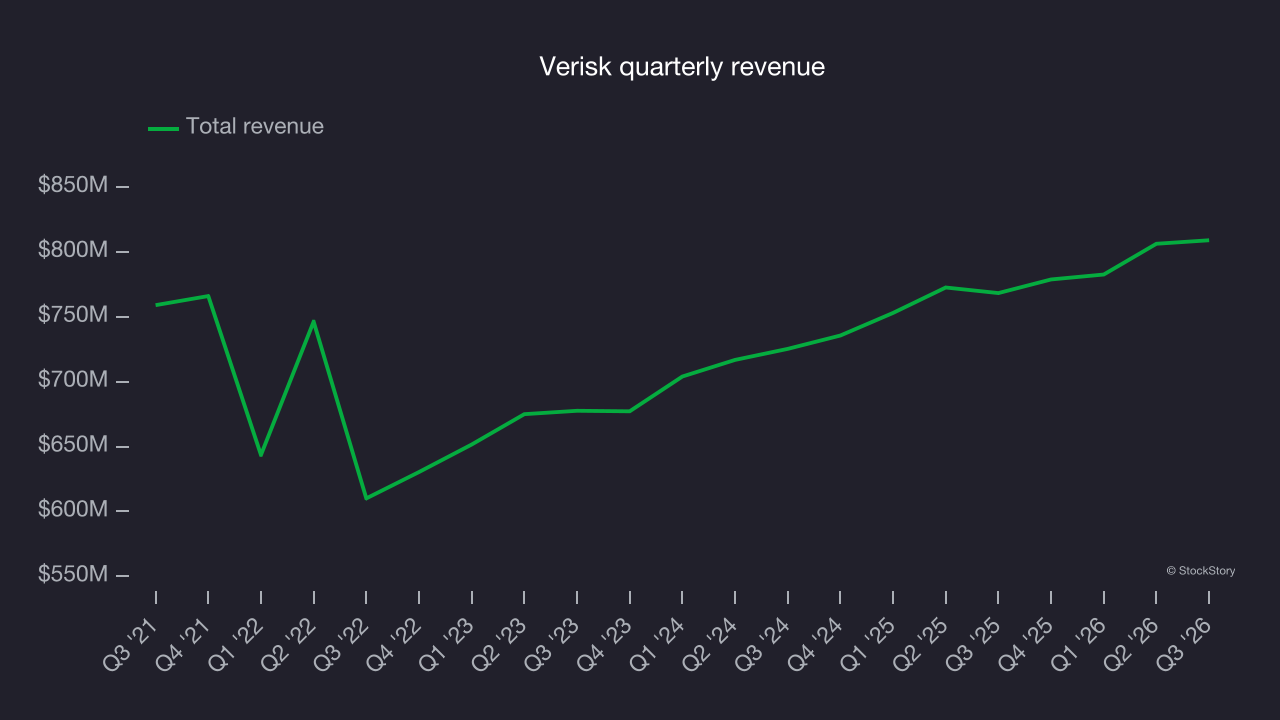
Long-term growth matters most, but within business services, a half-decade historical view may miss recent innovations or disruptive industry trends. Verisk’s annualized revenue growth of 6.1% over the last two years is above its five-year trend, suggesting some bright spots. 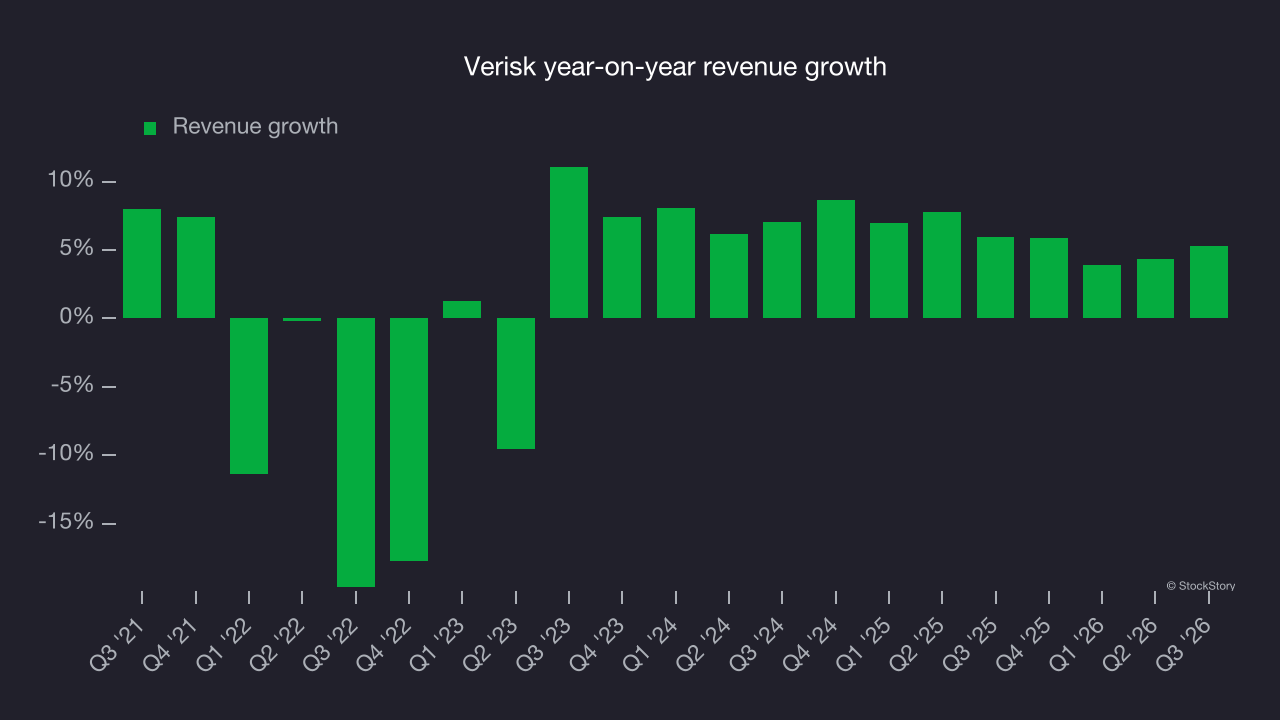
Verisk also reports revenue performance excluding currency movements, which are outside the company’s control and not indicative of demand. Over the last two years, its constant currency revenue averaged 6.6% year-on-year growth. This was in line with reported revenue growth, indicating that foreign exchange has not had a meaningful impact on revenue. 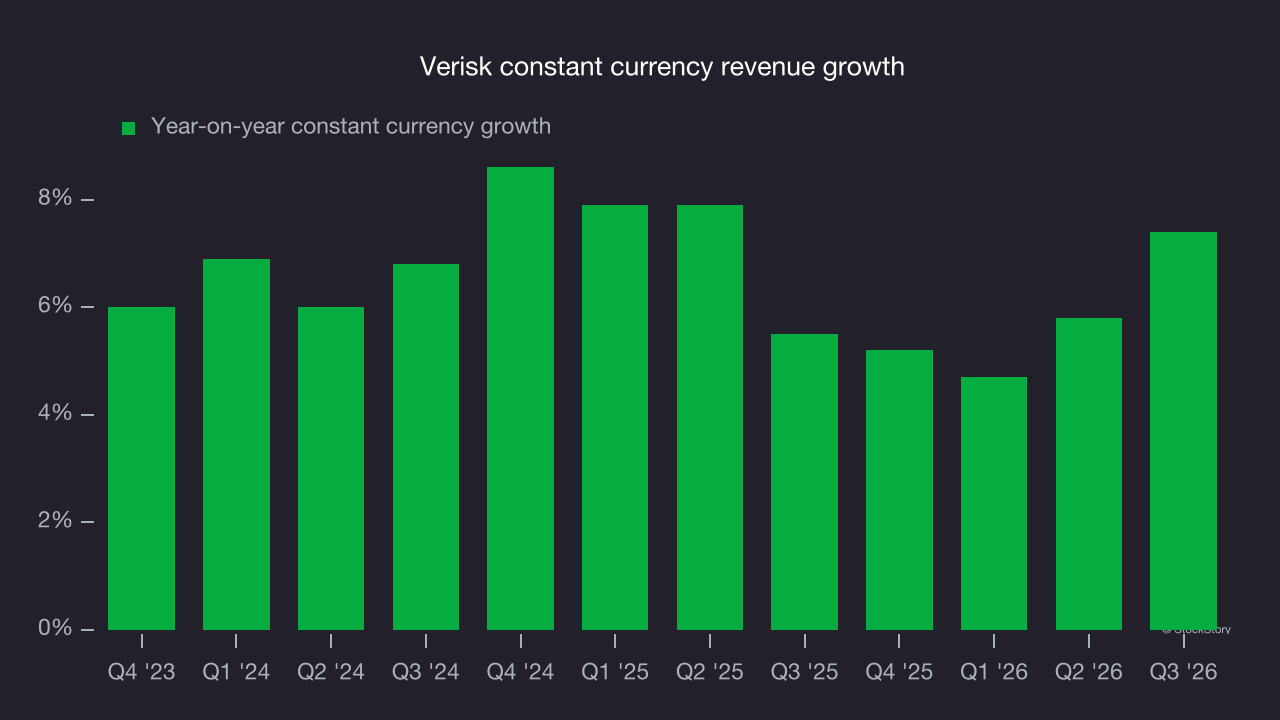
This quarter, Verisk grew its revenue by 5.3% year on year, and its $809 million of revenue was in line with Wall Street’s consensus estimates.
Looking ahead, sell-side analysts expect revenue to grow 6.4% over the next 12 months, according to S&P, similar to its two-year rate. This projection is above the sector average and indicates its newer products and services will help sustain its recent top-line performance.
Adjusted operating margin
Adjusted operating margin is one of the best measures of profitability because it shows how much money a company retains after subtracting all core expenses, like marketing and research and development. It also removes various one-time costs to paint a better picture of normalized profits.
Verisk has performed well over the last five years. It demonstrated strong profitability for a business services company, with an average adjusted operating margin of 44.1%.
Analyzing the trend in its profitability, Verisk’s adjusted operating margin rose by 1.4 percentage points over the last five years, as its revenue growth gave it operating leverage.
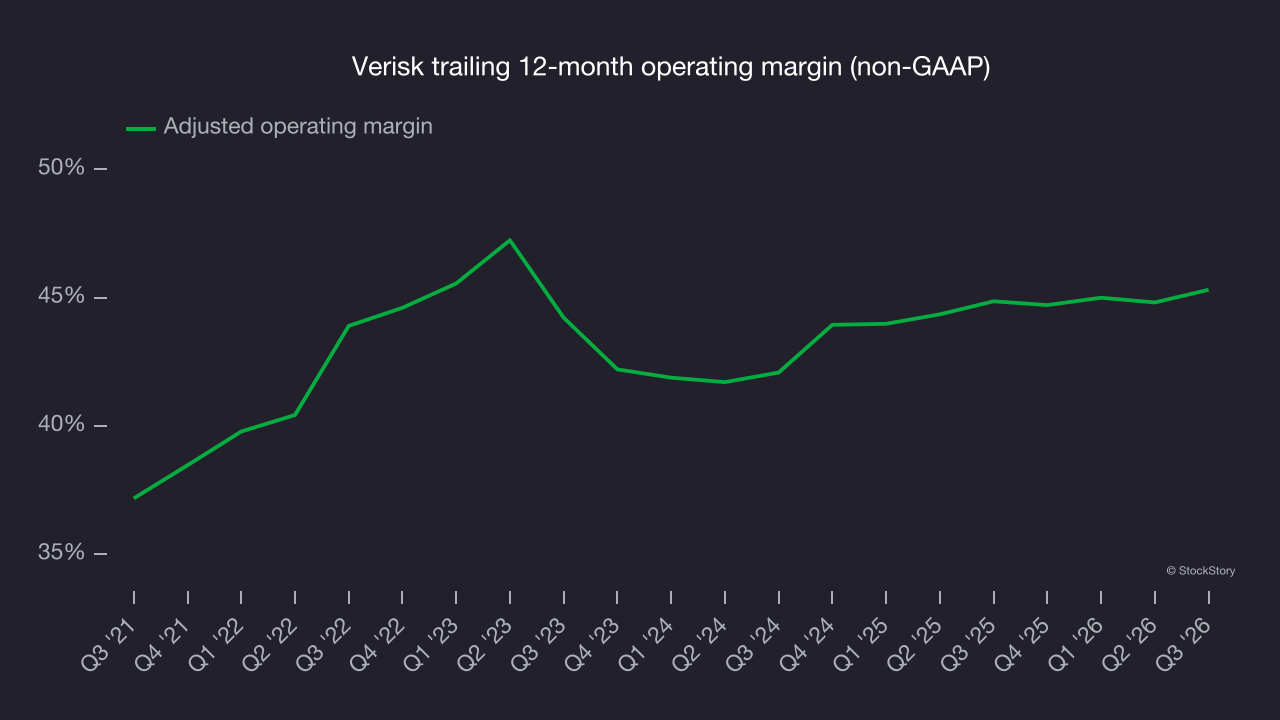
This quarter, Verisk generated an adjusted operating margin of 46.9%, up 1.9 percentage points year on year. This increase was a positive development and shows it was more efficient.
Earnings per share
Revenue trends explain a company’s historical growth, but the long-term change in earnings per share (EPS) points to the profitability of that growth. For example, a company could inflate its revenue through excessive spending on advertising and promotions.
Verisk’s EPS grew at an 8.2% compounded annual growth rate over the last five years, higher than its 1.5% annualized revenue growth. This indicates the company became more profitable on a per-share basis as it expanded.
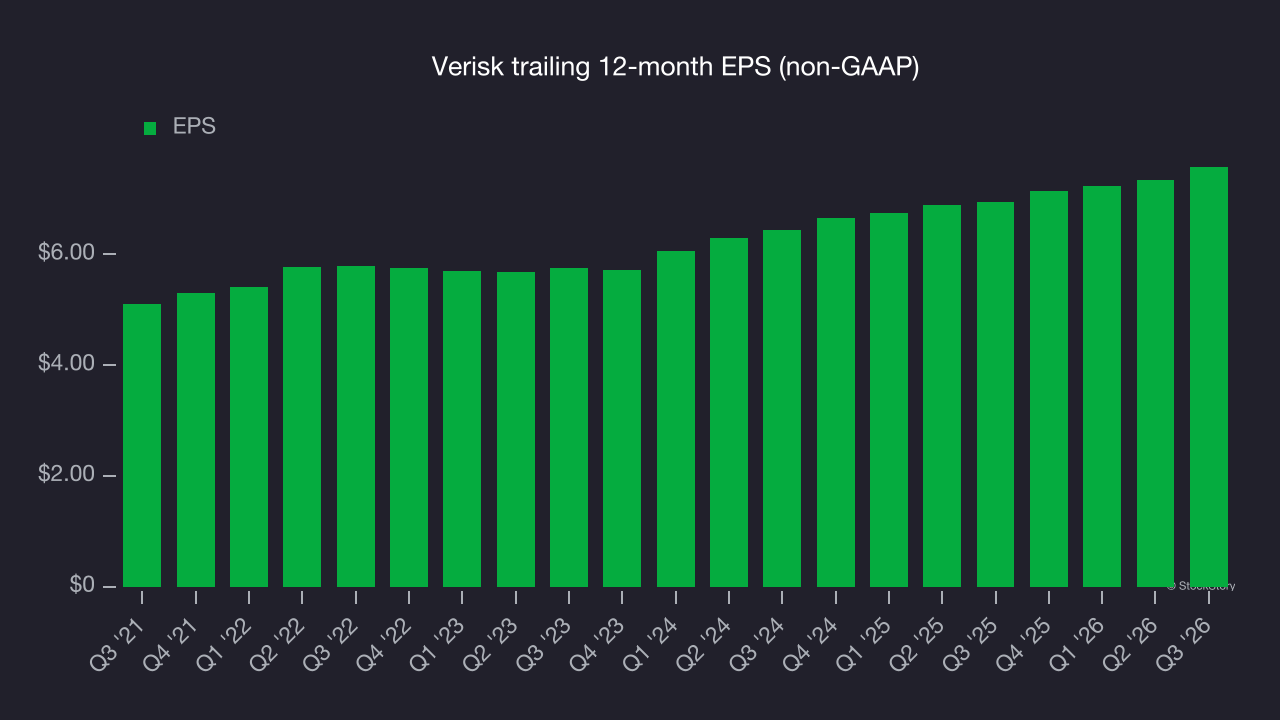
A closer look at Verisk’s earnings quality helps explain its performance. As mentioned earlier, Verisk’s adjusted operating margin expanded by 1.4 percentage points over the last five years. On top of that, its share count shrank by 20.6%. These are positive signs for shareholders because improving profitability and share buybacks boost EPS growth relative to revenue growth. 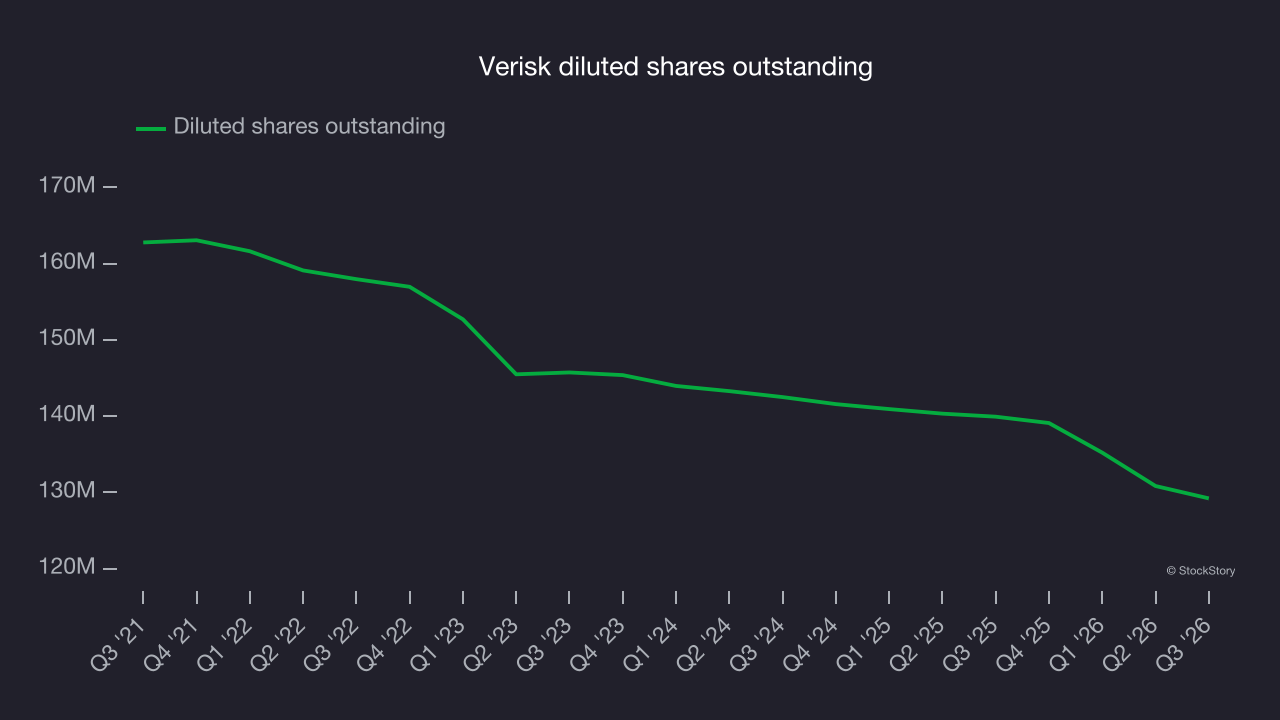
As with revenue, we analyze EPS over a more recent period because it can provide insight into an emerging theme or development for the business.
For Verisk, its two-year annual EPS growth of 8.5% is similar to its five-year trend, implying stable earnings.
In Q3, Verisk reported adjusted EPS of $1.96, up from $1.72 in the same quarter last year. This result beat analysts’ consensus estimates by 2%. Over the next 12 months, Wall Street expects Verisk’s full-year EPS to grow 11% from $7.58 to $8.42, according to S&P.
Key takeaways from Verisk’s Q3 results
Verisk’s Q3 results were mixed: EPS topped analysts’ consensus estimates, but full-year EPS guidance fell slightly short. Shares rose 4.5% to $208.26 immediately after the report.
When evaluating Verisk as an investment, the latest quarter matters, but longer-term fundamentals and valuation matter far more. Read the full research report here (it’s free).