IT solutions provider ePlus (NASDAQ: PLUS) reported revenue ahead of Wall Street’s expectations in calendar Q3 2026 (fiscal Q2 2027), with revenue up 9.7% year on year to $667.9 million. Its non-GAAP profit of $1.82 per share was 23.8% above analysts’ consensus estimates.
For more on ePlus, read our free full research report.
ePlus (PLUS) Q3 CY2026 highlights:
- Revenue $667.9 million vs S&P analysts’ consensus estimates of $636.1 million (9.7% year-on-year growth, 5% beat)
- Adjusted EPS $1.82 vs S&P analysts’ consensus estimates of $1.47 (23.8% beat)
- Adjusted EBITDA $67.1 million vs analysts’ consensus estimates of $56.85 million (10% margin, 18% beat)
- Operating margin 8.5%, in line with the same quarter last year
- Market capitalization $2.34 billion
"The accelerating adoption of AI, increasing demand for advanced data center infrastructure and growing emphasis on cybersecurity and digital transformation continue to reshape the technology landscape, creating significant opportunities for long-term growth for ePlus. As organizations accelerate investments in modernizing their IT networks and strengthening cybersecurity, our deep customer relationships and broad portfolio of products and services position us well to meet demand and support our customers' growth. These factors, combined with our strong performance year to date, support our confidence in the sustainability of our business trends and our increased full year fiscal 2027 guidance," concluded Mr. Marron.
Revenue growth
A company’s long-term revenue performance can indicate its overall quality. Any business can post a good quarter or two, but many enduring ones grow for years.
With $2.51 billion in revenue over the past 12 months, ePlus is a mid-sized business services company, which sometimes brings disadvantages compared to larger competitors benefiting from better economies of scale. On the positive side, it can still generate high growth rates because it’s working from a smaller revenue base.
ePlus grew its revenue at a solid 8.7% compounded annual growth rate over the last five years. This shows ePlus’s demand was higher than that of many business services companies.
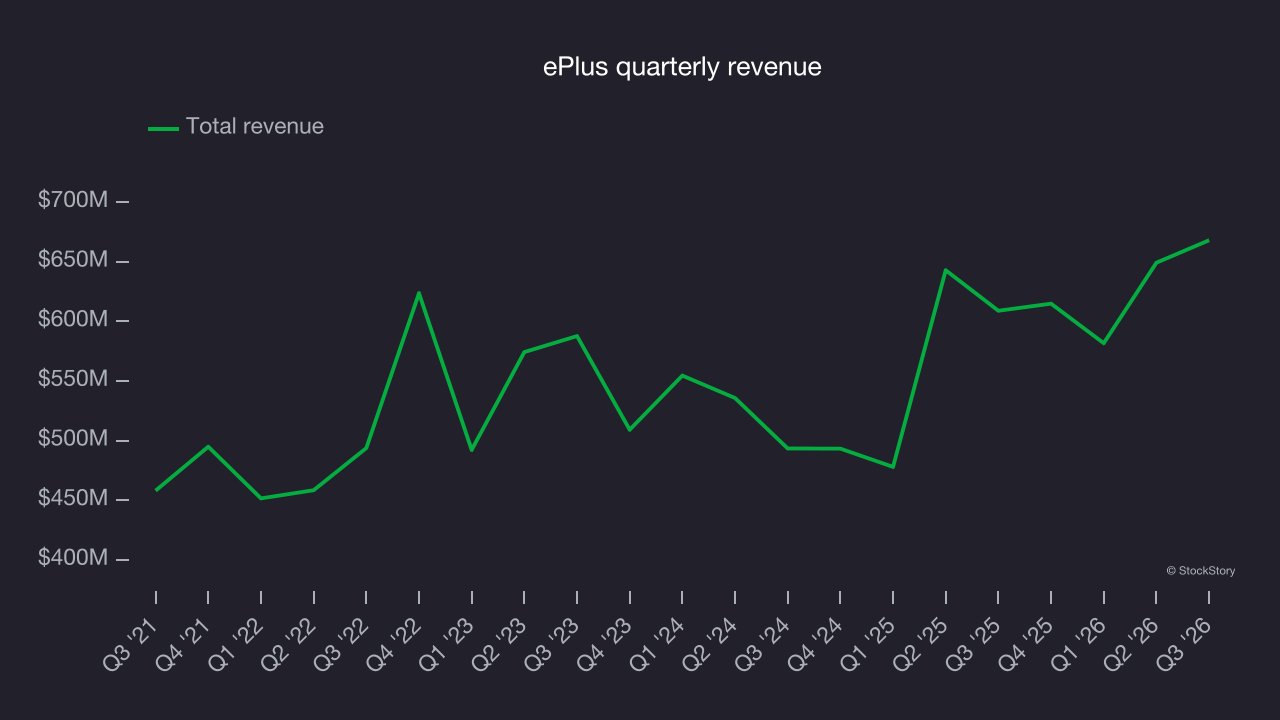
Long-term growth is the most important, but within business services, a half-decade historical view may miss new innovations or demand cycles. ePlus’s annualized revenue growth of 9.6% over the last two years aligns with its five-year trend, suggesting its demand was predictably strong. 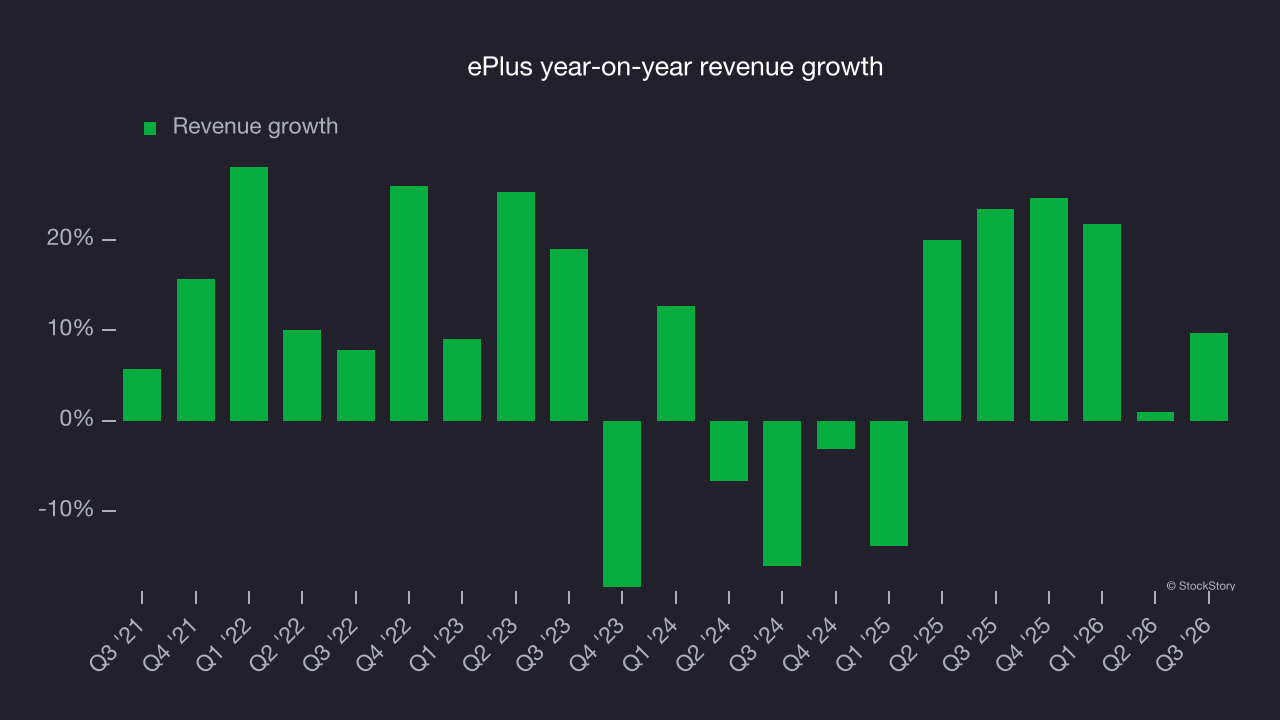
This quarter, ePlus reported year-on-year revenue growth of 9.7%, and its $667.9 million in revenue exceeded Wall Street’s consensus estimates by 5%.
Looking ahead, sell-side analysts expect revenue to grow 4.2% over the next 12 months, according to S&P, a deceleration versus the last two years. This projection is underwhelming and implies its products and services will see some demand headwinds. Still, the company is tracking well in other measures of financial health.
Adjusted operating margin
Adjusted operating margin is a key measure of profitability. Think of it as net income (the bottom line) excluding the impact of non-recurring expenses, taxes and interest on debt – items less connected to business fundamentals.
ePlus’s adjusted operating margin has risen over the last 12 months and averaged 7.5% over the last five years. Although its profitability is still paltry, its solid revenue growth is giving it operating leverage as it scales. This provides scope for higher long-term profits if it can keep expanding.
ePlus’s adjusted operating margin may have fluctuated slightly but has generally stayed the same over the last five years. This raises questions about the company’s expense base because its revenue growth should have given it leverage on its fixed costs, resulting in better economies of scale and profitability.
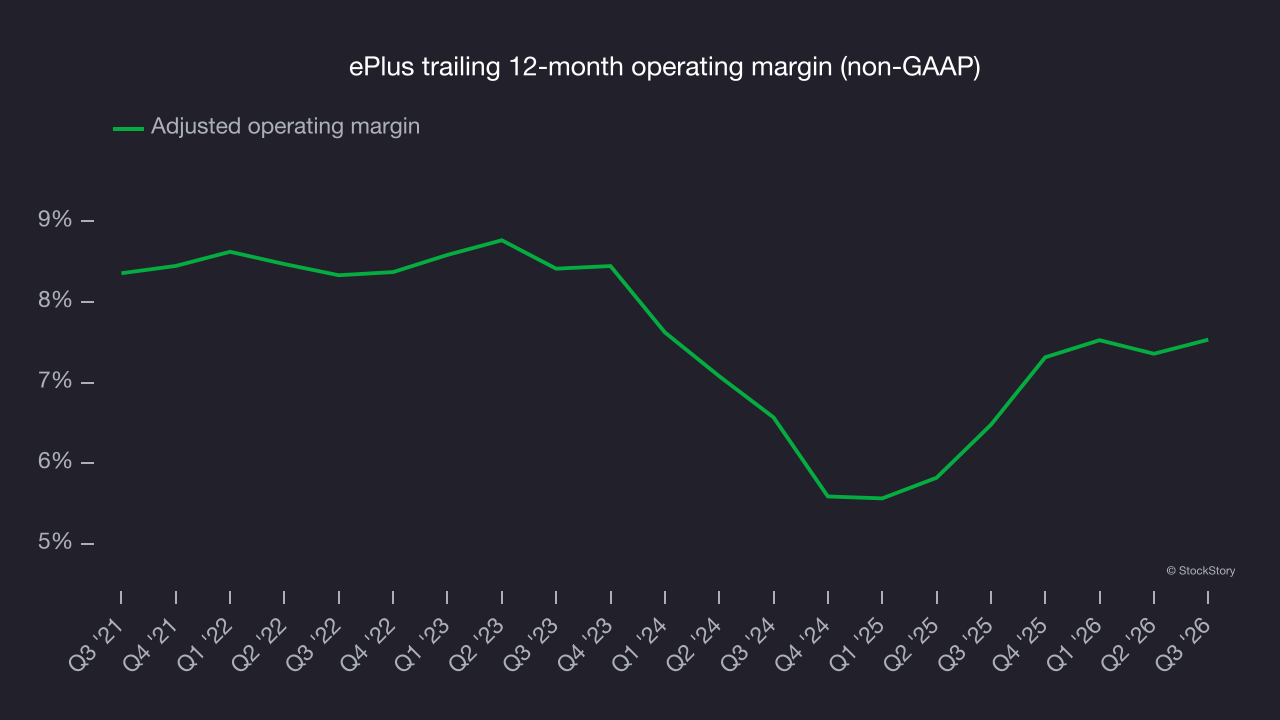
In Q3, ePlus generated an adjusted operating margin of 9.1%, in line with the same quarter last year. This indicates the company’s overall cost structure has been relatively stable.
Earnings per share
Revenue trends explain a company’s historical growth, but the long-term change in earnings per share, or EPS, points to the profitability of that growth. For example, a company could inflate its revenue through excessive spending on advertising and promotions.
ePlus’s unimpressive 7.4% annual EPS growth over the last five years aligns with its revenue performance. This tells us it maintained its per-share profitability as it expanded.
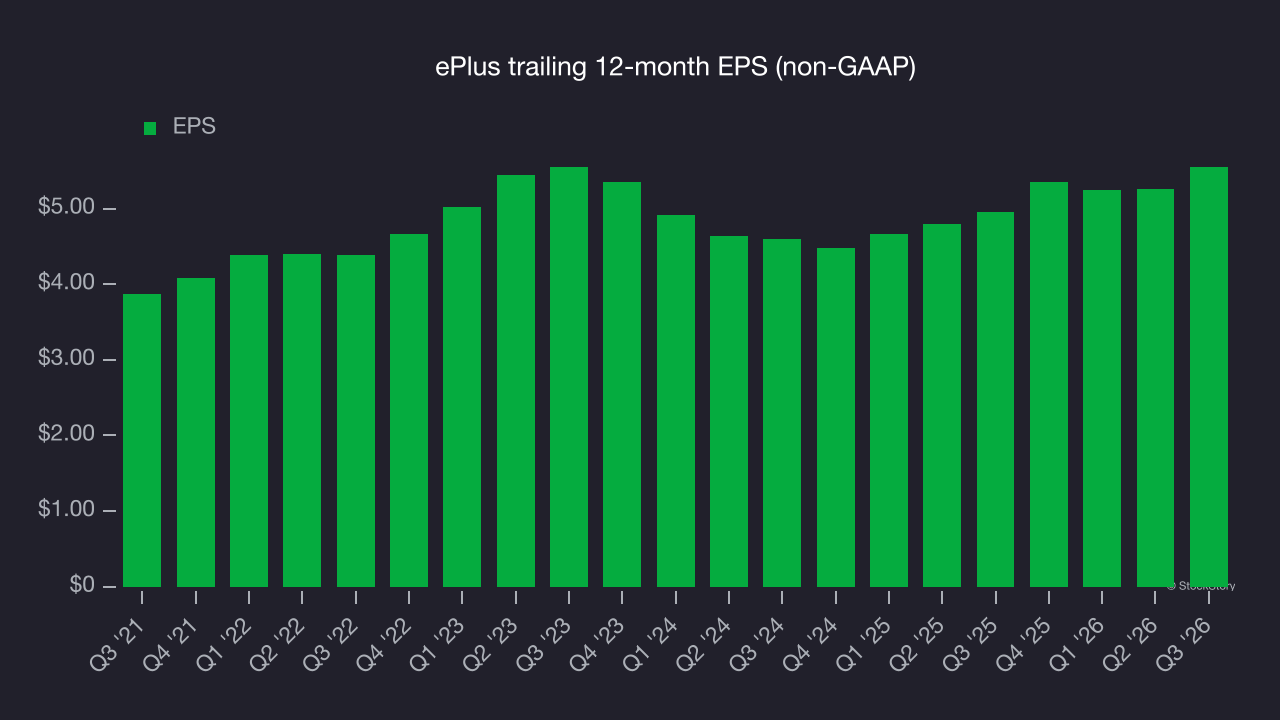
As with revenue, analyzing EPS over a shorter period can reveal changes in the business.
For ePlus, its two-year annual EPS growth of 9.8% was higher than its five-year trend. Accelerating earnings growth is almost always a positive sign.
In Q3, ePlus reported adjusted EPS of $1.82, up from $1.53 in the same quarter last year. EPS comfortably beat analysts’ consensus estimates, a positive result for shareholders. Over the next 12 months, Wall Street expects ePlus’s full-year EPS to grow 2.4% from $5.55 to $5.69, according to S&P.
Key takeaways from ePlus’s Q3 results
A wide revenue beat helped make this a solid quarter for ePlus, with EPS also topping analysts’ consensus estimates. The results had some clear positives, and shares edged higher 1.8% to $83.79 immediately after the release.
ePlus had a solid quarter, but the latest results are only one piece of the longer-term business quality picture. Quality, combined with valuation, can help determine whether the stock is a buy. For more on those factors, read our full research report here (it’s free).