Medical device company Zimmer Biomet (NYSE: ZBH) beat Wall Street’s revenue expectations in Q3 2026, with revenue up 3.1% year on year to $2.06 billion. Its non-GAAP profit of $1.90 per share was 1% above analysts’ consensus estimates.
For more on Zimmer Biomet, read our full research report for free.
Zimmer Biomet (ZBH) Q3 2026 highlights:
- Revenue $2.06 billion vs S&P analysts’ consensus estimates of $2.04 billion (3.1% year-on-year growth, 1.1% beat)
- Adjusted EPS $1.90 vs S&P analysts’ consensus estimates of $1.88 (1% beat)
- Adjusted EPS guidance Management slightly raised its full-year adjusted EPS guidance to $8.55 at the midpoint
- Operating margin 14.9%, down from 17.6% in the same quarter last year
- Free cash flow margin 18.1%, up from 13.9% in the same quarter last year
- Constant currency revenue rose 3.7% year on year (8.6% in the same quarter last year)
- Market capitalization $18.51 billion
"We are very pleased with our solid third quarter results, growing net sales 3.7% on a constant-currency basis and generating strong operating and free cash flow," said Ivan Tornos, Chairman, President and CEO of Zimmer Biomet. "Our Hips, S.E.T. and Technology & Data, Bone Cement and Surgical franchises – representing two-thirds of our book of business – grew at upper single digit or double-digit rates, validating the progress of our diversification strategy, the strength of our innovation engine and the significant strides we are making in commercial execution. This broad-based performance gives us confidence to raise our full-year organic constant-currency sales growth and adjusted EPS guidance. I'm very proud of our team and believe we will continue to build on this momentum as we advance our Mission and ultimately position the Company for sustained long-term growth."
Revenue growth
A company’s long-term revenue performance is one signal of its overall quality. Even a weak business can perform well for one or two quarters, but a high-quality one grows for years. Zimmer Biomet’s revenue grew at a tepid 3.7% annualized rate over the last five years, falling short of the healthcare sector standard.
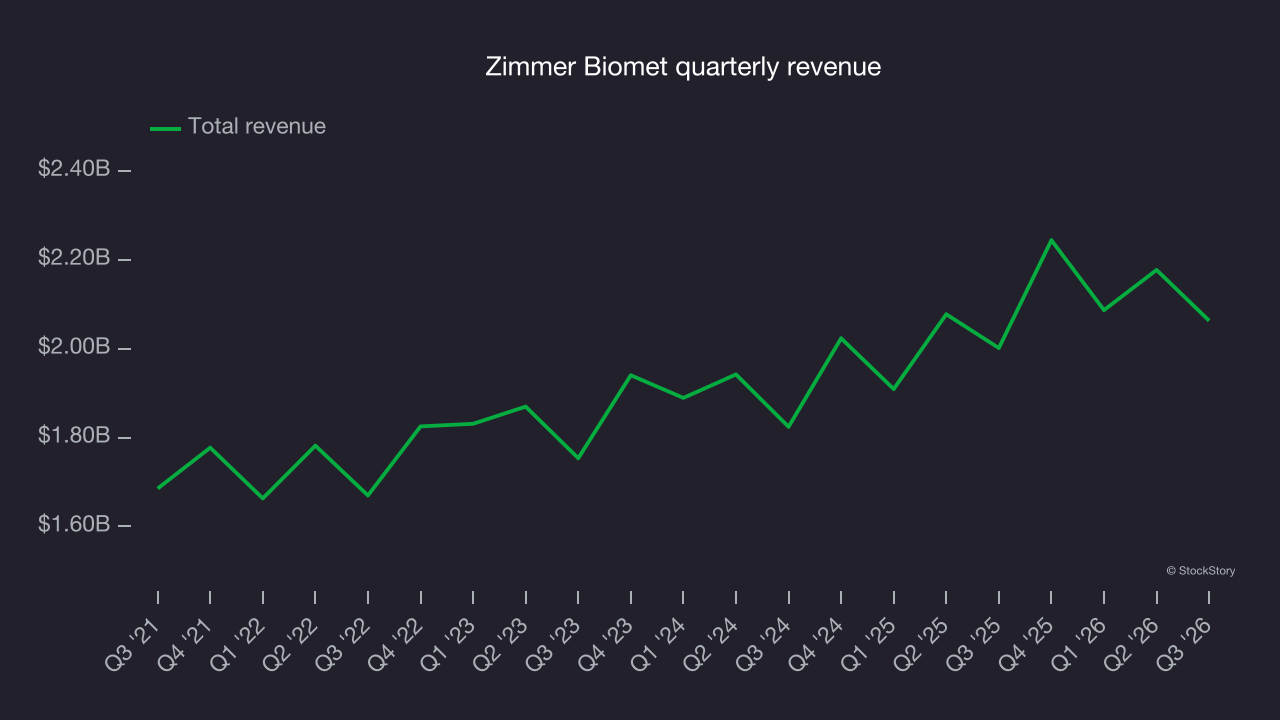
Long-term growth is the most important, but within healthcare, a half-decade historical view may miss new innovations or demand cycles. Zimmer Biomet’s annualized revenue growth of 6.2% over the last two years is above its five-year trend, a positive sign. 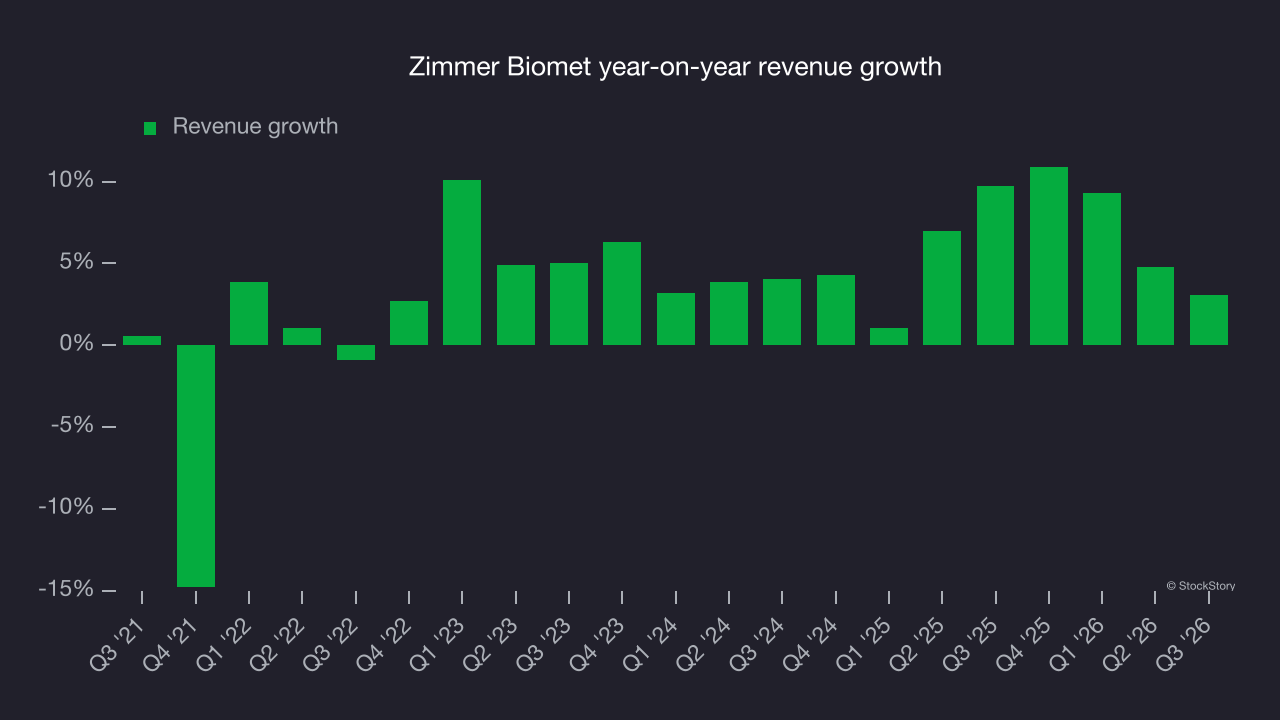
Zimmer Biomet also reports revenue performance excluding currency movements, which are outside the company’s control and not indicative of demand. Over the last two years, its constant currency revenue averaged 5.4% year-on-year growth. This was in line with reported revenue growth, indicating that foreign exchange has not had a meaningful impact on revenue. 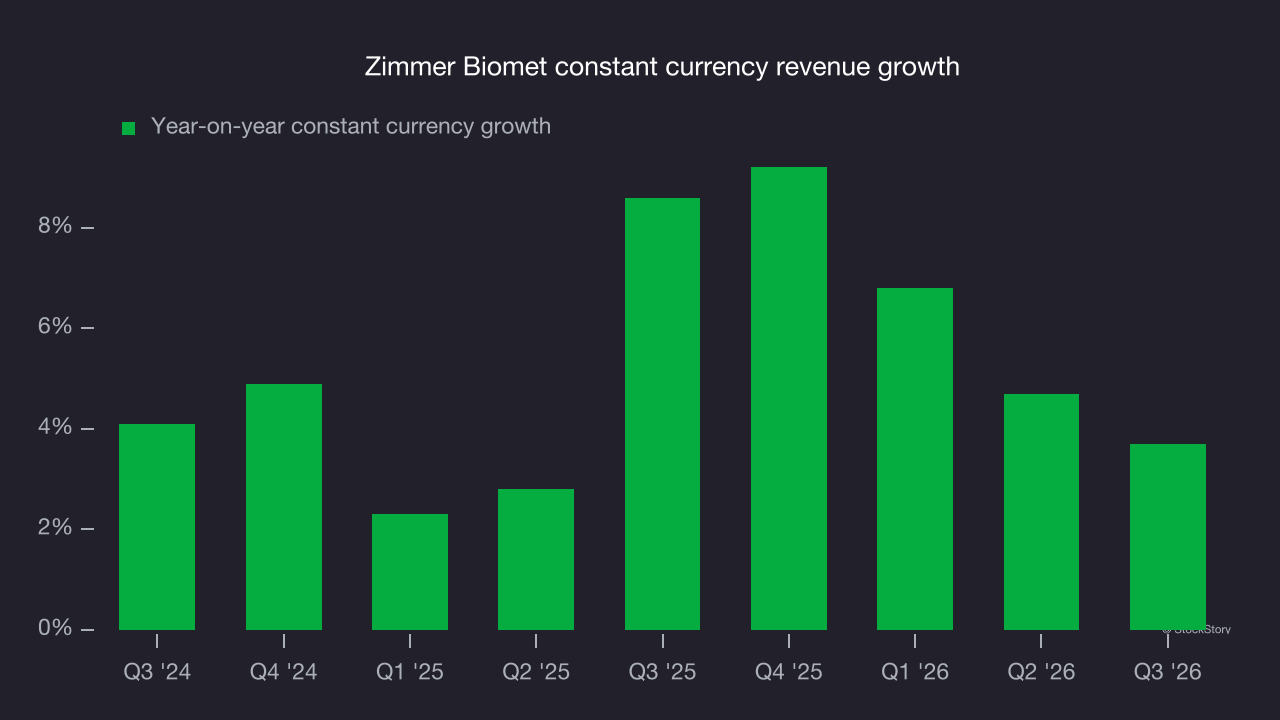
This quarter, Zimmer Biomet reported modest year-on-year revenue growth of 3.1% but beat Wall Street’s consensus estimates by 1.1%.
Looking ahead, sell-side analysts expect revenue to grow 2.9% over the next 12 months, according to S&P, a deceleration versus the last two years. This underwhelming projection indicates its products and services will face some demand challenges.
Adjusted operating margin
Adjusted operating margin is an important measure of profitability as it shows the portion of revenue left after accounting for all core expenses, everything from the cost of goods sold to advertising and wages. It’s also useful for comparing profitability across companies because it excludes non-recurring expenses, interest on debt and taxes.
Zimmer Biomet has been an efficient company over the last five years. It was one of the more profitable businesses in the healthcare sector, with an average adjusted operating margin of 27.1%.
Zimmer Biomet’s adjusted operating margin decreased by 2.5 percentage points over the last five years. The decline stemmed from more recent setbacks, as the company’s margin fell by 3.8 percentage points on a two-year basis. These disappointing results show its expenses were rising and it couldn’t pass those costs on to its customers.
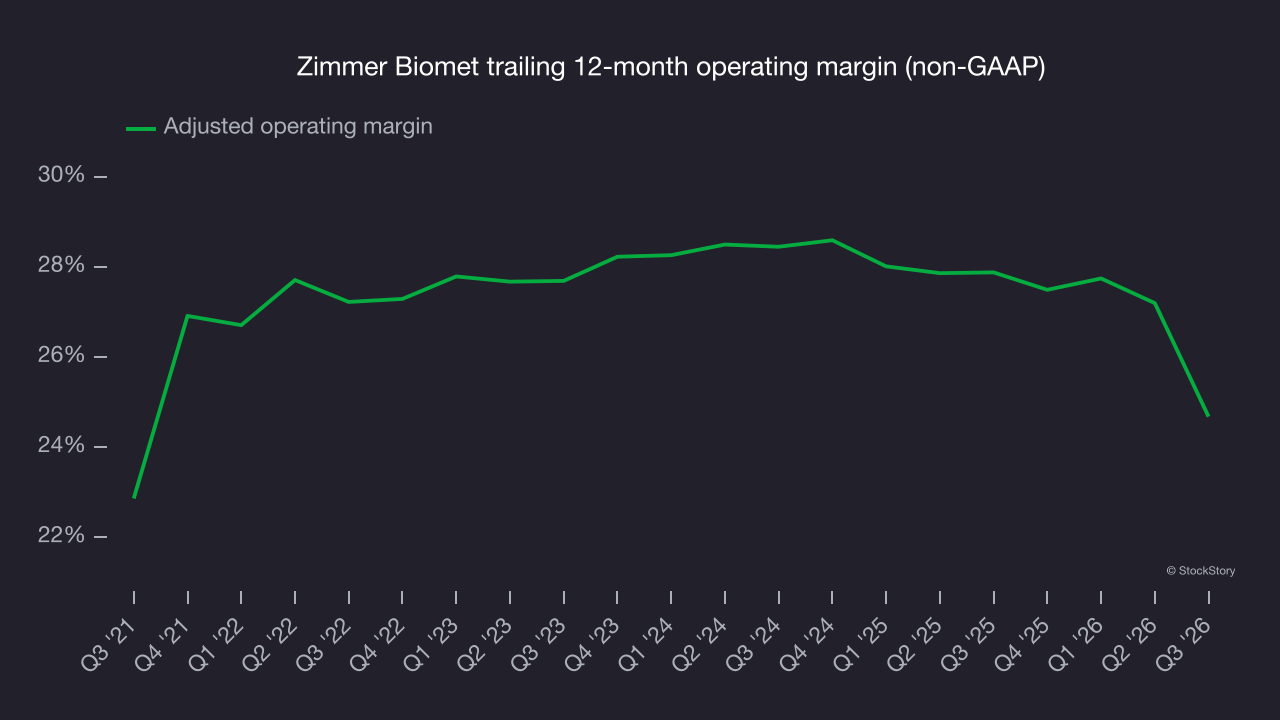
This quarter, Zimmer Biomet reported an adjusted operating margin of 16.1%, down 10.4 percentage points year on year. This contraction shows it was less efficient because its expenses grew faster than its revenue.
Earnings per share
Revenue trends explain a company’s historical growth, but the long-term change in earnings per share (EPS) points to the profitability of that growth. For example, a company could inflate its revenue through excessive spending on advertising and promotions.
Zimmer Biomet’s unimpressive 2.4% annual EPS growth over the last five years aligns with its revenue performance, indicating that it maintained its per-share profitability as it expanded.
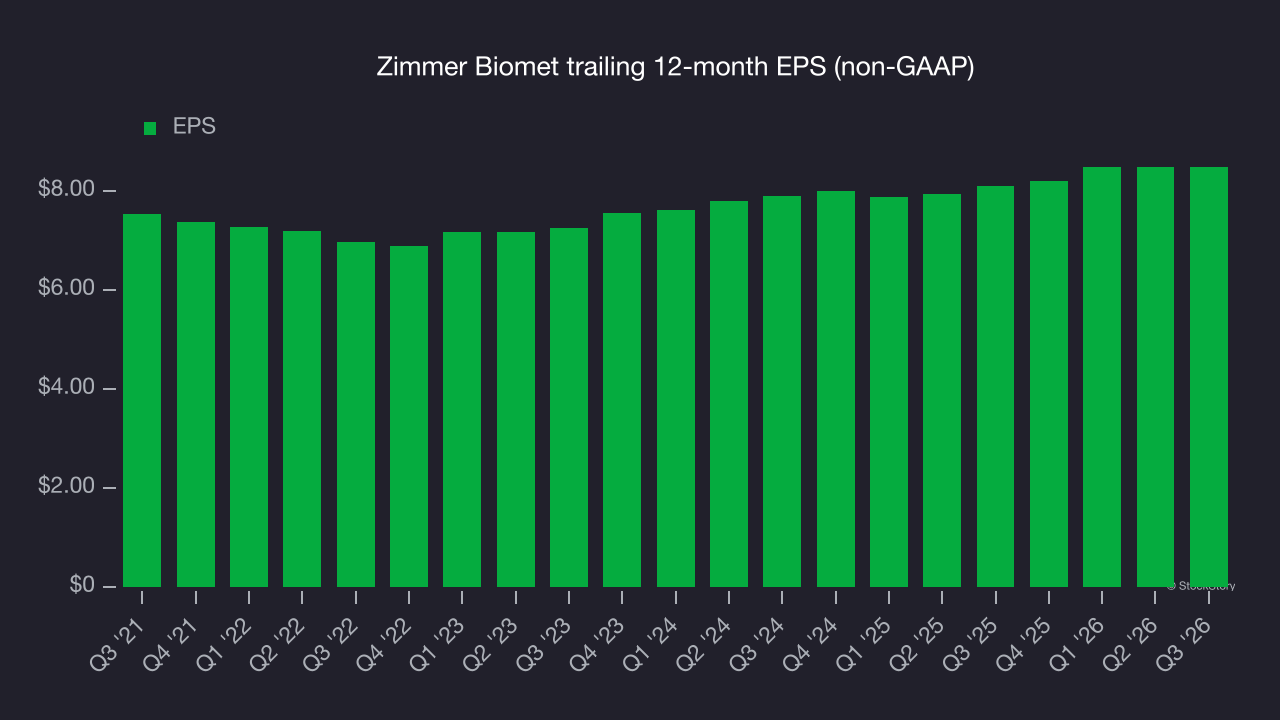
In Q3, Zimmer Biomet reported adjusted EPS of $1.90, in line with the same quarter last year. This result was close to analysts’ consensus estimates. Over the next 12 months, Wall Street expects Zimmer Biomet’s full-year EPS to grow 5.9% from $8.48 to $8.98, according to S&P.
Key takeaways from Zimmer Biomet’s Q3 results
Zimmer Biomet’s narrow revenue beat against analysts’ consensus estimates was a key positive in its Q3 results. The quarter had some positives overall, and shares remained flat at $98.01 immediately after the release.
Zimmer Biomet’s latest quarter is only one piece of the longer-term business quality picture. Quality, combined with valuation, can help determine whether the stock is a buy. Read the full research report here (it’s free).