Content discovery platform Taboola (NASDAQ: TBLA) fell short of the market’s revenue expectations in Q3 2026, with revenue falling 6.9% year on year to $462.3 million. Next quarter’s revenue guidance of $485 million underwhelmed, coming in 9.2% below analysts’ consensus estimates. Its GAAP profit of $0.06 per share was in line with analysts’ consensus estimates.
For more on Taboola, read our free full research report.
Taboola (TBLA) Q3 2026 highlights:
- Revenue $462.3 million vs S&P analysts’ consensus estimates of $466.8 million (6.9% year-on-year decline, 1% miss)
- EPS (GAAP) $0.06 vs analysts’ consensus estimates of $0.06 (in line)
- Adjusted EBITDA $56.01 million vs analysts’ consensus estimates of $54.43 million (12.1% margin, 2.9% beat)
- Revenue guidance $485 million at the midpoint for Q4 2026, below analysts’ consensus estimates of $533.9 million
- EBITDA guidance $216.5 million at the midpoint for the full year, below analysts’ consensus estimates of $233.2 million
- Operating margin 5.8%, up from 1.3% in the same quarter last year
- Free cash flow margin 4.4%, down from 9.3% in the same quarter last year
- Market capitalization $918.5 million
"In the third quarter, we delivered $189 million in ex-TAC and $56 million in Adjusted EBITDA," said Adam Singolda, CEO of Taboola. "As the open web continues to evolve, we're focused on three areas, bringing more premium publishers onto our platform, growing the revenue we generate with our existing publisher partners, and investing in complementary growth areas like Taboola News and social commerce. We believe our technology, data, scale and deep partner relationships position us well to help publishers and advertisers navigate change and capture the opportunities ahead."
Revenue growth
A company’s long-term performance is an indicator of its overall quality. Any business can deliver a good quarter or two, but the best consistently grow over the long haul.
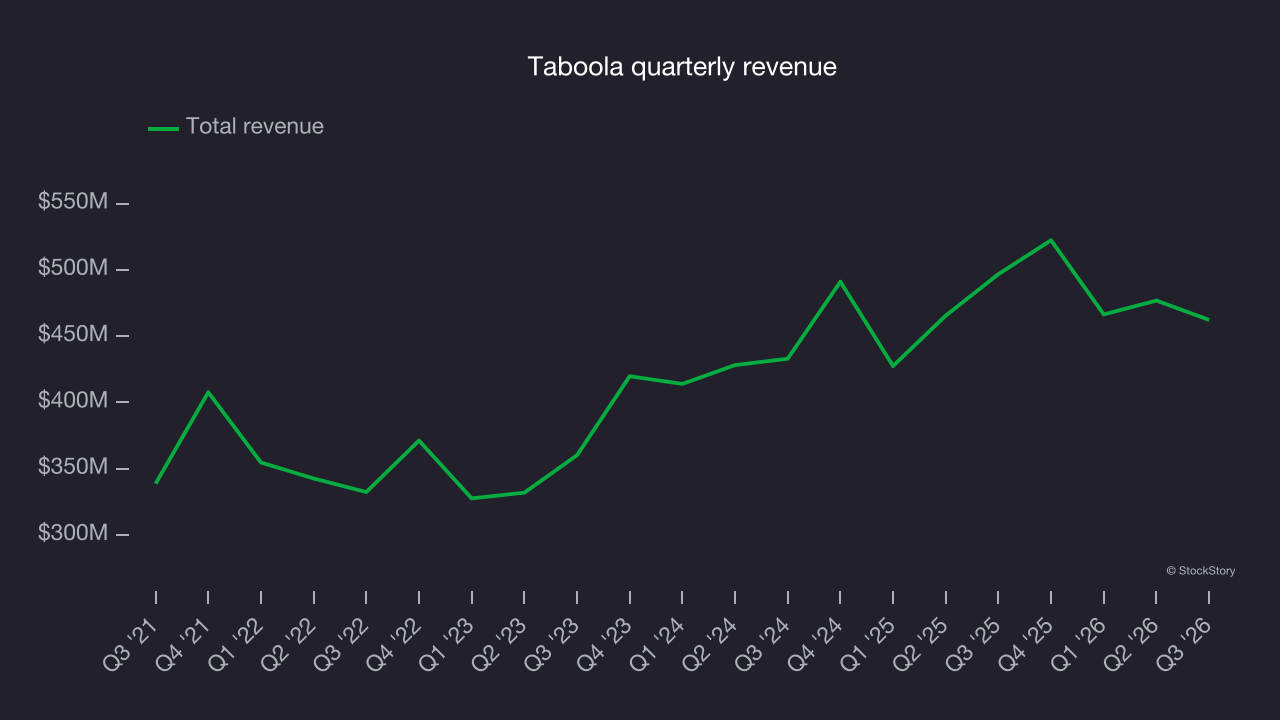
With $1.93 billion in revenue over the past 12 months, Taboola is a mid-sized business services company, which sometimes brings disadvantages compared to larger competitors benefiting from better economies of scale. On the positive side, it can still achieve high growth rates because it’s working from a smaller revenue base.
Taboola grew its revenue at a solid 7.8% compounded annual growth rate over the last five years. This shows demand for Taboola was stronger than for many business services companies.
Long-term growth matters most, but within business services, a half-decade historical view may miss recent innovations or disruptive industry trends. Taboola’s annualized revenue growth of 6.6% over the last two years is below its five-year trend, but the results were still respectable. 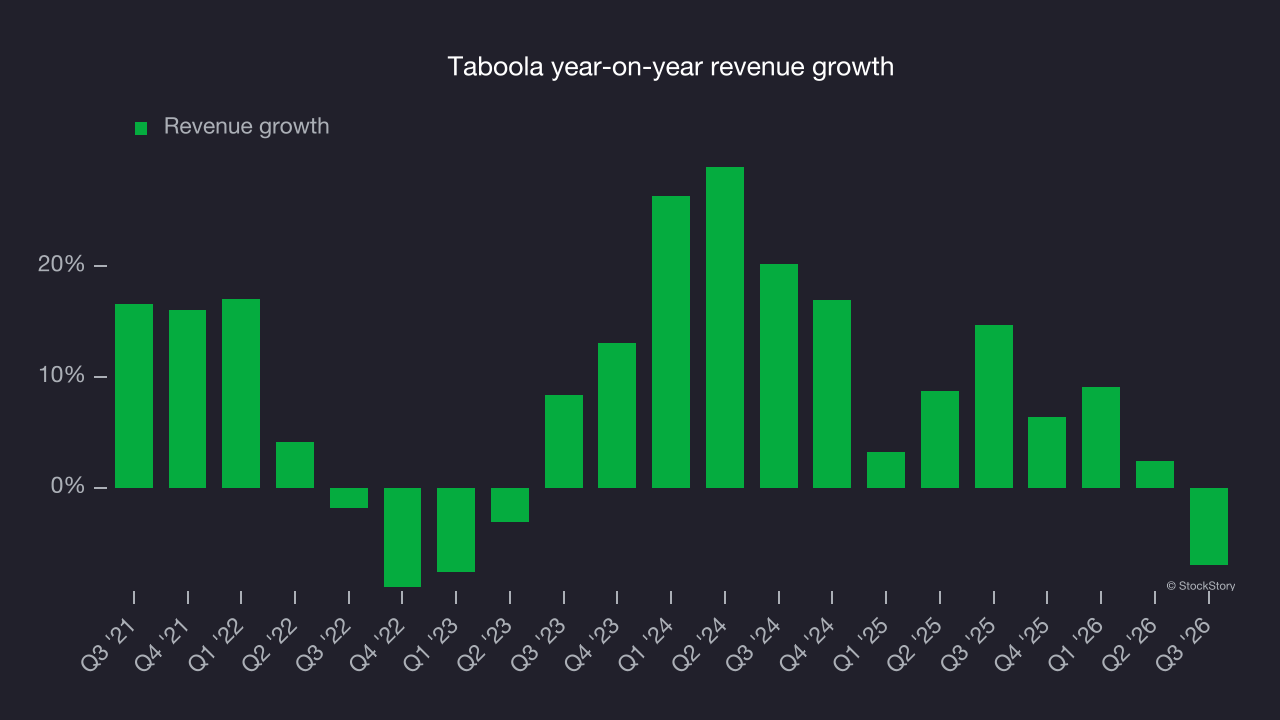
This quarter, Taboola missed Wall Street’s consensus estimates and reported an uninspiring 6.9% year-on-year revenue decline, generating $462.3 million in revenue. Management is guiding for a 7.1% year-on-year decline in revenue next quarter.
Looking further ahead, sell-side analysts expect revenue to grow 5.5% over the next 12 months, according to S&P, similar to its two-year rate. Despite the slowdown, this projection is above average for the sector and indicates the market sees some success for its newer products and services.
Adjusted operating margin
Taboola was profitable over the last five years but held back by its large cost base. Its average adjusted operating margin of 5.4% was weak for a business services business.
On the positive side, Taboola’s adjusted operating margin rose by 6.3 percentage points over the last five years, as its revenue growth provided operating leverage.
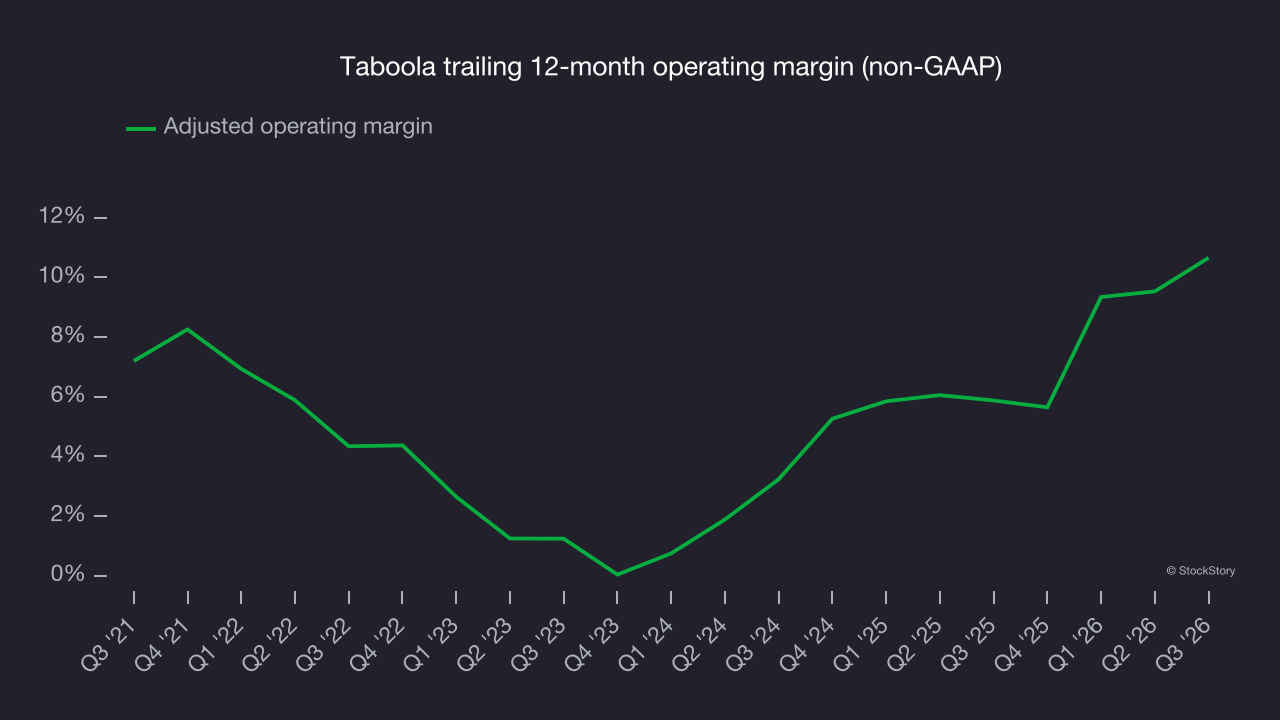
This quarter, Taboola generated an adjusted operating margin of 8.8%, up 4.3 percentage points year on year. This increase was a positive development, especially since its revenue fell, showing it became more efficient by reducing expenses.
Earnings per share
Long-term changes in earnings per share, or EPS, matter for the same reason as long-term revenue growth. Compared to revenue, however, EPS highlights whether a company’s growth is profitable.
Taboola’s full-year EPS flipped from negative to positive over the last five years. This is a good sign and shows it’s at an inflection point.
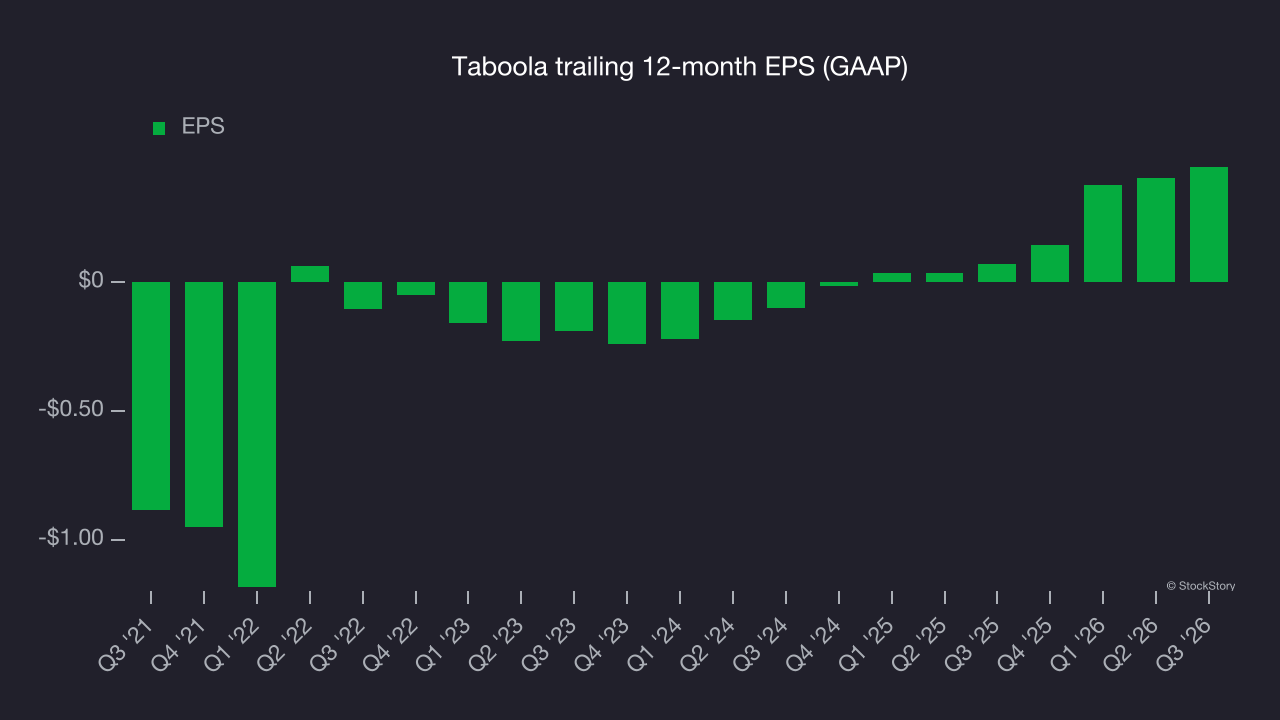
As with revenue, examining EPS over a more recent period can provide insight into an emerging theme or development for the business.
Taboola’s two-year annual EPS growth of 156% was higher than its five-year trend. That acceleration is a positive sign, especially given the already high base.
In Q3, Taboola reported EPS of $0.06, up from $0.02 in the same quarter last year. This result beat analysts’ consensus estimates by 5.9%. Over the next 12 months, Wall Street expects Taboola’s full-year EPS to shrink by 22.9% from $0.45 to $0.35, according to S&P.
Key takeaways from Taboola’s Q3 results
Taboola’s guidance left room for improvement: Both its full-year revenue outlook and next-quarter revenue forecast fell short of Wall Street’s consensus estimates. EPS met analysts’ consensus expectations, but that was not enough to make this a solid quarter. Overall, the results could have been better. Shares plunged 17.5% to $2.81 immediately after the release.
Taboola underperformed this quarter, but has that created an investment opportunity? That decision depends on its valuation, business quality and latest quarterly results. For more on Taboola, read our full research report here (it’s free).