Real estate services firm Cushman & Wakefield (NYSE: CWK) beat Wall Street’s revenue expectations in Q3 2026, with revenue up 7.7% year on year to $2.81 billion. Its non-GAAP profit of $0.37 per share was 3.8% above analysts’ consensus estimates.
For more on Cushman & Wakefield, read our free full research report.
Cushman & Wakefield (CWK) Q3 2026 highlights:
- Revenue $2.81 billion vs S&P analysts’ consensus estimates of $2.78 billion (7.7% year-on-year growth, 1.1% beat)
- Adjusted EPS $0.37 vs S&P analysts’ consensus estimates of $0.36 (3.8% beat)
- Adjusted EBITDA $183.7 million vs analysts’ consensus estimates of $182.3 million (6.5% margin, 0.8% beat)
- Operating margin 4.6%, in line with the same quarter last year
- Free cash flow margin 6.3%, down from 8.6% in the same quarter last year
- Market capitalization $3.20 billion
“Today we reported our seventh consecutive quarter of double-digit adjusted earnings per share growth, showcasing the power of our balanced platform and strategy. With $800 million in debt paydowns since 2024 our balance sheet has been transformed, and we enter this next stage of growth with increased strength, stability and optionality,” said Michelle MacKay, Chief Executive Officer of Cushman & Wakefield. “In three years, we have built a more agile and future-ready company, and the opportunity in front of us has never been greater. Our teams have consistently delivered, and we will continue to focus on converting the strength we have built into durable, profitable long-term growth.”
Revenue growth
A company’s long-term revenue performance can indicate its overall quality. Any business can have short-term success, but a top-tier one grows for years. Cushman & Wakefield’s revenue grew at a weak 9.7% compounded annual growth rate over the last five years, falling short of our standard for the consumer discretionary sector.
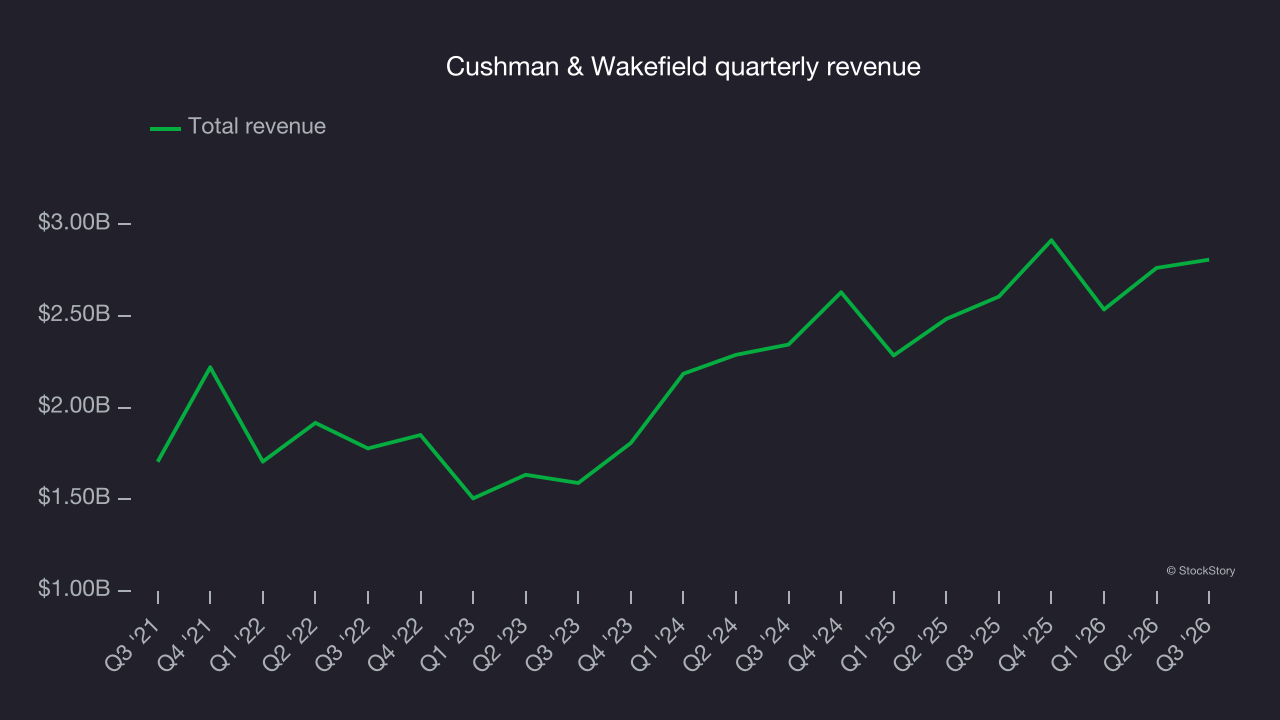
Long-term growth matters most, but within consumer discretionary, product cycles are short and revenue can be hit-driven due to rapidly changing trends and consumer preferences. Cushman & Wakefield’s annualized revenue growth of 13% over the last two years is above its five-year trend, a positive sign. 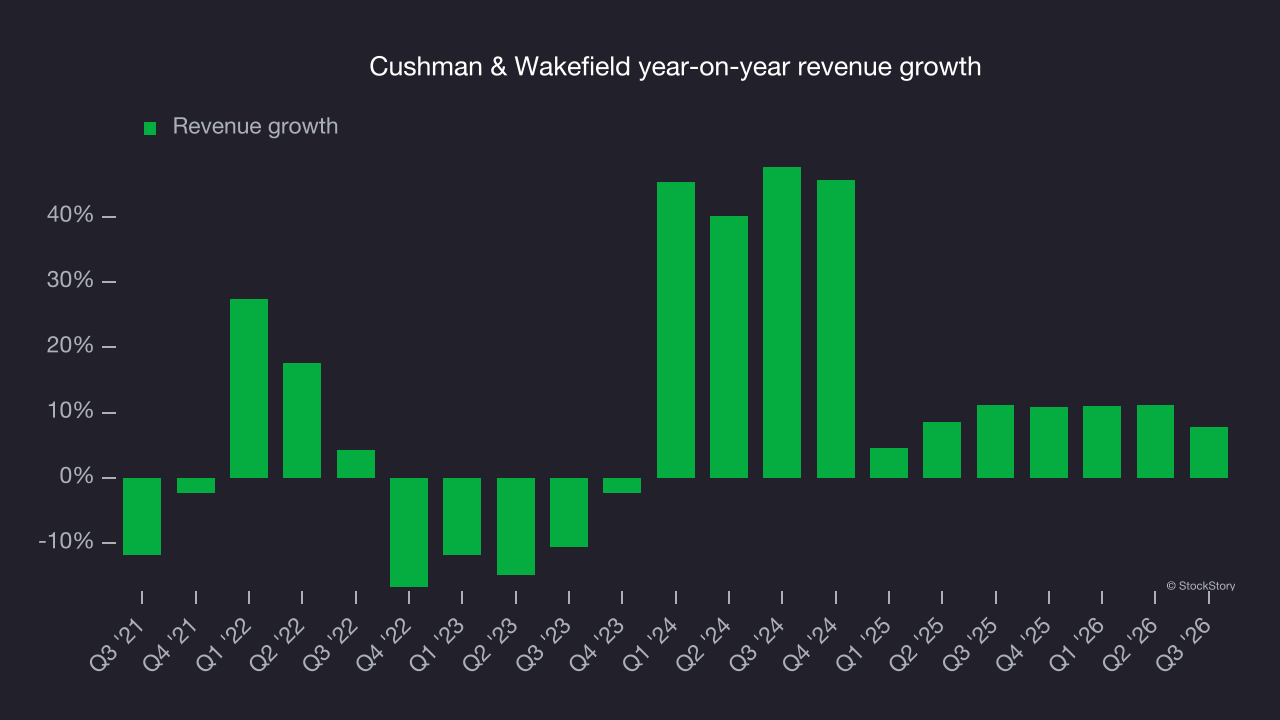
A closer look at the company’s revenue dynamics starts with its three most important segments: Management, Leasing and Capital Markets, which account for 64.9%, 22.3% and 8.6% of revenue, respectively. Over the last two years, Cushman & Wakefield’s revenue in all three segments increased. Its Management revenue (property management) averaged year-on-year growth of 53.6% while its Leasing (sourcing tenants) and Capital Markets (financial advisory) revenue averaged growth of 14.8% and 16.3%. 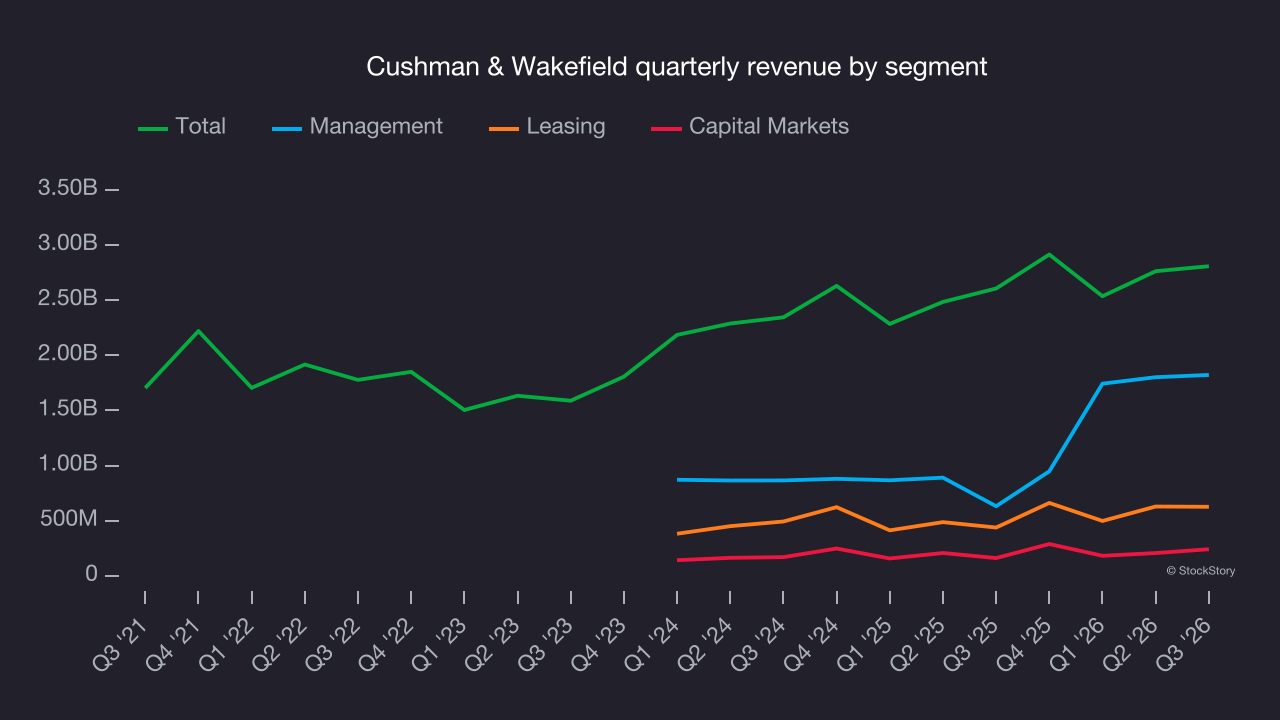
This quarter, Cushman & Wakefield reported year-on-year revenue growth of 7.7%, and its $2.81 billion in revenue exceeded Wall Street’s consensus estimates by 1.1%.
Looking ahead, sell-side analysts expect revenue to grow 5.3% over the next 12 months, according to S&P, a deceleration versus the last two years. This projection is underwhelming and implies its products and services will face some demand challenges.
Operating margin
Cushman & Wakefield’s operating margin has generally stayed the same over the last 12 months, rather than increasing as economies of scale and cost efficiency improve over time.
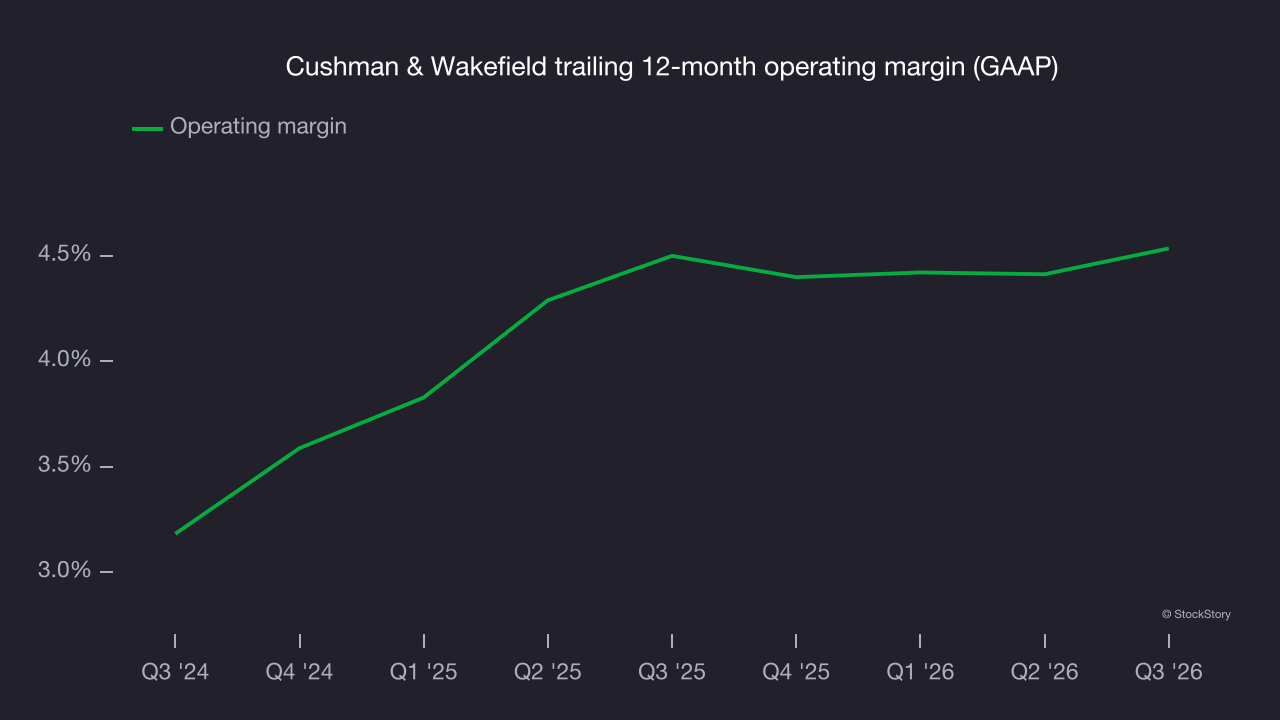
In Q3, Cushman & Wakefield generated an operating margin of 4.6%, in line with the same quarter last year. This indicates the company’s overall cost structure has been relatively stable.
Earnings per share
Revenue trends explain a company’s historical growth, but the long-term change in earnings per share (EPS) points to the profitability of that growth – for example, a company could inflate its revenue through excessive spending on advertising and promotions.
Cushman & Wakefield’s EPS declined by 1.5% annually over the last five years while its revenue grew by 9.7%. This indicates the company became less profitable on a per-share basis as it expanded.
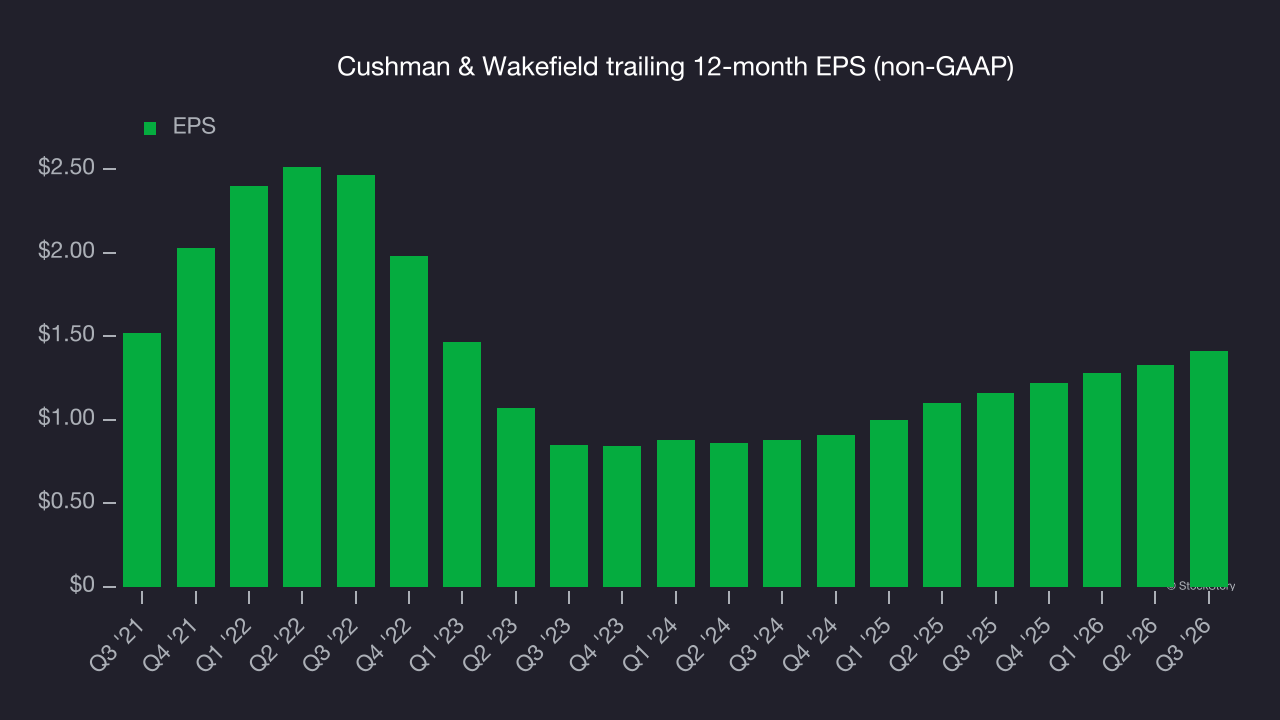
In Q3, Cushman & Wakefield reported adjusted EPS of $0.37, up from $0.29 in the same quarter last year. This result beat analysts’ consensus estimates by 3.8%. Over the next 12 months, Wall Street expects Cushman & Wakefield’s full-year EPS to grow 11.2% from $1.41 to $1.57, according to S&P.
Key takeaways from Cushman & Wakefield’s Q3 results
Cushman & Wakefield’s Q3 results had some key positives: Revenue narrowly beat analysts’ consensus estimates, and EPS also topped Wall Street’s consensus. Shares remained flat at $13.65 immediately after the release.
When evaluating Cushman & Wakefield, the latest quarter matters, but not as much as longer-term business quality and valuation when deciding whether to invest in the stock. Read the full research report here for more on those factors (it’s free).