Home services online marketplace ANGI (NASDAQ: ANGI) met Wall Street’s revenue expectations in Q3 2026, but revenue fell by 8.9% year on year to $242 million. Its GAAP profit of $0.03 per share was 73.4% below analysts’ consensus estimates.
For more on Angi, read our free full research report.
Angi (ANGI) Q3 2026 highlights:
- Revenue $242 million vs S&P analysts’ consensus estimates of $242.7 million (8.9% year-on-year decline, in line)
- EPS (GAAP) $0.03 vs analysts’ consensus estimates of $0.11 (73.4% miss partly due to accelerated depreciation on capitalized software related to the planned retirement of our legacy technology platform)
- Adjusted EBITDA $42.2 million vs analysts’ consensus estimates of $28.73 million (17.4% margin, 46.9% beat due to lower fixed expense, including reduced product development costs following the Q1 2026 reorganization, and lower variable expense)
- Operating margin 6.4%, down from 8.2% in the same quarter last year
- Free cash flow margin 5.9%, up from 4.9% in the previous quarter
- Market capitalization $234.8 million
Revenue growth
Examining a company’s long-term performance can provide clues about its quality. Any business can put up a good quarter or two, but the best consistently grow over the long haul. Angi struggled to consistently generate demand over the last three years as its revenue dropped at a 13% annual rate. That underwhelming performance suggests it is a lower-quality business.
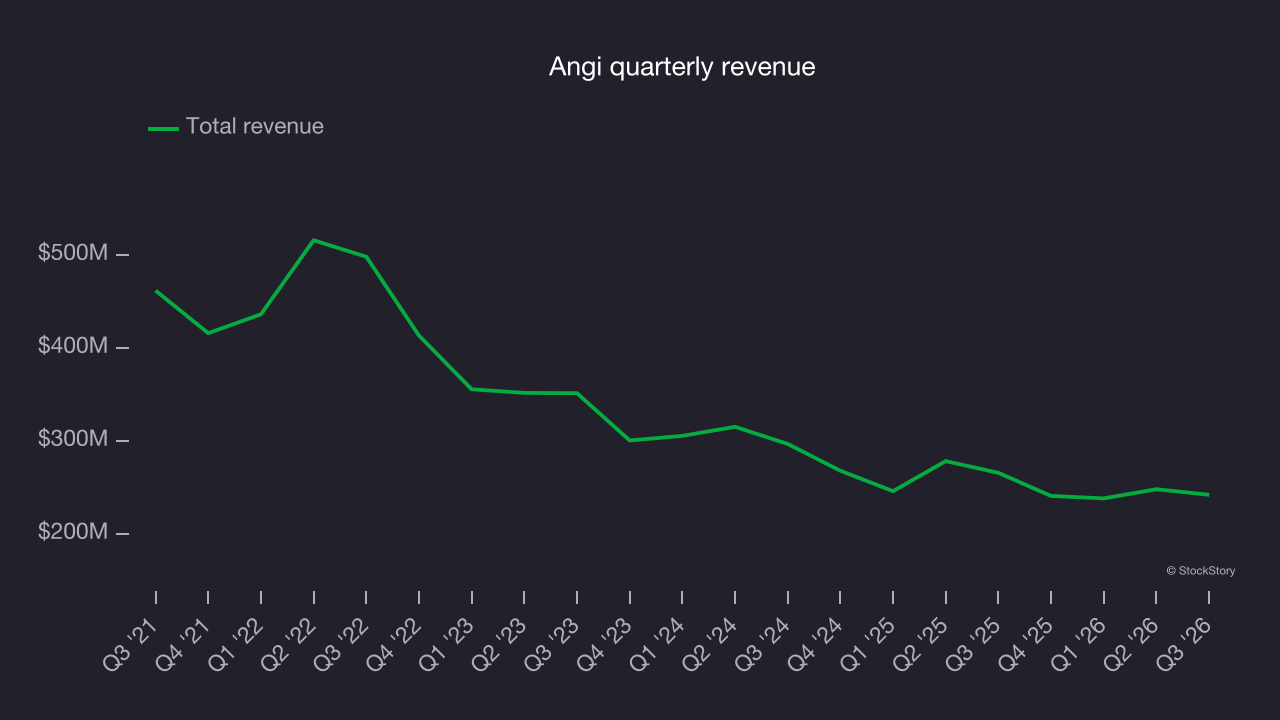
This quarter, Angi reported an uninspiring 8.9% year-on-year revenue decline to $242 million, in line with Wall Street’s consensus estimates.
Looking ahead, sell-side analysts expect revenue to decline by 3.4% over the next 12 months, according to S&P. That outlook offers little encouragement for a company struggling with demand.
Cash flow
Although EBITDA is valuable for assessing company performance, cash matters most because accounting profits alone can’t pay the bills.
Angi has shown mediocre cash profitability relative to peers over the last two years, giving the company fewer opportunities to return capital to shareholders. Its free cash flow margin averaged 3.2%, below expectations for a consumer internet business. The divergence from its good EBITDA margin stems from its capital-intensive business model, which requires Angi to make large cash investments in working capital (i.e., stocking inventories) and capex (i.e., building new facilities).
Angi’s margin dropped by 2.5 percentage points over the last few years. Along with its uninspiring margin level, that decline puts the company in a difficult position, and shareholders are likely hoping it can reverse course. If the trend continues, it could signal that the business is becoming more capital-intensive.
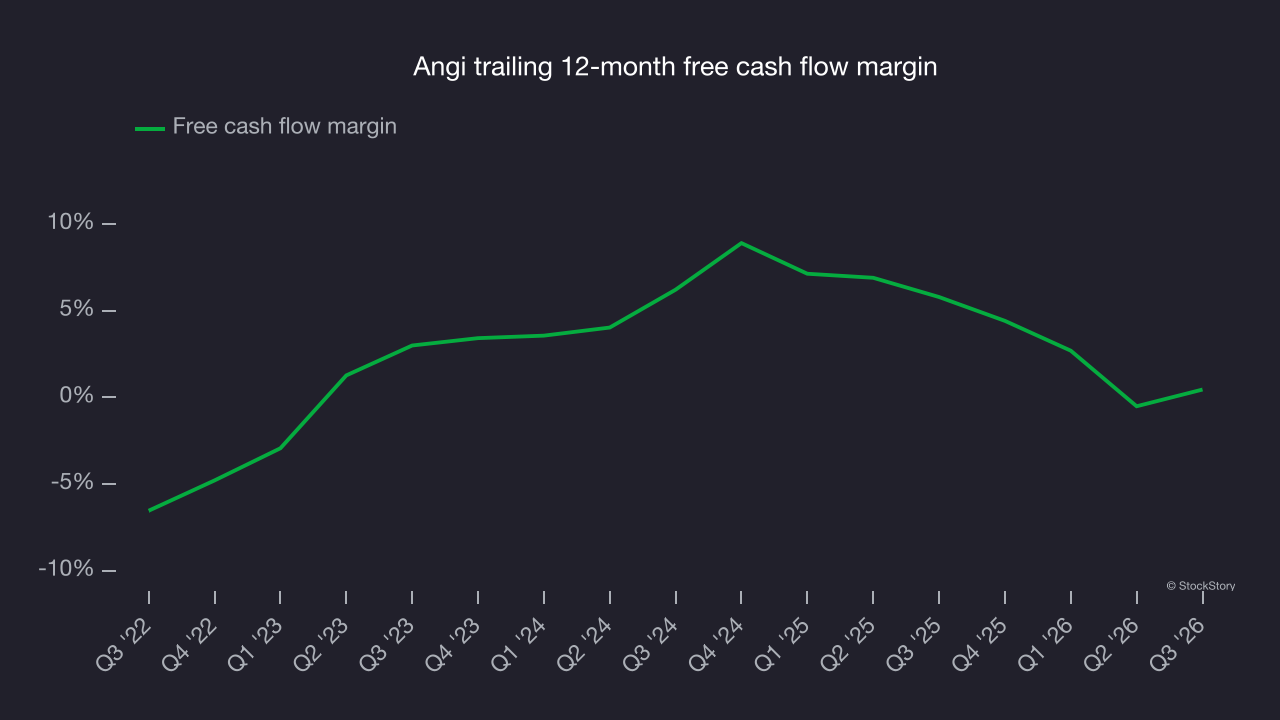
Angi’s free cash flow totaled $14.4 million in Q3, equivalent to a 5.9% margin. This was a good result, with its margin 4.1 percentage points higher than in the same quarter last year, but short-term results deserve less weight because investment needs can be seasonal, causing temporary swings. Long-term trends carry greater meaning.
Key takeaways from Angi’s Q3 results
Angi’s EBITDA beat analysts’ consensus estimates by a wide margin in Q3, the standout result in a solid quarter with some clear positives. Revenue came in as expected rather than delivering a similar beat. Shares rose 4% to $5.86 immediately after the results.
Angi had an encouraging quarter, but one earnings result doesn’t necessarily make the stock a buy. An investment decision should also consider its valuation and business quality alongside the latest quarterly results. Read our full research report here (it’s free).