Earnings results often indicate what direction a company will take in the months ahead. With Q2 behind us, let’s have a look at Haemonetics (NYSE: HAE) and its peers.
The medical devices industry operates a business model that balances steady demand with significant investments in innovation and regulatory compliance. The industry benefits from recurring revenue streams tied to consumables, maintenance services, and incremental upgrades to the latest technologies, although specialty devices are more niche. The capital-intensive nature of product development, coupled with lengthy regulatory pathways and the need for clinical validation, can weigh on profitability and timelines. In addition, there are constant pricing pressures from healthcare systems and insurers maximizing cost efficiency. Over the next several years, one tailwind is demographic–aging populations means rising chronic disease rates that drive greater demand for medical interventions and monitoring solutions. Advances in digital health, such as remote patient monitoring and smart devices, are also expected to unlock new demand by shortening upgrade cycles. On the other hand, the industry faces headwinds from pricing and reimbursement pressures as healthcare providers increasingly adopt value-based care models. Additionally, the integration of cybersecurity for connected devices adds further risk and complexity for device manufacturers.
The 7 medical devices & supplies - specialty stocks we track reported a very strong Q2. As a group, revenues beat analysts’ consensus estimates by 2.1%.
Thankfully, share prices of the companies have been resilient as they are up 5.6% on average since the latest earnings results.
Haemonetics (NYSE: HAE)
With roots dating back to 1971 and a mission to improve blood-related healthcare, Haemonetics (NYSE: HAE) provides specialized medical devices and software for blood collection, processing, and management across plasma centers, blood banks, and hospitals.
Haemonetics reported revenues of $339.4 million, up 5.6% year on year. This print exceeded analysts’ expectations by 2.8%. Overall, it was a very strong quarter for the company with a solid beat of analysts’ organic revenue and EPS estimates.
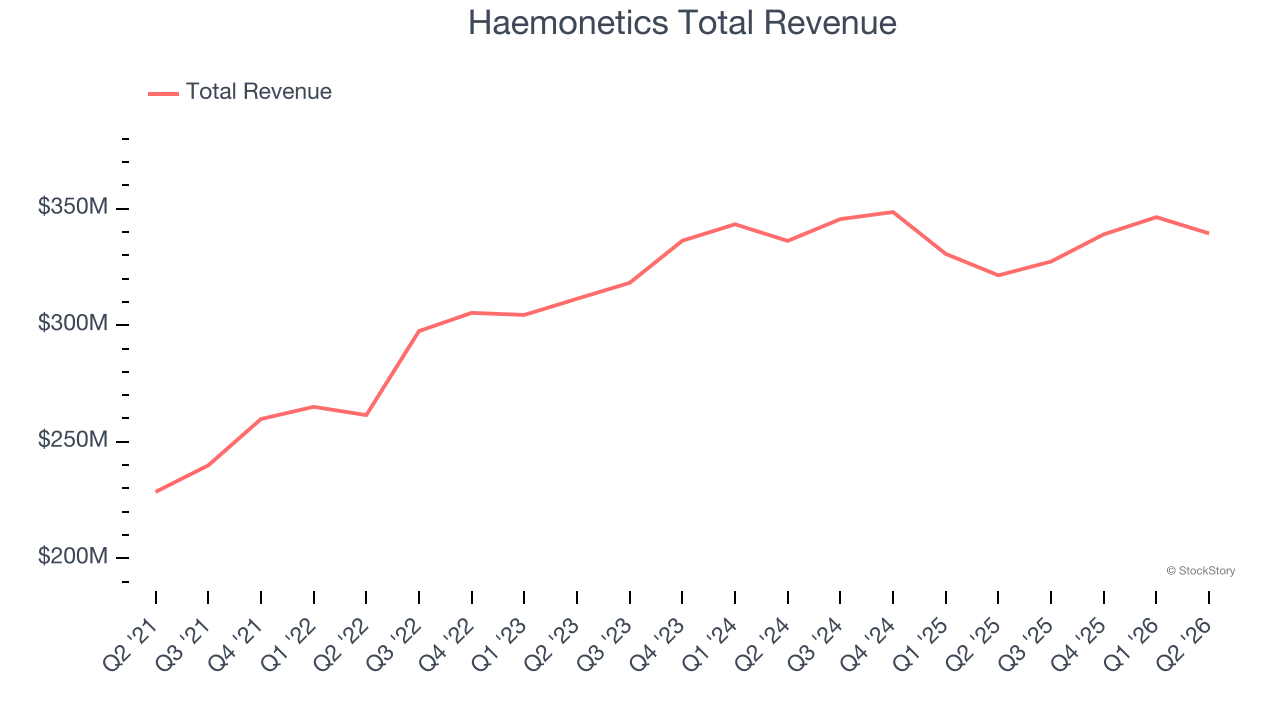
Interestingly, the stock is up 29.5% since reporting and currently trades at $108.25.
Is now the time to buy Haemonetics? Access our full analysis of the earnings results here, it’s free.
Best Q2: Inspire Medical Systems (NYSE: INSP)
Offering an alternative for the millions who struggle with traditional CPAP machines, Inspire Medical Systems (NYSE: INSP) develops and sells an implantable neurostimulation device that treats obstructive sleep apnea by stimulating nerves to keep airways open during sleep.
Inspire Medical Systems reported revenues of $200.6 million, down 7.6% year on year, outperforming analysts’ expectations by 3%. The business had an exceptional quarter with a beat of analysts’ EPS estimates and an impressive beat of analysts’ full-year EPS guidance estimates.
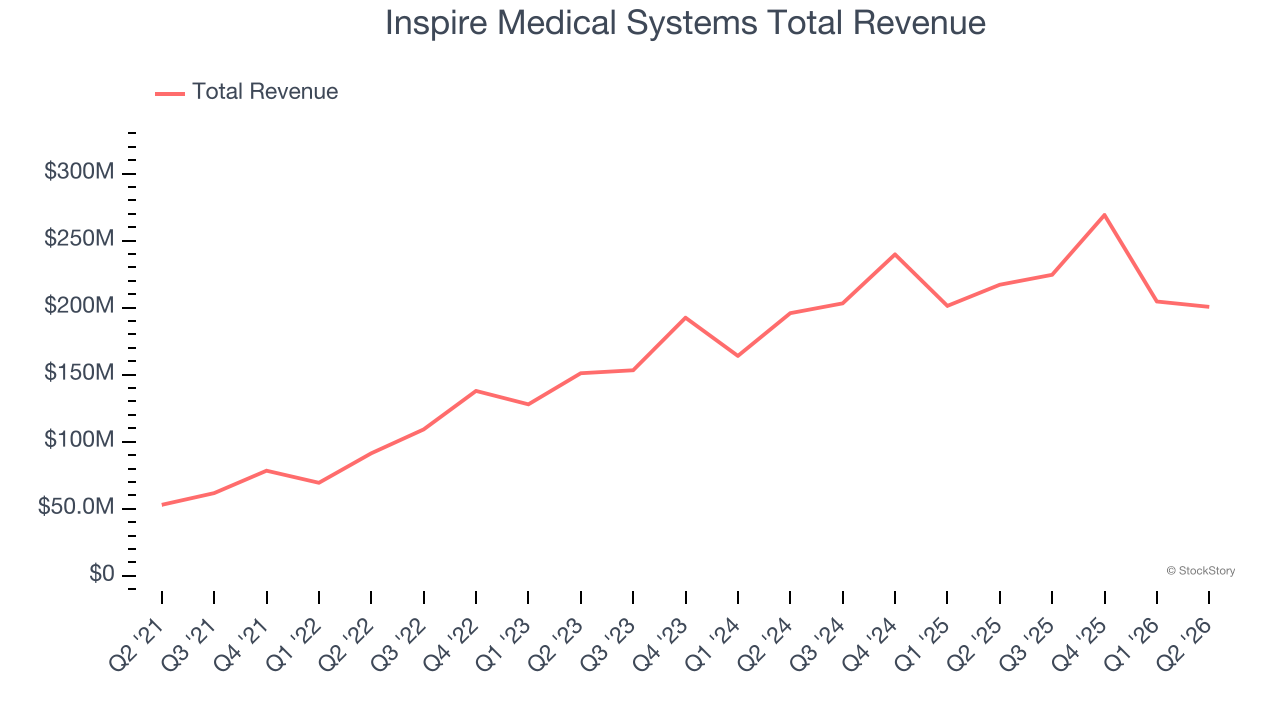
Inspire Medical Systems pulled off the highest full-year guidance raise of the whole group. The market seems happy with the results as the stock is up 20.4% since reporting. It currently trades at $62.89.
Is now the time to buy Inspire Medical Systems? Access our full analysis of the earnings results here, it’s free.
Weakest Q2: Enovis (NYSE: ENOV)
With a focus on helping patients regain or maintain their natural motion, Enovis (NYSE: ENOV) develops and manufactures medical devices for orthopedic care, from injury prevention and pain management to joint replacement and rehabilitation.
Enovis reported revenues of $582.8 million, up 3.2% year on year, in line with analysts’ expectations. It was a mixed quarter as it posted a beat of analysts’ EPS estimates but a slight miss of analysts’ full-year EPS guidance estimates.
Enovis delivered the weakest performance against analyst estimates and weakest full-year guidance update among its peers. As expected, the stock is down 13.3% since the results and currently trades at $26.17.
Read our full analysis of Enovis’s results here.
Integer Holdings (NYSE: ITGR)
With its name reflecting the mathematical term for "whole" or "complete," Integer Holdings (NYSE: ITGR) is a medical device outsource manufacturer that produces components and systems for cardiac, vascular, neurological, and other medical applications.
Integer Holdings reported revenues of $464.1 million, down 2.6% year on year. This result topped analysts’ expectations by 3%. It was an exceptional quarter as it also logged a solid beat of analysts’ organic revenue estimates and a beat of analysts’ EPS estimates.
The stock is up 3.3% since reporting and currently trades at $125.22.
Read our full, actionable report on Integer Holdings here, it’s free.
Bausch + Lomb (NYSE: BLCO)
With a nearly 170-year history dedicated to vision care and eye health innovation, Bausch + Lomb (NYSE: BLCO) develops and manufactures a comprehensive range of eye health products including contact lenses, pharmaceuticals, surgical devices, and consumer eye care solutions.
Bausch + Lomb reported revenues of $1.39 billion, up 9.1% year on year. This number beat analysts’ expectations by 1.7%. Zooming out, it was a satisfactory quarter as it also recorded full-year revenue guidance meeting analysts’ expectations but EPS in line with analysts’ estimates.
The stock is up 3.6% since reporting and currently trades at $17.21.
Read our full, actionable report on Bausch + Lomb here, it’s free.
Market Update
Over the past year, investors have been forced to repeatedly answer the same question: what is the market’s biggest risk? The answer has changed several times, and each shift has reshaped market leadership.
Late in 2025 and early 2026, artificial intelligence became the market’s primary uncertainty. Investors questioned whether AI would erode software pricing power and weaken competitive moats as AI made it easier to replicate once-differentiated products.
By the spring, technology took a back seat to geopolitics. The U.S. conflict with Iran briefly became the market’s dominant narrative, raising concerns about oil prices, inflation, and global growth. But as energy markets remained orderly and fears of a prolonged supply disruption faded, investors quickly turned their focus back to fundamentals.
Want to invest in winners with rock-solid fundamentals? Check out our Top 6 Stocks and add them to your watchlist. These companies are poised for growth regardless of the political or macroeconomic climate.