Wrapping up Q2 earnings, we look at the numbers and key takeaways for the consumer discretionary - travel and vacation providers stocks, including Royal Caribbean (NYSE: RCL) and its peers.
The Consumer Discretionary sector, by definition, is made up of companies selling non-essential goods and services. When economic conditions deteriorate or tastes shift, consumers can easily cut back or eliminate these purchases. For long-term investors with five-year holding periods, this creates a structural challenge: the sector is inherently hit-driven, with low switching costs and fickle customers. As a result, only a handful of companies can reliably grow demand and compound earnings over long periods, which is why our bar is high and High Quality ratings are rare. Travel and vacation providers operate tour packages, cruise lines, online travel agencies, and vacation rental platforms, connecting consumers with leisure and business travel experiences. Tailwinds include robust post-pandemic travel demand, a consumer preference shift toward experiences over goods, and technology-enabled personalization improving conversion and loyalty. However, headwinds are significant: the industry is acutely sensitive to macroeconomic cycles, geopolitical instability, and fuel price volatility. Low switching costs mean fierce price competition, while capacity additions in segments like cruises can lead to oversupply. Regulatory burdens, weather disruptions, and public health risks further create episodic but potentially severe demand shocks.
The 19 consumer discretionary - travel and vacation providers stocks we track reported a satisfactory Q2. As a group, revenues beat analysts’ consensus estimates by 1.3% while next quarter’s revenue guidance was 0.6% above.
While some consumer discretionary - travel and vacation providers stocks have fared somewhat better than others, they have collectively declined. On average, share prices are down 3.9% since the latest earnings results.
Royal Caribbean (NYSE: RCL)
Established in 1968, Royal Caribbean Cruises (NYSE: RCL) is a global cruise vacation company renowned for its innovative and exciting cruise experiences.
Royal Caribbean reported revenues of $4.83 billion, up 6.5% year on year. This print was in line with analysts’ expectations, and overall, it was a satisfactory quarter for the company with full-year EPS guidance topping analysts’ expectations.
"The strong second quarter performance demonstrates the continued strength of our brands, the appeal of our vacation experiences, and the momentum in our business," said Jason Liberty, Chairman and CEO, Royal Caribbean Group.
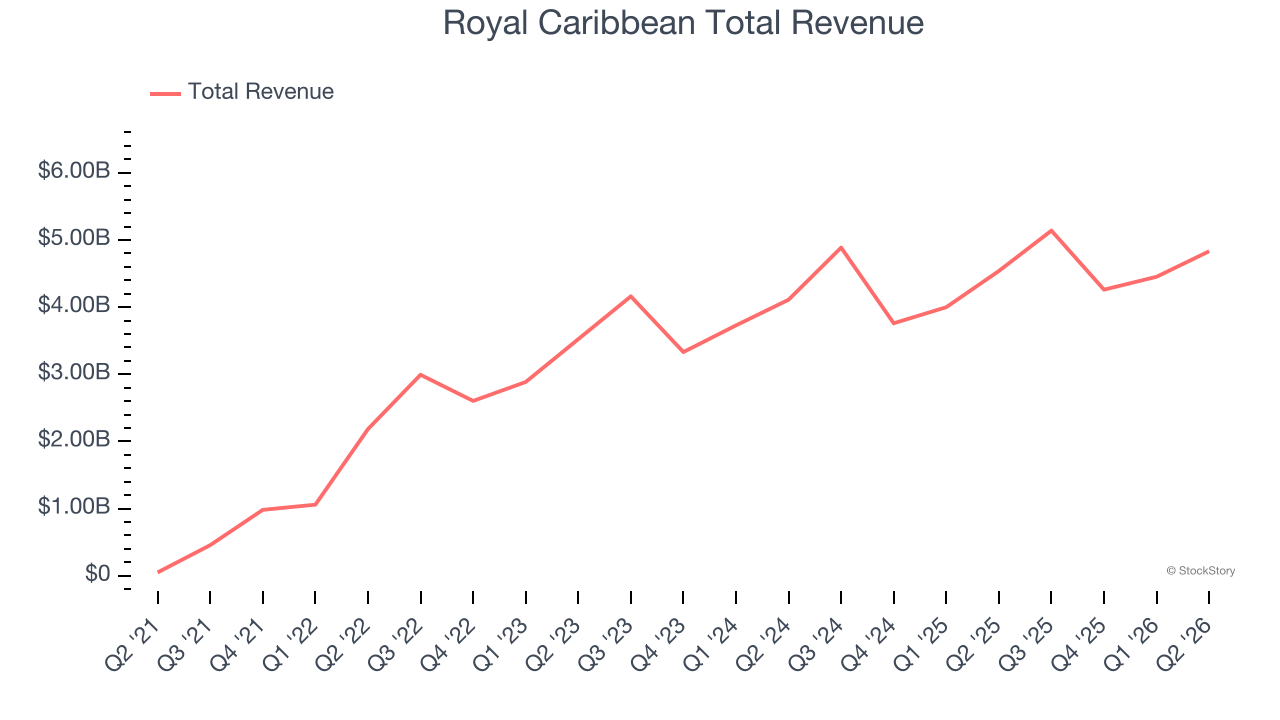
Even though it had a relatively good quarter, the market seems discontent with the results. The stock is down 5.3% since reporting and currently trades at $288.90.
Is now the time to buy Royal Caribbean? Access our full analysis of the earnings results here, it’s free.
Best Q2: Target Hospitality (NASDAQ: TH)
Building mini-communities at places such as oil drilling sites, Target Hospitality (NASDAQ: TH) is a provider of specialty workforce lodging accommodations and services.
Target Hospitality reported revenues of $85.46 million, up 38.7% year on year, outperforming analysts’ expectations by 7.8%. The business had an incredible quarter with a beat of analysts’ EPS estimates and a solid beat of analysts’ EBITDA estimates.
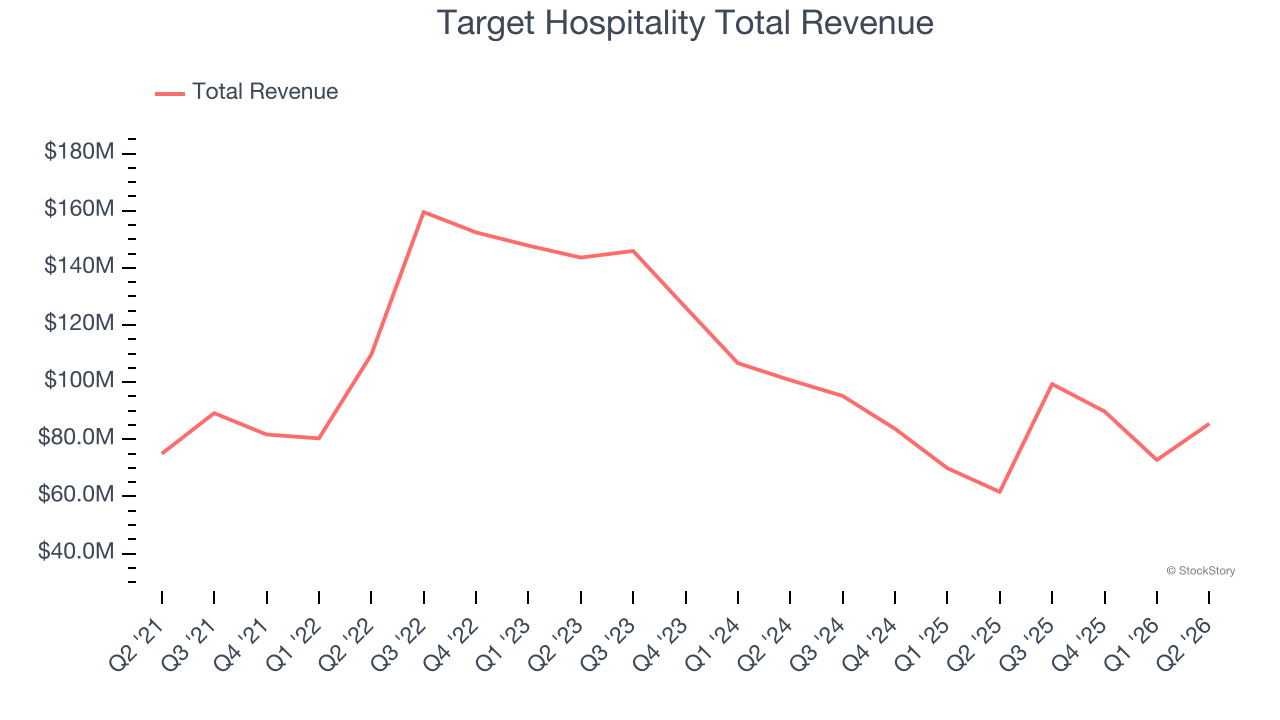
Target Hospitality pulled off the biggest analyst estimate beat, fastest revenue growth, and highest full-year guidance raise among its peers. The market seems happy with the results as the stock is up 6.8% since reporting. It currently trades at $17.63.
Is now the time to buy Target Hospitality? Access our full analysis of the earnings results here, it’s free.
Weakest Q2: Hilton Grand Vacations (NYSE: HGV)
Spun off from Hilton Worldwide in 2017, Hilton Grand Vacations (NYSE: HGV) is a global timeshare company that provides travel experiences for its customers through its timeshare resorts and club membership programs.
Hilton Grand Vacations reported revenues of $1.36 billion, up 7.3% year on year, falling short of analysts’ expectations by 2.7%. It was a softer quarter as it posted a significant miss of analysts’ EPS estimates and a miss of analysts’ EBITDA estimates.
As expected, the stock is down 13.3% since the results and currently trades at $44.60.
Read our full analysis of Hilton Grand Vacations’s results here.
Choice Hotels (NYSE: CHH)
With almost 100% of its properties under franchise agreements, Choice Hotels (NYSE: CHH) is a hotel franchisor known for its diverse brand portfolio including Comfort Inn, Quality Inn, and Clarion.
Choice Hotels reported revenues of $440.8 million, up 3.4% year on year. This print topped analysts’ expectations by 2.9%. Overall, it was a satisfactory quarter as it also recorded a decent beat of analysts’ EBITDA estimates.
The stock is flat since reporting and currently trades at $109.24.
Read our full, actionable report on Choice Hotels here, it’s free.
Marriott Vacations (NYSE: VAC)
Spun off from Marriott International in 1984, Marriott Vacations (NYSE: VAC) is a vacation company providing leisure experiences for travelers around the world.
Marriott Vacations reported revenues of $1.32 billion, up 5.9% year on year. This number surpassed analysts’ expectations by 2.1%. Overall, it was a very strong quarter as it also logged full-year EBITDA guidance beating analysts’ expectations and a beat of analysts’ EPS estimates.
The stock is up 8.4% since reporting and currently trades at $110.24.
Read our full, actionable report on Marriott Vacations here, it’s free.
Market Update
Over the past year, investors have been forced to repeatedly answer the same question: what is the market’s biggest risk? The answer has changed several times, and each shift has reshaped market leadership.
Late in 2025 and early 2026, artificial intelligence became the market’s primary uncertainty. Investors questioned whether AI would erode software pricing power and weaken competitive moats as AI made it easier to replicate once-differentiated products.
By the spring, technology took a back seat to geopolitics. The U.S. conflict with Iran briefly became the market’s dominant narrative, raising concerns about oil prices, inflation, and global growth. But as energy markets remained orderly and fears of a prolonged supply disruption faded, investors quickly turned their focus back to fundamentals.
Want to invest in winners with rock-solid fundamentals? Check out our Top 6 Stocks and add them to your watchlist. These companies are poised for growth regardless of the political or macroeconomic climate.