Auto parts and accessories retailer O’Reilly Automotive (NASDAQ: ORLY) reported Q3 2026 results exceeding the market’s revenue expectations, with revenue up 8.8% year on year to $5.12 billion. The company expects the full year’s revenue to be around $19.15 billion, close to analysts’ consensus estimates. Its GAAP profit of $0.97 per share was 4.7% above analysts’ consensus estimates.
For more on O'Reilly, read our free full research report.
O'Reilly (ORLY) Q3 2026 highlights:
- Revenue $5.12 billion vs S&P analysts’ consensus estimates of $5.02 billion (8.8% year-on-year growth, 2.1% beat)
- EPS (GAAP) $0.97 vs analysts’ consensus estimates of $0.93 (4.7% beat)
- Revenue guidance The company slightly lifted its revenue guidance for the full year to $19.15 billion at the midpoint from $19.05 billion
- GAAP EPS guidance $3.30 at the midpoint for the full year, roughly in line with what analysts were expecting
- Operating margin 21.4%, in line with the same quarter last year
- Free cash flow margin 4.9%, down from 6.3% in the same quarter last year
- Locations 6,758 at quarter end, up from 6,538 in the same quarter last year
- Same-store sales rose 7.2% year on year (5.6% in the same quarter last year)
- Market capitalization $72.66 billion
Brad Beckham, O’Reilly’s CEO, commented, “I would like to thank our Team Members for their unwavering commitment to providing industry-leading service to each of our customers. Team O’Reilly’s dedication was evident in our strong third quarter comparable store sales increase of 7.2%. This robust growth came on top of strong sales in the third quarter last year, resulting in a two-year stack of 12.8%, and was driven by share gains on both sides of our business, with double-digit growth in our professional business and mid-single digit growth in DIY. Our impressive top-line growth, coupled with a $39 million benefit from tariff refunds received during the third quarter, drove a 14% increase in our third quarter diluted earnings per share. We are extremely pleased with the continued ability of our Team to deliver industry-leading results through their hard work and unrelenting focus on our customers.”
Revenue growth
Examining a company’s long-term performance can provide clues about its quality. Any business can have short-term success, but a top-tier one grows for years.
With $18.99 billion in revenue over the past 12 months, O'Reilly is one of the larger companies in the consumer retail industry and benefits from a well-known brand that influences purchasing decisions. However, its scale is a double-edged sword because it’s harder to find incremental growth when you’ve penetrated most of the market. For O'Reilly to boost its revenue, it likely needs to adjust its prices or pursue growth in foreign markets.
O'Reilly’s 6.7% annualized revenue growth over the last three years was tepid, but it did open new stores and increase revenue at existing, established locations.
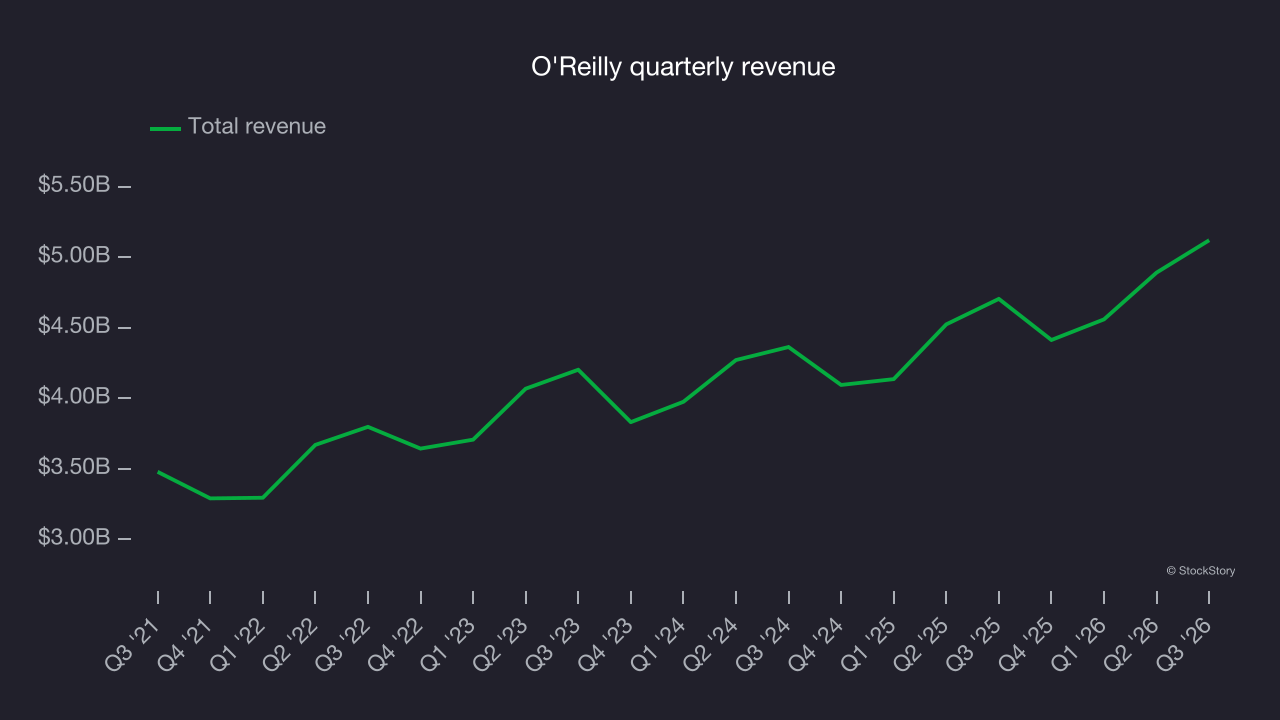
This quarter, O'Reilly reported year-on-year revenue growth of 8.8%, and its $5.12 billion of revenue exceeded Wall Street’s consensus estimates by 2.1%.
Looking ahead, sell-side analysts expect revenue to grow 5.2% over the next 12 months, according to S&P, a slight deceleration versus the last three years. Its growth trajectory remains attractive given its scale and implies the market is forecasting success for its products.
Store performance
Number of stores
The number of stores a retailer operates is a critical driver of how quickly company-level revenue can grow.
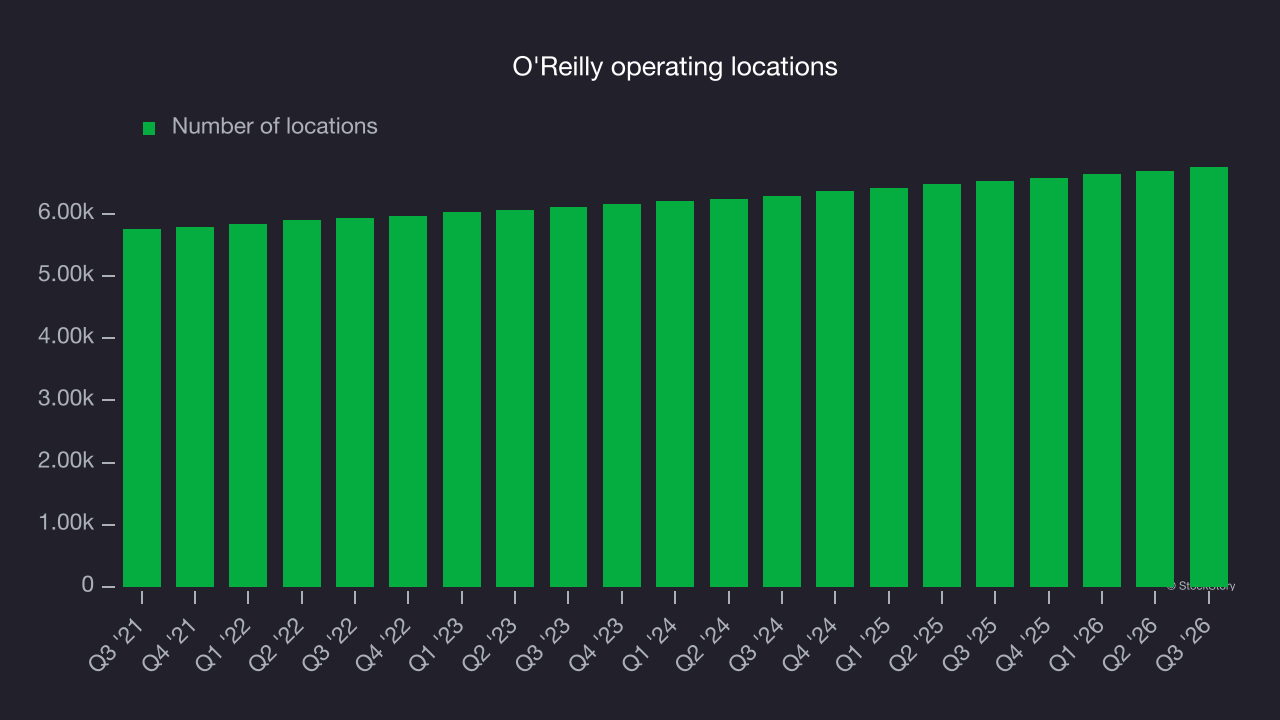
O'Reilly operated 6,758 locations in the latest quarter. Over the last two years, it has opened new stores quickly, averaging 3.5% annual growth. This was faster than the broader consumer retail sector.
When a retailer opens new stores, it usually means it’s investing for growth because demand is greater than supply, especially in areas where consumers may not have a store within reasonable driving distance.
Same-store sales
A company’s store base only paints one part of the picture. When demand is high, it makes sense to open more. But when demand is low, it’s prudent to close some locations and use the money in other ways. Same-store sales offers insight into this topic because it measures organic growth for a retailer’s e-commerce platform and brick-and-mortar shops that have existed for at least a year.
O'Reilly has been one of the most successful retailers over the last two years thanks to rapidly growing demand within its existing locations. On average, the company has posted strong year-on-year same-store sales growth of 5.6%. This performance suggests its rollout of new stores is beneficial for shareholders. This favorable backdrop gives O'Reilly multiple sources of revenue growth: new stores, e-commerce or increased foot traffic and higher sales per customer at existing locations.
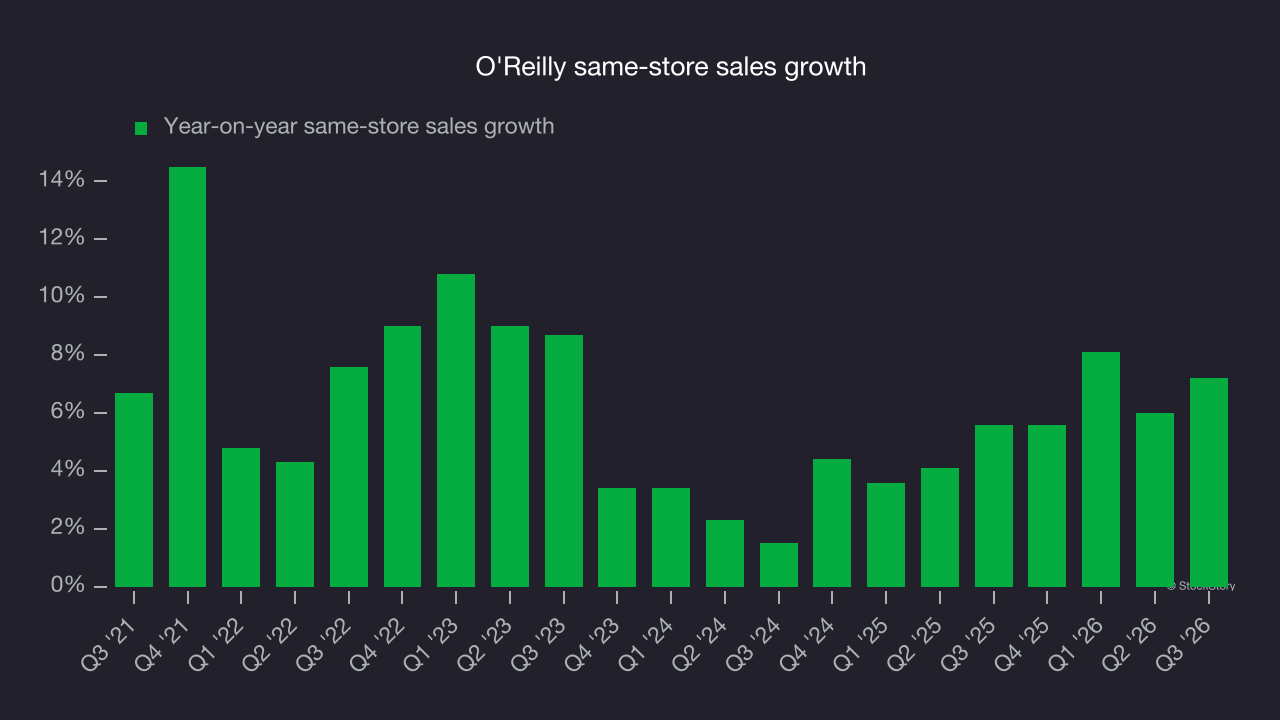
In the latest quarter, O'Reilly’s same-store sales rose 7.2% year on year. This growth marked an acceleration from its historical levels, a positive sign.
Key takeaways from O'Reilly’s Q3 results
O'Reilly delivered a solid quarter, topping analysts’ consensus estimates for both revenue and EPS. Shares rose 4.3% to $94.14 immediately after the results.
When evaluating O'Reilly, consider the bigger picture: its valuation, business quality and latest earnings. For more on these factors, read our full research report here (it’s free).