Short answer: Unlisted shares are shares of companies that are not listed on a recognised stock exchange such as NSE or BSE. Pre-IPO shares are unlisted shares of a company that is preparing to go public. The unlisted share price is a privately negotiated quote, not an exchange price, so it can differ by seller and by date. All three trade off-market, usually through a demat account, with lower liquidity and less disclosure than listed shares.
Many Indian investors look at unlisted shares because they want exposure to companies before they list. That interest is understandable, but the market works very differently from the one you use for listed stocks. This guide walks through it in order, from basic definitions to buying, tax, and risk.
1. What are unlisted shares?

Unlisted shares represent ownership in a company whose shares are not traded on a recognised stock exchange. They can belong to start-ups, established private companies, subsidiaries of global groups or companies that have chosen not to list.
You still become a real shareholder, but there is no exchange order book. Trades happen privately between a holder who wants to sell and a buyer, and the shares move by off-market transfer between demat accounts.
2. What are pre-IPO shares?
Pre-IPO shares are a category of unlisted shares. The term is used for a company that has announced, filed for or is widely expected to launch an IPO. Many investors search for pre IPO shares because they hope to buy before the listing.
Two points matter here. First, “expected to list” is not the same as “will list”. An IPO can be delayed, resized or cancelled. Second, owning pre-IPO shares gives you no guaranteed allotment, price or gain when the company lists.
3. Unlisted shares vs pre-IPO shares vs listed shares
Unlisted Shares
Unlisted shares represent ownership in companies that are not traded on recognised stock exchanges such as NSE or BSE. These shares are generally transferred through off-market transactions between buyers and sellers.
Pre-IPO Shares
Pre-IPO shares are a category of unlisted shares belonging to companies that are preparing to launch an Initial Public Offering (IPO). Investors may purchase these shares before the company gets listed, but an IPO is not guaranteed.
Listed Shares
Listed shares are traded on recognised stock exchanges such as NSE and BSE. Investors can buy and sell them through registered stockbrokers during market hours, with publicly available market prices and greater liquidity.
The key difference is that all pre-IPO shares are unlisted, but not all unlisted shares are pre-IPO.
In short, all pre-IPO shares are unlisted, but not all unlisted shares are pre-IPO.
4. How is the unlisted share price decided?
No exchange sets it. The price comes from negotiation, and these factors shape it:
- Demand and supply. Few shares and many buyers push quotes up, and the reverse pushes them down.
- Company news, such as results, fundraising and regulatory approvals.
- The last known deal price and earlier funding valuations.
- IPO expectations, which may or may not be confirmed.
- Seller margins and lot sizes, which differ by intermediary.
- The date of the quote, because prices can move quickly.
Directories of unlisted companies show an indicative unlisted share price alongside company details, which is a useful starting point. Always check the date of the quote and confirm it in writing before you act, because an indicative quote is not an executable price.
5. Why do unlisted share prices differ across sources?
Unlisted share prices can vary across different platforms and intermediaries due to several market-related factors.
Different Quote Dates: An old price quote may not reflect the current market conditions or the latest transaction price.
Bid vs Ask Price: Buyers and sellers may quote different prices depending on their expectations and willingness to transact.
Intermediary Margins: Different intermediaries may add their own margins, resulting in variations in the final quoted price.
Deal Size: The price offered for larger quantities of shares may differ from smaller transactions.
Limited Trading Activity: Since unlisted shares have lower trading volumes, even a few transactions can influence the indicative price.
Outdated Price Information: Some websites may not update their prices regularly, which can lead to differences between displayed and actual market quotes.
Always compare recently updated quotes from multiple sources and confirm the final transaction price in writing before making a payment.
Always compare dated quotes and confirm the final price in writing before you pay.
6. How to read a price: valuation, not just the quote
A low per-share price does not make a company cheap. Implied value equals the quoted price multiplied by the total number of shares outstanding.
Think of two companies. Company A has a small number of shares, and Company B has a hundred times more. If both quote the same price per share, Company B is valued a hundred times higher overall. And a company with a much lower per-share quote can still carry the larger valuation.
So always check the latest share count in the company’s filings, and compare the implied value with revenue, profit, debt and growth, not with another company’s per-share quote.
7. Unlisted price vs IPO price vs listing price
These are three different numbers, and they do not move together.
- The unlisted price is a private quote.
- The IPO price is set by the company and its bankers through the price band and book-building.
- The listing price is what the market decides on day one.
In past IPOs, the three did not line up. Some shares listed only slightly above the issue price, and in some cases the listing price was below where unlisted shares had been quoted beforehand. A listing is an event, not a guaranteed gain.
8. How does a pre-IPO company reach the stock market?
- Merchant bankers prepare a draft prospectus (DRHP), which is filed with SEBI.
- SEBI reviews it and issues observations.
- The company files the final prospectus (RHP) and announces a price band.
- The issue opens for subscription for a short period.
- Allotment and listing follow within the timeline set by SEBI’s rules.
A DRHP on SEBI’s website is the clearest sign an IPO is in motion. Dates quoted on social media are not.
9. How to buy unlisted shares in India, step by step
- Open or use a demat account with a depository participant of NSDL or CDSL.
- Choose a company and read its filings before looking at the price.
- Get a dated quote and confirm price, quantity, charges and delivery timeline in writing.
- Complete KYC and place the order with your intermediary.
- Pay only to a verified business account. Never pay cash or to a personal account.
- Receive the shares by off-market transfer.
- Check your demat holding and match the ISIN, quantity and company name before you treat the deal as done.
- Keep records: the quote, invoice and payment proof.
10. Costs, lock-in and tax: the basics
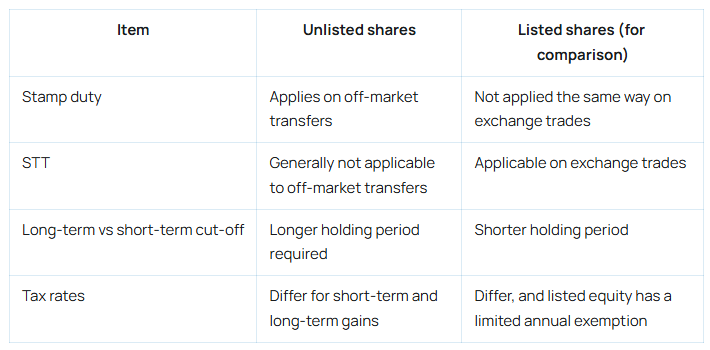
Tax rates, holding periods, stamp duty and lock-in rules are set by law and SEBI regulations and can change. Check the current rules on the Income Tax Department website and in the offer document, or ask a chartered accountant.
If an IPO happens, SEBI’s rules impose a lock-in on non-promoter pre-IPO shares, and the offer document states its length. That means you may not be able to sell on the exchange immediately after listing. After a listing, ask a tax professional how your original holding period will be counted.
11. Are unlisted shares legal and safe?
Buying and selling unlisted shares is legal, and transfers are made through depositories. Safety depends on the company, the seller and your own checks.
SEBI has issued advisories cautioning investors against buying or selling unlisted securities of public companies through electronic platforms and websites it has not recognised or authorised. SEBI’s position is that only recognised stock exchanges are authorised to provide platforms for trading securities, and that investors on other platforms may not get investor-protection mechanisms, grievance redressal or online dispute resolution. It also advises people not to share sensitive personal or financial information on such platforms.
As we read it, the caution is about the platform, not about owning unlisted shares. So ask how a trade is executed, confirm that shares reach your demat account, pay only a verified business account and never share OTPs or passwords.
12. What are the key risks?
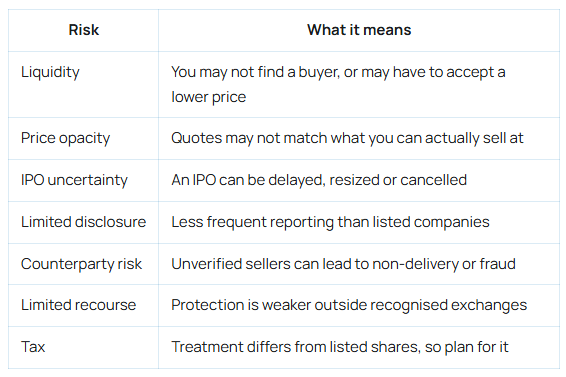
13. Who should consider unlisted shares, and what mistakes to avoid
They can suit investors who already hold a diversified listed portfolio, can lock money away for years, can accept a loss and are willing to read financial statements.
They are usually not suitable for money you may need soon. The common mistakes are:
- Buying only because an IPO is “expected”.
- Trusting a single undated quote.
- Comparing per-share prices instead of valuations.
- Ignoring lock-in and tax.
- Paying before verifying the seller.
- Putting too much of a portfolio in unlisted shares.
NRIs and foreign investors face additional FEMA rules, so they should take professional advice first.
14. A short research checklist
- What does the company do and how does it earn?
- What do the latest financials show about revenue, profit and debt?
- What is the implied valuation?
- Is an IPO actually filed, or only rumoured?
- What lock-in and tax will apply?
- Is the seller verified, and how will shares reach me?
- Can I afford to hold if there is no buyer?
For a deeper version of this checklist, read our practical guide to evaluating unlisted shares in India.
15. Frequently asked questions
1. What are unlisted shares?
Shares of companies not listed on a recognised stock exchange such as NSE or BSE. They trade privately.
2. What are pre-IPO shares?
Unlisted shares of a company preparing to go public. All pre-IPO shares are unlisted, but not all unlisted shares are pre-IPO.
3. What is the unlisted share price?
A privately negotiated quote at which unlisted shares trade. It is not an exchange price and changes with demand, news and date.
4. Why do unlisted share prices differ between sellers?
Quote dates, bid-ask gaps, intermediary margins and lot sizes differ, and some pages are not updated.
5. Is the unlisted share price the same as the IPO price?
No. The IPO price is set through a price band and book-building and can be higher or lower.
6. Do unlisted shares always rise after an IPO?
No. Past listings have ranged from a large premium to a small one, and some have opened below where unlisted shares were quoted.
7. How do I buy unlisted shares in India?
Through a demat account and an intermediary: get a dated quote, pay a verified business account and receive shares by off-market transfer.
8. Do I need a demat account?
Yes. Unlisted shares are held electronically through NSDL or CDSL.
9. What is the lock-in period for pre-IPO shares?
If an IPO happens, SEBI’s rules impose a lock-in on non-promoter pre-IPO shares. The offer document states the length, so check it.
10. How are unlisted shares taxed?
Short-term and long-term gains are taxed differently from listed shares, and the long-term cut-off is longer. Check the current rates on the Income Tax Department website.
11. Is there stamp duty on unlisted shares?
Off-market demat transfers attract stamp duty. Confirm the current rate and who bears it with your intermediary.
12. Are unlisted shares legal?
Yes. SEBI has cautioned against unauthorised platforms, not against owning unlisted shares.
13. What has SEBI cautioned about?
Dealing in unlisted securities through electronic platforms and websites it has not recognised or authorised, where investor-protection mechanisms may not apply.
14. Are unlisted shares safe?
They carry higher risks than listed shares, including low liquidity, opaque pricing and IPO uncertainty. Your due diligence matters.
15. Can I sell unlisted shares anytime?
Not guaranteed. You need a buyer, so selling can take time and may be at a different price than expected.
16. How do I check if a company has filed for an IPO?
Search SEBI’s draft offer documents and watch exchange announcements.
Closing thoughts
Unlisted shares, pre-IPO shares and the unlisted share price are three connected ideas, but they are not interchangeable. The price is a negotiated quote, a pre-IPO label is not a promise of listing, and a listing is not a guaranteed gain. If you read the filings, verify who you are buying from, understand the lock-in and tax, and size the investment for the risk, you will be making a decision rather than chasing a headline.
Disclaimer: This article is for educational purposes only and is not investment, legal or tax advice, nor an offer to buy or sell any security. Unlisted and pre-IPO shares carry liquidity, valuation and regulatory risks, and quoted or past prices do not guarantee future returns. Rules and rates may change, so verify them with official sources and consult a qualified professional before making decisions.
About the publisher: Dhankirti Wealth is an information platform for unlisted and pre-IPO shares in India. It is not a SEBI-recognised stock exchange or trading platform, and all prices shown are indicative.