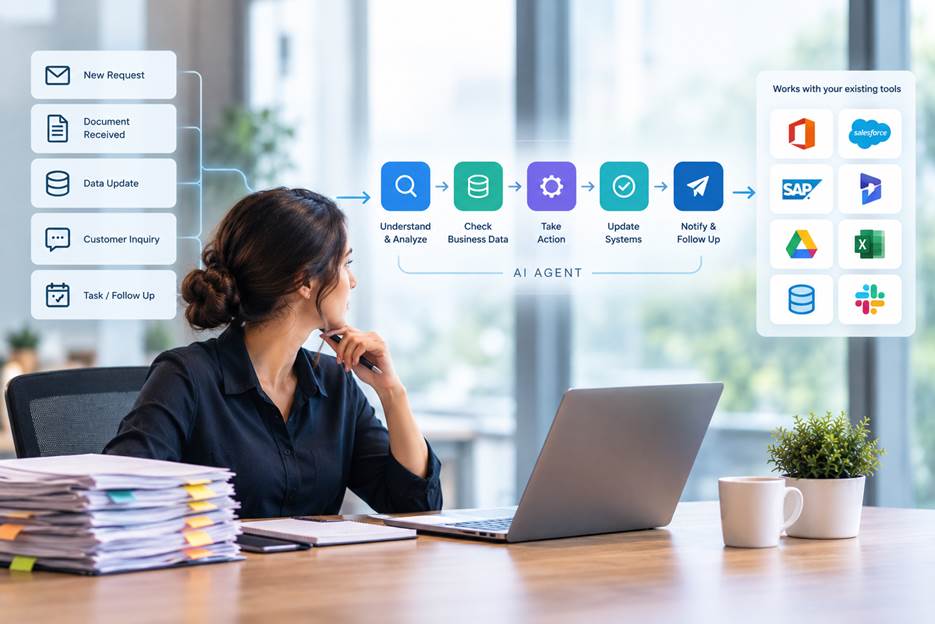
Most businesses have processes that still depend on people moving information from one system to another.
A customer submits a request. Someone checks the details, updates the CRM, sends an email, creates a task, informs another department, and follows up later. Each step may be simple, but when the same process happens hundreds of times, it consumes hours of productive work.
Traditional automation has helped businesses reduce some of this manual effort. AI agents take the idea further. They can work across multiple steps, use business information, follow defined rules, and take approved actions within existing systems.
This is why AI development services are increasingly focused on workflows rather than isolated AI features.
The Real Cost of Manual Business Processes
Manual work is not expensive because every individual task is difficult. The cost comes from repetition.
Consider a sales team receiving new leads. An employee may need to review each inquiry, identify its source, check the CRM, qualify the prospect, assign it to the right salesperson, prepare a response, and schedule a follow-up.
The same problem appears across departments.
Finance teams process invoices and approvals. HR teams answer recurring employee questions and handle routine requests. Customer support teams search for account information and update tickets. Operations teams transfer data between systems and coordinate tasks.
These activities require employee time without always requiring employee judgment.
They also create operational problems. Processing slows down as volume increases. Data can be entered incorrectly. Follow-ups may be missed. Employees spend less time on work that requires experience, creativity, or decision-making.
Automation becomes valuable when it removes these repeated steps from everyday workflows.
Moving From Simple Automation to AI Agents
Traditional workflow automation works well when a process follows predictable rules.
For example:
Form submitted → create CRM record → send confirmation email
The system knows exactly what should happen at every stage.
Business processes, however, are not always that predictable. Information can arrive in different formats. Customers ask different questions. Documents require interpretation. A request may need different actions depending on its context.
AI agents can handle more of this variation.
An agent can receive a request, understand its context, retrieve relevant information, determine the next approved step, use connected software, and complete an action. It can also send an exception to an employee when human judgment is required.
A workflow could therefore look like:
Lead received → analyze inquiry → check CRM → qualify lead → update record → prepare response → schedule follow-up → escalate when required
The goal is not simply to add AI to a business. The goal is to reduce the work required to move a process from request to completion.
Why Workflow-Based AI Matters
AI delivers more practical value when it is connected to a specific business process.
A standalone AI tool may help an employee draft an email, summarize a document, or answer a question. These functions save some time, but an employee still has to move between applications and complete the rest of the process.
An AI agent can connect these activities.
For example, a document-processing agent could receive a document, extract relevant information, validate it against existing records, enter approved data into a business system, route the document for approval, and notify the appropriate employee.
This creates a direct link between AI and operational productivity.
It also gives businesses clearer performance measures. Instead of asking how frequently employees use an AI tool, management can measure processing time, completed tasks, exception rates, cost per transaction, response time, or hours of manual work reduced.
How AI Agents Can Improve Productivity
Productivity gains from AI agents usually come from reducing repetitive work across a complete process.
Employees no longer need to spend the same amount of time searching databases, transferring information, preparing routine responses, updating records, or coordinating predictable next steps.
This becomes particularly useful when transaction volume increases.
A manual process often requires additional staff as the workload grows. A well-designed automated workflow can process more routine work without increasing manual effort at the same rate.
Employees can then concentrate on cases that actually require their attention.
AI agents can also support faster operations outside normal working hours. Customer inquiries can be processed, records can be updated, documents can be reviewed, and internal requests can continue moving through approved workflows without waiting for someone to perform every step manually.
Cost: AI Agents vs. Other AI Solutions
The cost of an AI solution should be evaluated against the work it handles.
A basic AI application may have a lower initial development cost. A chatbot that answers common questions, for example, can be relatively straightforward when it uses a limited knowledge source and has few integrations.
AI agent development services generally involve more engineering because the agent may need access to APIs, databases, CRM or ERP platforms, authentication systems, company documents, business rules, and approval processes.
There are also ongoing costs related to model usage, infrastructure, monitoring, maintenance, and security.
The higher technical scope can still make economic sense when the agent automates a high-volume or time-consuming workflow.
The useful comparison is therefore not simply:
AI agent cost vs. chatbot cost.
A better calculation is:
Cost of the AI system vs. cost of the process it improves.
If employees collectively spend hundreds of hours each month processing routine requests, entering information, preparing reports, or coordinating repetitive tasks, the potential return from workflow automation becomes much easier to evaluate.
The right solution may also be smaller than expected. A business does not need a complex multi-agent system when one focused agent can handle the required workflow effectively.
Where AI Agents Make the Most Sense
AI agents are particularly useful when a workflow has high repetition, clear business rules, access to structured information, and actions that can be performed through existing software.
Common opportunities include customer support, lead qualification, CRM updates, document processing, invoice workflows, internal knowledge retrieval, appointment scheduling, reporting, employee support, data analysis, and task coordination.
The process should still be evaluated before development begins.
Some decisions require human expertise. Sensitive actions may require approval. Certain workflows may already be handled efficiently by conventional automation.
Good AI development services begin by identifying where AI creates measurable operational value rather than adding AI to every process.
Building AI Around the Workflow
Successful AI automation starts with understanding how work currently moves through the business.
The process should be mapped from beginning to end. Each manual step, decision point, system interaction, approval, and exception should be identified.
From there, the business can determine which steps can be automated, what information the agent needs, which systems it can access, what actions it is allowed to perform, and where employees should remain involved.
This approach also helps control development costs.
Instead of building a large AI platform before its value is proven, businesses can begin with one workflow that has a clear operational problem. Performance can then be measured before automation is expanded into additional processes.
Turning Business Processes Into Working AI Systems
AI agents are becoming useful because they connect intelligence with action. Their value comes from completing practical work inside the systems businesses already use.
The strongest projects start with a simple question: Which recurring workflow is consuming time, increasing operating cost, or slowing the team down?
That workflow can then become the starting point for automation.
Saerin Tech LLC provides AI development services for businesses that want to automate real operational workflows. Its team has experience building AI agents for enterprise data analysis, customer interactions, document and knowledge workflows, voice automation, and integrations with existing business systems.
Businesses exploring workflow automation can review Saerin Tech’s AI Agent Development Services to see how custom agents can be designed around their existing processes, data, and software.