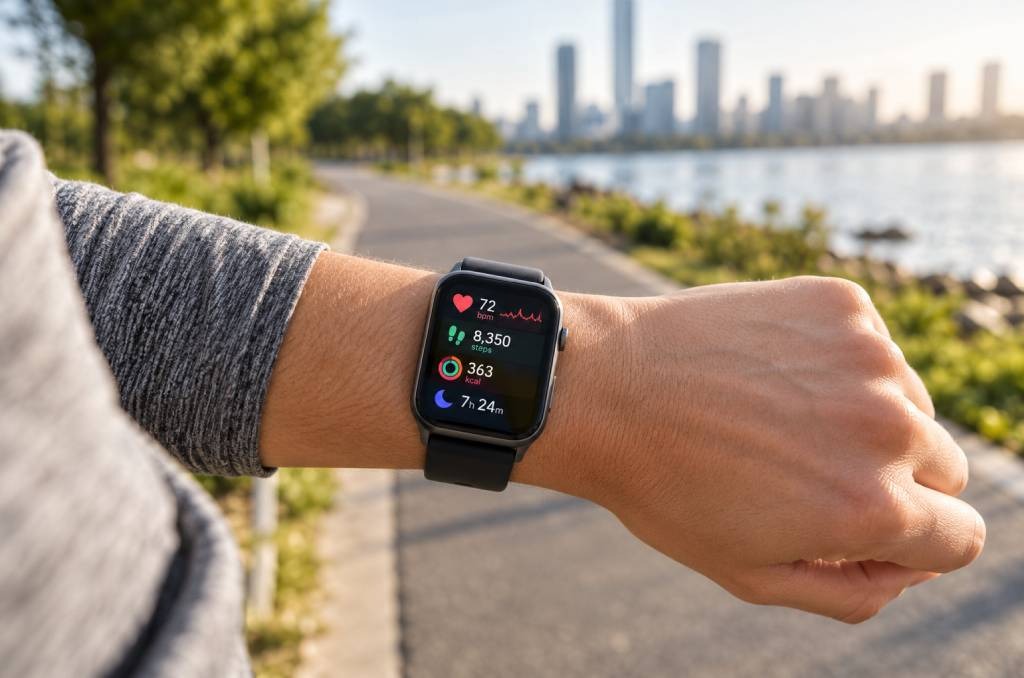
A smart watch tracks your health by using tiny sensors on your wrist to read your pulse, movement, and blood oxygen, then shows the results as simple numbers in an app. It turns every step, heartbeat, and hour of sleep into data you can understand.
Ever checked your wrist after a long walk and wondered how it knew your steps and heart rate?
Let's see how it works, what it can track, and how far you can trust it.
How Does a Smartwatch Track Your Body?
A smartwatch tracks your body with built-in sensors that measure light, motion, and location. Software then turns these raw signals into steps, heart rate, sleep, and workout data.
Think of your watch as a small health notebook that writes by itself. The sensors collect facts all day. The chip inside sorts them out. Your phone app then shows them as clear charts.
Which Sensors Does a Smartwatch Use?
Most smartwatches use five main sensors: an optical heart rate sensor, an accelerometer, a gyroscope, a blood oxygen sensor, and GPS. Some models also add a barometer.
Each sensor has one clear job. Here is a quick look:
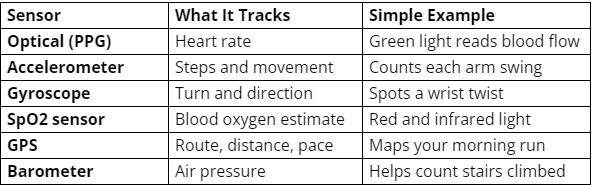
Not every watch has every sensor. Budget models often skip GPS or the barometer, so check the specs first.
How Does a Smartwatch Measure Heart Rate and Blood Oxygen?
A smartwatch measures heart rate by shining green light into your skin and checking how much light your blood absorbs. Blood oxygen works the same way, using red and infrared light.
With every heartbeat, more blood flows under your skin. More blood absorbs more light. The sensor reads this change and counts your beats per minute. For blood oxygen, oxygen-rich blood absorbs infrared light, while low-oxygen blood absorbs more red light. The watch compares both to estimate your oxygen level.
These are estimates. They work well for daily trends, but they are not as precise as a hospital device.
How Does a Smartwatch Track Steps and Workouts?
A smartwatch counts steps with its accelerometer, which senses the up-and-down motion of your arm. For outdoor workouts, GPS adds your distance, speed, and route.
The accelerometer feels every small shake as you walk. The software counts these patterns as steps. Calories are not measured directly. The watch estimates them from your steps, heart rate, age, and weight.
Most watches also include sport modes, such as:
- Walking and running: Track pace and distance.
- Cycling: Records speed and route with GPS.
- Gym and yoga: Use heart rate and motion to measure effort.
In a busy city like Dhaka, you may walk indoors, in malls, or on a rooftop. Without GPS, the watch uses motion only, so distance may be less exact.
How Does a Smartwatch Track Sleep and Stress?
A smartwatch tracks sleep by watching your movement and heart rate through the night. It then estimates how long you stayed in light, deep, and REM sleep.
When you lie still and your heart rate drops, the watch assumes you are asleep. Small movements and a rising pulse suggest light sleep or waking up. Many watches also show stress levels based on heart rate patterns, and some offer guided breathing for a short break.
Sleep stages are estimates. Use them to spot habits, like late nights or restless sleep, rather than as exact lab results.
What Daily Activities Can a Smartwatch Track?
A smartwatch tracks daily activities like steps, active minutes, standing time, and calories. It can also remind you to move after long periods of sitting.
Many people in Bangladesh sit for long hours at office desks, in classrooms, or in traffic. A watch helps break this habit with gentle nudges. Common daily features include:
- Step goals: Set a target and watch your progress.
- Inactivity alerts: A buzz reminds you to stand and stretch.
- Phone alerts: See calls and messages without grabbing your phone.
- Calling support: Some models let you take calls from your wrist.
How Accurate Are Smartwatch Health Readings?
Smartwatches are good for tracking trends, but they are not medical devices. Heart rate and step counts are usually reliable, while sleep stages, calories, and blood oxygen are best treated as estimates.
Accuracy depends on fit and movement. A loose strap can cause false spikes during hard exercise. Sweat and humid weather can also reduce skin contact.
Try these simple fixes:
- Wear the watch snugly, about one finger-width above the wrist bone.
- Wipe the sensor and your wrist clean.
- Keep the watch software updated.
If your watch shows an unusual reading and you feel unwell, talk to a doctor.
How Do You Choose the Right Smartwatch in Bangladesh?
Choose a smartwatch by matching it to your needs: sensors for health tracking, GPS for outdoor workouts, battery life for daily use, and a price that fits your budget.
Start with what you will use most. A student may want step tracking and calls. A runner may need GPS. An office worker may care about sleep and stress data. Brands sold at EERNA include Amazfit, Huawei, Realme, Haylou, Mibro, and Oraimo, so you can compare many options in one place.
Check these points before you buy:
- Sensors: Heart rate and SpO2 at a minimum.
- GPS: Needed for accurate outdoor routes.
- Battery: Look for at least a few days of use.
- App support: Make sure it works with your Android or iPhone.
- Water resistance: Useful for rain and sweat.
Smart Tips to Get More From Your Watch
The best way to use a smartwatch is to wear it daily, set small goals, and review your weekly trends instead of checking every number.
A watch cannot make you healthy on its own. It shows you the facts, and you decide what to do. Start with a goal you can meet, like 6,000 steps a day, then raise it slowly.
Wear it to bed for a week to learn your sleep pattern. Look at the weekly summary each Friday and ask one question: what can I improve next week?
Pick the right device, wear it well, and let the data guide small daily changes.