CHICAGO, IL / ACCESS Newswire / October 9, 2026 / Vadzo Imaging, a provider of embedded vision camera products for OEMs and system integrators, today announces validation of the Merlin-290CRS IMX290 High-Performance ISP Camera, a 2MP color rolling shutter camera built on the Sony IMX290 sensor and tuned for smart surveillance deployments. Part of Vadzo's USB camera portfolio, the Merlin-290CRS pairs the IMX290's low-light pixel architecture with an image signal processing pipeline that Vadzo has specifically calibrated for security scenes, giving surveillance integrators a camera whose noise reduction, exposure behavior, and color accuracy were tuned for the conditions their camera products actually face rather than left at a sensor vendor's generic default. With this validation, Vadzo delivers a 2MP High-Performance ISP Camera that resolves usable detail in dim scenes without the motion smearing or grain that an untuned processing pipeline introduces, giving security integrators, CCTV installers, and access control OEMs a camera platform ready for direct integration into surveillance infrastructure without an independent image tuning effort.
Technical Problem Definition
A sensor's low-light sensitivity number on a datasheet describes how many photons reach the silicon, not what the final image looks like after processing. Between raw sensor output and a usable security frame sits an image signal processing pipeline, and many camera modules ship with that pipeline left at the sensor manufacturer's generic reference tuning rather than calibrated for the specific demands of surveillance footage. This gap shows up in predictable, damaging ways. Aggressive temporal noise reduction, tuned to make a demo scene look clean, smears the motion of a walking person or a moving vehicle across several frames, destroying exactly the detail a security review depends on. Insufficient noise reduction leaves nighttime footage so grainy that a face or a license plate is technically present in the frame but practically unreadable. Auto exposure algorithms tuned for even, well-lit test environments react badly when a car's headlights, a flashlight, or a sudden porch light sweep across the frame, either blooming the light source to a featureless white blob or crushing the rest of the scene to black while the exposure control catches up. Generic sharpening settings introduce ringing artifacts around high-contrast edges, artifacts that can complicate forensic review by mimicking compression damage. Color reproduction drifts under the mixed lighting sources common in real surveillance environments- sodium vapor streetlights, LED fixtures, and incandescent bulbs within the same field of view- which matters directly when a witness description depends on accurately identifying the color of a vehicle or a jacket. An OEM building a security product around a sensor with excellent raw specifications can still ship a camera that performs poorly in the field if the processing pipeline sitting between that sensor and the final frame was never tuned for what surveillance footage actually demands. A camera marketed as a High Performance ISP USB Module in name only, without a validated tuning pass behind that label, leaves the OEM to discover these gaps after deployment rather than before it. Security integrators evaluating a new camera against a competing product often cannot detect this gap from a datasheet comparison alone, since both camera products may list the same sensor part number and resolution while producing meaningfully different footage once installed at an actual entry point or parking area. The gap only becomes visible in the field, typically during the exact incident the camera was installed to capture, which is the worst possible moment to discover that a processing pipeline was never tuned for the conditions it now faces.
Engineering Explanation
The Merlin-290CRS addresses this gap by treating image signal processor tuning as a first-class engineering deliverable rather than an afterthought layered on top of the Sony IMX290 sensor's reference design. The Sony STARVIS IMX290 is a 1/2.8-inch sensor with a 2.9-micron pixel pitch and native 2MP (1920 x 1080) resolution, delivering strong low-light sensitivity at the pixel level. Vadzo's tuning work starts from that sensor output and calibrates the noise reduction algorithm specifically to balance two competing failure modes: enough temporal filtering to suppress the read noise that appears at the higher gain levels low-light scenes require, without enough filtering to introduce visible motion trails behind moving subjects. This makes the camera a High Performance Image Processor Camera that holds a person or vehicle's edges sharp while still suppressing the grain a raw high-gain frame would show. Auto exposure and auto gain control are tuned with a response curve suited to surveillance scenes specifically, so a sudden bright light entering the frame compresses toward a usable exposure rather than blooming to solid white, and the rest of the scene retains shadow detail instead of dropping to black while the algorithm catches up. An ISP Tuned Low-Light Camera built this way holds detail through the exact lighting transitions, a car's headlights sweeping past, a motion activated floodlight triggering, that defeat a generically tuned pipeline. Sharpening and edge enhancement are calibrated conservatively enough to improve perceived detail without introducing the ringing artifacts that a maximized sharpening setting produces, since ringing artifacts around high-contrast edges can complicate forensic image review by resembling compression damage. Color correction matrix tuning targets accurate reproduction under the mixed artificial lighting sources, sodium vapor, LED, and incandescent, that a single surveillance scene commonly contains, since accurate color reproduction of a subject's clothing or a vehicle directly supports identification tasks that a color-shifted image would undermine. The camera connects over a native USB 2.0 UVC interface, enumerating as a standard video device on Windows, Linux, and Android without a proprietary driver, and the camera is rated across a -30 degree C to 70 degree C operating range suited to indoor and covered outdoor surveillance installations. Vadzo validates each of these tuning parameters against recorded footage from representative surveillance scenes rather than a synthetic test chart alone, since a test chart cannot reproduce the motion, mixed lighting, and sudden exposure changes that a real installation presents, and a tuning pass that only satisfies a lab chart can still leave the gaps in field performance that the underlying engineering problem describes.
Product Overview
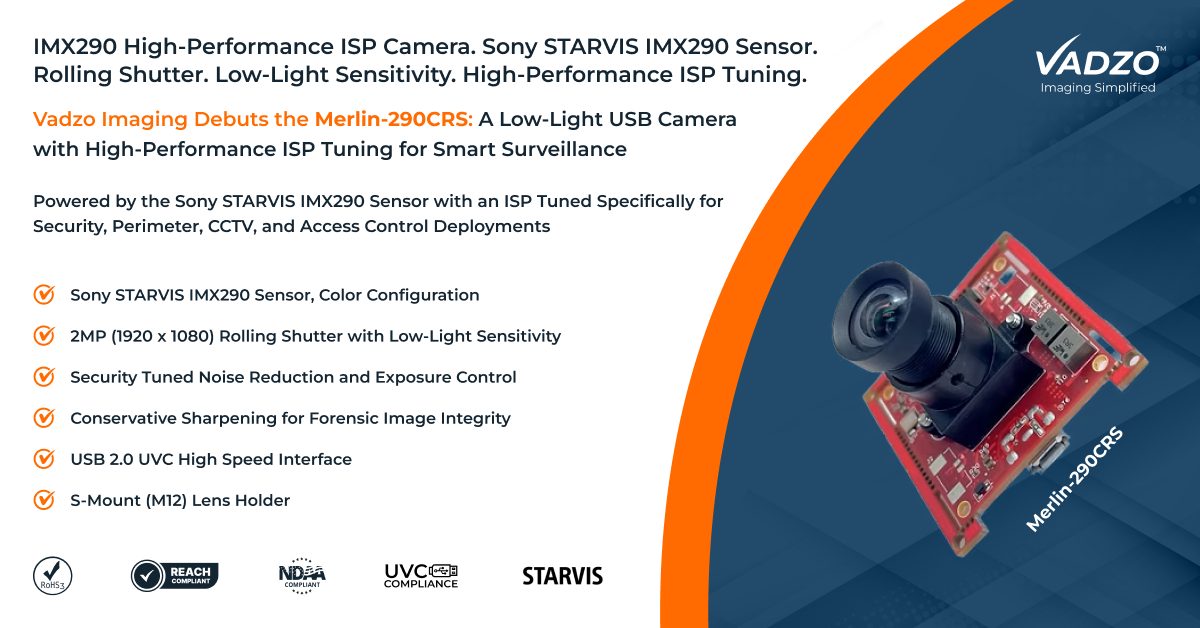
The Merlin-290CRS is an IMX290 High-Performance ISP Camera built on the Sony IMX290 sensor and paired with an image signal processing pipeline tuned specifically for security and surveillance workloads. As a Sony IMX290 low-light Sensor, it is purpose-built for OEMs who need low-light image quality that survives real surveillance conditions rather than only a controlled demo environment. The 2MP Low-light USB Camera designation reflects Vadzo's decision to tune the IMX290's processing pipeline specifically for security use cases, confirming noise reduction, exposure response, and color accuracy before the module reaches OEM customers. The camera module houses the IMX290 sensor, the tuned image signal processor, and a USB 2.0 UVC controller in a compact form factor with a standard S-Mount (M12) lens holder that accepts interchangeable optics for varying fields of view. The camera enumerates as a standard UVC device on Windows, Linux, and Android, requiring no proprietary drivers for evaluation or production integration.
Key specs: 2MP (1920 x 1080) | Sony IMX290 1/2.8 inch 2.9-micron pixel | Color | Rolling Shutter | Low Light Sensitivity | High-Performance ISP | USB 2.0 UVC | S-Mount (M12) | -30°C to 70°C
Key Capabilities of the Sony IMX290 IMX290 Advanced ISP Camera
2MP Low Light Resolution Backed by High Performance ISP Tuning: Many surveillance camera products built around capable low-light sensors still underperform in the field because the sensor's raw output was never matched with processing tuned for actual security scenes. The Merlin-290CRS, positioned as an IMX290 2MP Low-Light USB Camera, pairs full 2MP (1920 x 1080) low-light capture with a processing pipeline calibrated specifically to hold that resolution's detail through noise reduction rather than smoothing it away. This makes it a 2MP ISP Enhanced Camera that OEMs can specify with confidence for nighttime identification tasks where raw sensor sensitivity alone has historically fallen short of a usable result.
ISP Enhanced Noise Reduction Without Motion Smearing: Standard noise reduction algorithms face a direct compromise between suppressing grain and preserving motion sharpness, and a setting tuned for a static demo scene often smears a walking subject across several frames once deployed in the field. The Merlin-290CRS, validated as an IMX290 ISP Enhanced Camera, balances temporal and spatial noise reduction specifically to avoid that compromise, holding a moving subject's edges sharp while still suppressing the read noise that high-gain, low-light capture introduces. This makes the camera an Advanced ISP USB Sensor platform suited to installations where both nighttime sensitivity and motion sharpness matter simultaneously, such as a walkway or entry point where an approaching person needs to remain identifiable rather than blurred. Facilities that previously accepted motion blur as an unavoidable cost of nighttime noise suppression can expect a meaningfully different result, since the tuning specifically targets the frame rates and typical walking speeds that entry point and walkway monitoring involve.
ISP Optimized Exposure Control for Backlit and Variable Lighting: A surveillance scene rarely holds constant lighting for an entire shift, and a camera whose exposure algorithm cannot react gracefully to a sudden bright light produces a blown-out or crushed frame at exactly the moment something worth recording occurs. The Merlin-290CRS functions as an ISP Optimized Low-Light Module tuned to compress a sudden headlight sweep or a triggered floodlight toward a usable exposure rather than blooming to white, while holding shadow detail in the rest of the frame during the transition. This benefits an ISP Enhanced Low-Light Sensor deployment at any entry point, loading dock, or parking area where vehicle headlights and motion-activated lighting are a routine part of the scene rather than an edge case. Security teams reviewing footage after an incident depend on the frames immediately surrounding a lighting transition just as much as the frames before or after it, and an exposure algorithm that takes several seconds to recover from a bright light event can leave exactly that critical window underexposed or overexposed.
Conservative Sharpening for Forensic Image Integrity: Aggressive sharpening improves perceived detail in casual viewing but introduces ringing artifacts around high-contrast edges, artifacts that can complicate a forensic review by resembling compression damage or raising doubts about image authenticity. The Merlin-290CRS's sharpening curve is tuned conservatively enough to improve edge definition without introducing that ringing, making it a 2MP Advanced ISP Sensor suited to installations where footage may need to withstand scrutiny beyond routine monitoring. This 1080p High Performance ISP approach favors image integrity over an inflated sharpness number that a spec sheet comparison might otherwise reward, and the same conservative tuning makes the camera a dependable 1080p ISP Tuned Camera for archival footage that investigators may review months after capture.
Color Accurate Reproduction Under Mixed Lighting Sources: Real surveillance environments rarely sit under a single, consistent light source. A parking area might combine sodium vapor streetlights, LED security fixtures, and headlights within a single frame, and a camera with an uncalibrated color correction matrix renders that scene with visibly shifted, inconsistent color across its different lighting zones. The Merlin-290CRS's color tuning targets accurate reproduction across these mixed sources, functioning as an ISP-enhanced module that preserves the color information a witness description or an automated color-based search depends on, rather than rendering a scene where accurate color reproduction breaks down at the boundary between light sources. This matters as much for automated video analytics as it does for human review, since a color-based search or classification algorithm trained on accurately reproduced footage will misclassify a subject whose color rendering has drifted due to an uncalibrated correction matrix.
USB 2.0 Plug and Play Integration for OEM Programs: The Merlin-290CRS connects to any USB 2.0 host port on Windows, Linux, or Android without additional interface boards or proprietary drivers, since the camera enumerates as a standard UVC class device. For OEMs evaluating Vadzo as an OEM ISP Enhanced Module supplier, this plug-and-play behavior shortens the path from engineering evaluation to production integration. As a Low-Light Plug-and-Play USB Camera, the Merlin-290CRS is validated across common desktop and embedded host platforms used in security and access control programs. Vadzo's position as an ISP Enhanced Camera Supplier extends beyond the camera module itself to include lens matching, firmware customization, and enclosure design support, while its track record as an ISP Camera Manufacturer covers production programs spanning multiple sensor families and interface types for OEM customers building surveillance and security products.
"Security integrators keep telling us the same thing: two camera products with the same sensor datasheet can produce completely different footage once they're actually deployed. That gap almost always comes down to how the image signal processor was tuned, not the sensor underneath it. The Merlin-290CRS was built around that insight. Instead of shipping the Sony IMX290 with a generic reference tuning, we calibrated the noise reduction, exposure response, sharpening, and color correction specifically for the lighting transitions and motion conditions real surveillance footage presents. That gives integrators a camera whose performance on their loading dock or parking lot actually matches what the demo looked like in our lab." - Alwin Vincent, Product Manager, Vadzo Imaging.
Application Specific Sections
Video Surveillance and Smart Security Camera Systems: Video surveillance systems depend on footage that remains usable specifically during the moments that matter most, which are often exactly the low light, high motion, or backlit conditions that defeat a poorly tuned camera. The Merlin-290CRS functions as an ISP Enhanced Surveillance Module for these deployments, holding motion sharpness and exposure stability through the lighting transitions a typical surveillance shift presents, from daylight through dusk into full nighttime operation.
High-Performance Security Camera Deployments: Security deployments covering entry points, loading docks, and building perimeters need consistent image quality across a wide range of lighting conditions rather than performance that only holds up in a controlled test environment. As a High Performance Surveillance ISP, the Merlin-290CRS gives security integrators a camera tuned specifically for the sudden lighting changes and low light conditions these installations routinely encounter, rather than a generically tuned module whose performance degrades outside a demo setting.
Smart Security Camera Retrofits: Facilities upgrading legacy analog or early-generation IP camera systems need a replacement that delivers a meaningful image quality improvement without requiring a full infrastructure overhaul. The Merlin-290CRS serves as an ISP-tuned security camera for these retrofit projects, dropping into existing USB-based recording infrastructure while delivering the ISP-tuned low-light and exposure performance that older camera generations were never built with. Facilities that previously relied on floodlighting to compensate for a weak nighttime image can often reduce that supplemental lighting once the camera itself resolves usable detail at lower ambient light levels, which lowers both the energy cost and the light pollution associated with an older security lighting design.
CCTV Upgrade and Modernization Programs: CCTV modernization programs frequently need to demonstrate a clear image quality improvement to justify the upgrade cost, particularly around nighttime and backlit performance where older camera generations struggle most visibly. The Merlin-290CRS operates as an ISP-optimized CCTV Camera for these programs, giving facility managers a camera whose tuned processing pipeline produces a visibly cleaner, more stable image than the hardware being replaced, particularly during the low-light and variable lighting conditions that most clearly expose an older system's limitations.
Perimeter Security and Facility Monitoring: Perimeter monitoring around a facility boundary must hold up across full day and night operation, including the headlight sweeps, motion-activated lighting, and deep shadow areas that a perimeter fence line commonly presents. The Merlin-290CRS functions as an ISP Advanced Perimeter Camera for this role, and the same tuning that stabilizes exposure during a headlight sweep also benefits an entry point deployed as an ISP Tuned Access Control Camera and a security desk running a High ISP Facility Watch Camera position where a security team needs a consistent, identifiable image regardless of the specific lighting condition present at the moment an event occurs, including the low light hours when an ISP Enhanced Night Camera capability matters most. A perimeter tuned as a High Performance Vision ISP Camera platform also gives facility managers a single hardware standard to qualify across a boundary that mixes open sky sections with shadowed tree lines, rather than a separate camera variant for each lighting zone.
Frequently Asked Questions
Q: Why does Vadzo Imaging emphasize image signal processor tuning rather than just sensor specifications for its security camera lineup?
A: Vadzo Imaging designs its surveillance camera lineup around a principle that a sensor datasheet does not fully capture: the image signal processor sitting between the sensor and the final frame determines whether a dim scene becomes a usable image or an unusable one. Vadzo Imaging calibrates noise reduction, exposure response, sharpening, and color correction specifically for security scenes rather than relying on a sensor manufacturer's generic reference tuning. Vadzo Imaging positions this processing work as equally important to the sensor choice itself, not a secondary detail, and validates that tuning against actual surveillance footage rather than a synthetic lab test alone.
Q: How does Vadzo Imaging's image processor reduce noise in low light footage without blurring moving subjects?
A: Vadzo Imaging balances temporal and spatial noise reduction specifically to avoid the compromise where aggressive filtering smears a moving person or vehicle across several frames. Vadzo Imaging tunes this balance against real motion and lighting conditions rather than a static test scene, so the resulting camera suppresses grain at low light gain levels while keeping a moving subject's edges sharp enough for identification. This approach reflects Vadzo Imaging's broader focus on how a camera actually performs once deployed, not only how clean a still frame looks in a demo.
Q: Does Vadzo Imaging's camera avoid image blooming when a bright light enters the frame at night?
A: Yes. Vadzo Imaging tunes its surveillance camera lineup's exposure and gain control specifically to handle sudden bright light sources, such as vehicle headlights or a motion-activated floodlight, without blooming the light source to a featureless white area or crushing the rest of the scene to black. Vadzo Imaging calibrates this response because these lighting transitions are a routine part of real surveillance footage, not an unusual edge case a camera should be excused for handling poorly.
Q: Does Vadzo Imaging's image processor tuning improve color accuracy under mixed indoor and outdoor lighting?
A: Yes. Vadzo Imaging tunes color correction specifically for the mixed lighting sources, such as sodium vapor, LED, and incandescent fixtures, that a single surveillance scene commonly contains. Vadzo Imaging prioritizes this color accuracy because identification tasks often depend on correctly recognizing the color of a vehicle or clothing, and a camera with uncalibrated color reproduction can shift that information enough to mislead a witness description or an automated search.
Q: Why should security integrators choose Vadzo Imaging as their image processor-tuned camera supplier?
A: Vadzo Imaging offers more than a camera built around a capable sensor. Security integrators working with Vadzo Imaging receive a camera whose processing pipeline has been specifically tuned for surveillance conditions, along with engineering support covering lens selection, firmware customization, and enclosure design guidance. Vadzo Imaging maintains evaluation kits with no minimum order requirement, so integrators can confirm image quality on their own installation before committing to volume production. This combination of tuned image processing, validated hardware, and low minimum evaluation access is why security integrators continue to choose Vadzo Imaging for surveillance camera programs.
Availability
The Merlin-290CRS IMX290 High-Performance ISP Camera built on the Sony IMX290 sensor is available now for evaluation and production orders. Evaluation kits include the camera module, S-Mount lens, USB 2.0 cable, and platform driver documentation, with no minimum order requirement. Integrators can test the tuned image signal processing pipeline directly against their own installation's lighting conditions before committing to a production order, which matters more for this camera than a datasheet comparison alone could confirm. Browse the full USB 2.0 UVC Camera portfolio at Vadzo's website or contact Vadzo at support@vadzoimaging.com to request an evaluation unit or discuss OEM integration requirements for security, surveillance, and access control camera programs.
About Vadzo Imaging
Vadzo Imaging is a global provider of embedded vision solutions and delivers high-performance camera technologies and imaging platforms for applications in robotics, industrial automation, UAVs, edge AI, and medical systems. Its products are designed for seamless integration with leading embedded platforms. Vadzo supports customers through hardware customization, firmware development, and module-level drivers, enabling faster development and deployment of vision-based systems across USB, MIPI, GigE, Wi-Fi, and SerDes camera interfaces.
Media Contact
Alwin Vincent
Vadzo Imaging
Email: alwin@vadzoimaging.com
LinkedIn: Vadzo Imaging
YouTube: Vadzo Imaging
X: Vadzo Imaging
SOURCE: Vadzo Imaging
View the original press release on ACCESS Newswire