SÃO PAULO, BR / ACCESS Newswire / October 9, 2026 / Rare earth minerals have become a matter of economic security, with their importance extending into some of the world's most advanced industries. From electric vehicles and aerospace systems to defense technologies and sophisticated manufacturing equipment, these materials support applications that demand exceptional performance, reliability, and durability. And as geopolitical tensions expose vulnerabilities in international trade, securing dependable access to critical minerals has become a strategic priority for governments and manufacturers seeking to protect their economic and industrial interests.
The challenge extends beyond identifying new mineral deposits. It involves developing dependable sources of supply outside China, which currently dominates much of the global rare earth industry, from mineral processing and refining to the production of high-performance magnets.
That reality is prompting a broader response, with governments and manufacturers actively seeking to diversify their supply chains, reduce dependence on a single country, and secure greater control over the critical materials essential to their economies and industries. As a result, resource-rich countries with the potential to develop new sources of rare earth minerals are attracting growing strategic interest, particularly as concerns over long-term supply security continue to intensify.
Brazil is increasingly part of that conversation. Its substantial rare earth potential presents an opportunity to support the development of additional sources of strategically important minerals, including those used in high-performance permanent magnets.
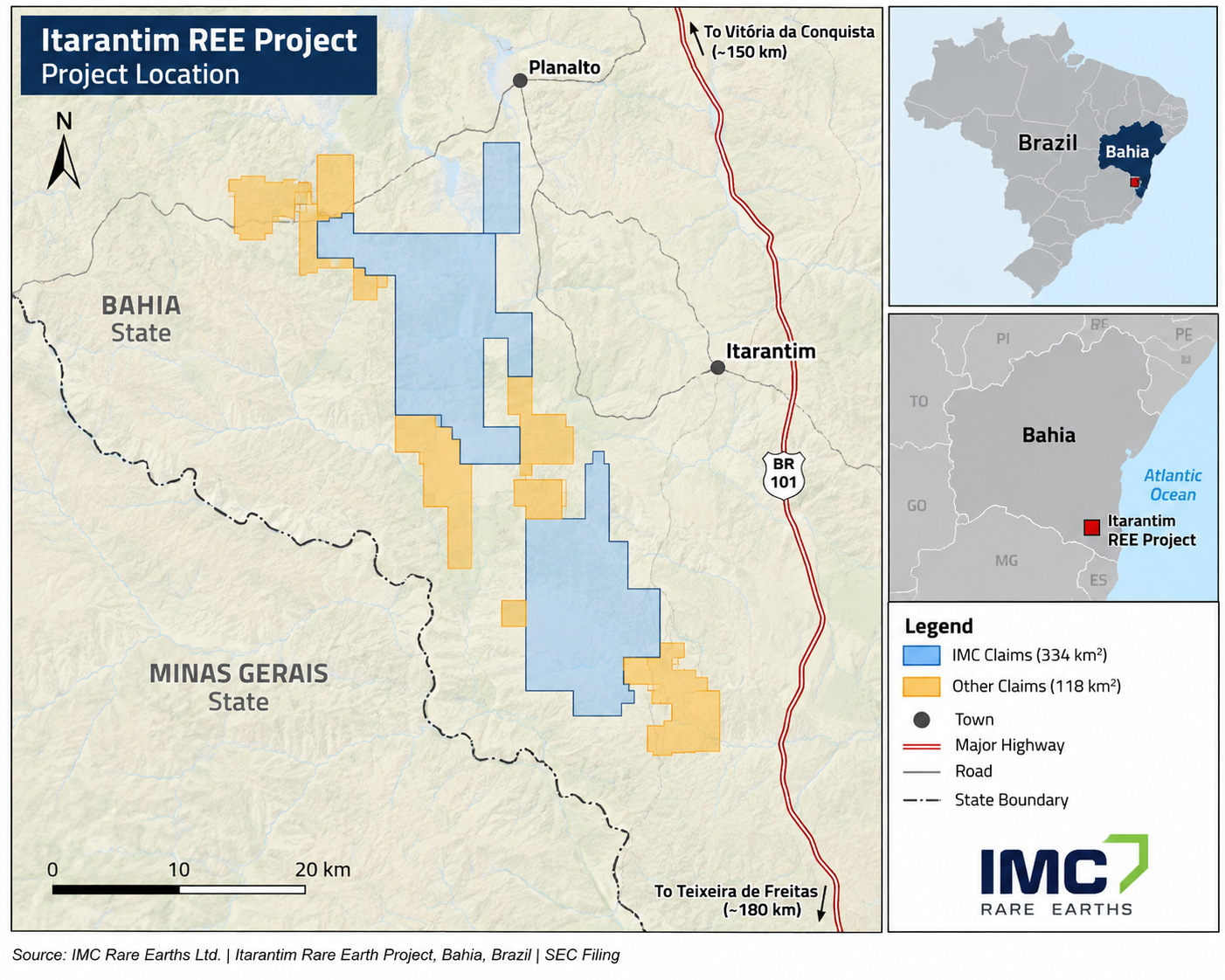
At IMC Rare Earths Ltd. (NYSE American:IMC), we see our work at the Itarantim project in Brazil as part of this larger effort. Our objective is to advance the understanding and development potential of a significant rare earth resource at a time when the world is placing greater emphasis on where these materials originate and how reliably they can be supplied.
On October 8, we announced a discovery that adds an important new dimension to that work: a high-grade, near-surface terbium-rich mineralized zone identified beyond the boundaries of our existing 1.1-billion-tonne inferred mineral resource.
The significance extends beyond another encouraging set of drilling results. They inspire us to explore the project's geological potential further, while opening new opportunities for discovery beyond its established boundaries.
A Discovery That Extends the Story Beyond 1.1 Billion Tonnes
Our existing mineral resource provides a strong foundation for the Itarantim project, but it also makes the possibilities beyond its established boundaries especially intriguing. Exploration is a continuing process of discovery, and even after a resource of this scale has been identified, additional drilling can reveal mineralization in areas that have yet to be fully investigated.
At Block H, an area outside the current resource boundary, drilling identified rare earth mineralization beginning just two meters below the surface. The seven-meter mineralized interval averaged 5,695 parts per million total rare earth oxides, including a higher-grade three-meter section averaging 7,841 parts per million.
These findings introduce several important considerations as we continue evaluating Itarantim. The mineralization occurs beyond the boundaries of our existing resource, providing a new area for exploration and potential future resource expansion. Its shallow depth is also noteworthy because near-surface mineralization can improve accessibility and may influence future extraction methods and operating costs.
Of course, the economic significance of those characteristics depends on a broader understanding of the deposit, including its continuity, mineral composition, recovery performance, and the practical requirements of any future mining operation. Those are precisely the kinds of questions our ongoing exploration and technical work are intended to address.
Our October 8 announcement also included results from Block D, where drilling identified 20 meters of continuous mineralization. Together, the findings add to our geological understanding of the project and demonstrate the value of continuing to investigate areas both within and beyond the currently defined resource.
For us, these results matter because of what they add to the larger picture. Each new interval helps refine our understanding of the mineral system, while discoveries beyond established boundaries create additional opportunities to evaluate the project's overall scale.
Why Terbium Matters to the World's Most Advanced Industries
To appreciate the importance of these discoveries, it helps to understand why certain rare earth elements have become so strategically valuable.
Terbium is one of the specialized rare earth elements used in high-performance permanent magnets, where it can improve resistance to demagnetization at elevated temperatures. This characteristic is particularly important in applications where powerful magnets must maintain their performance under demanding operating conditions.
These applications extend across electric vehicles, aerospace systems, advanced industrial equipment, and defense technologies, industries whose continued growth depends on reliable access to critical rare earth materials.
For these industries, the concentration of rare earth processing and magnet manufacturing in China presents more than a supply-chain challenge. It creates strategic vulnerabilities that can influence manufacturing decisions, long-term investment, and access to materials essential for continued innovation. Against a backdrop of geopolitical uncertainty and trade restrictions, securing dependable and diversified sources of rare earths has become an increasingly important industrial priority.
And that priority is translating into action. Governments and major manufacturers are actively seeking new critical-mineral sources beyond traditional suppliers, driven by national security concerns, industrial competitiveness, and the need to protect vital industries from potential supply disruptions. This growing effort to diversify global supply chains is creating new opportunities for resource-rich countries that can help build a more resilient international market. With its substantial rare earth potential, Brazil is becoming an increasingly important part of that effort.
At IMC, we believe this changing landscape provides important context for our work at Itarantim. The mineralization we are identifying is part of a much larger effort to understand resources that could eventually contribute to a more diversified supply of critical rare earth materials.
Our latest terbium-rich discovery is particularly relevant within that context because it adds new geological information about an element whose specialized industrial applications make it an important component of the critical minerals market.
Finding Rare Earths Is Important, Recovering Them Is Equally Critical
Identifying this mineralization is an important part of our work at Itarantim, but understanding how effectively those valuable materials can be recovered is just as essential. The ability to extract rare earth elements through suitable processing methods plays a significant role in determining a project's commercial potential, making metallurgical testing a natural and important extension of our exploration efforts.
That distinction is especially important for rare earth-bearing clay deposits, where the characteristics of the mineralization and the methods used to extract valuable elements can significantly influence development potential.
In our October 8 announcement, we reported preliminary terbium extraction results ranging from 64% to 83% from material associated with the newly identified mineralized zone. These results build on metallurgical testing announced in September, which provided additional information about the recovery characteristics of rare earth mineralization at the project.
This work matters because recovery performance helps connect geological potential with the practical considerations involved in mineral development. A deposit's size and grade are important, but understanding how its valuable elements respond to extraction methods is equally essential in evaluating possible development pathways.
Through our ongoing metallurgical testing, we are building a more detailed picture of how the mineralization at Itarantim behaves during processing. That information can help guide future technical studies, refine our understanding of potential recovery methods, and support the broader evaluation of the project.
The combination of new drilling results and continued metallurgical progress is especially encouraging because it allows us to examine Itarantim from multiple perspectives. We are expanding our geological understanding while simultaneously gathering information about the technical characteristics that could influence future development. And we believe our progress is coming at a particularly important time, as global demand for secure and diversified sources of critical minerals creates new opportunities for projects like Itarantim.
Brazil's Opportunity in a Changing Global Supply Chain
Brazil is particularly well positioned to participate in this emerging opportunity. With substantial rare earth resources and growing international interest in developing new sources of critical minerals, the country has the potential to become a more significant contributor to the global supply chain. That prospect is bringing greater attention to exploration and development projects capable of helping transform Brazil's geological potential into future sources of supply.
At IMC Rare Earths, we believe Itarantim represents a compelling opportunity within that changing landscape. Our existing 1.1-billion-tonne inferred mineral resource provides a substantial geological foundation, while our ongoing metallurgical programs are helping us better understand how these valuable materials may be recovered. Now, with the discovery of additional terbium-rich mineralization beyond our established resource boundaries, we're gaining new insight into the project's potential.
What makes this combination particularly meaningful is how each development builds upon the others. Our defined resource establishes the project's geological scale, metallurgical testing advances our understanding of recovery potential, and continued exploration is revealing new areas worthy of investigation. Together, these efforts are helping us develop a more complete picture of Itarantim and the opportunity it may represent within an increasingly strategic global industry.
Beyond the Discovery, a Larger Opportunity Takes Shape
For IMC Rare Earths, the opportunity is as compelling as it is timely. We are building on an already substantial mineral resource, advancing our understanding of how these valuable materials may be recovered, and exploring new areas that could reveal even greater potential at Itarantim. And we're doing so at a time when the world's search for secure, diversified sources of critical minerals is bringing renewed attention to discoveries like ours.
Our latest results have given us another reason to look beyond what we already know about Itarantim. With each new discovery, we're gaining a clearer understanding of the project's potential and opening new possibilities for what further exploration may reveal.
And for us, that's what makes the next chapter at Itarantim so exciting. We're not simply building on what we've discovered. We're exploring how much more value there may be to uncover.
About IMC Rare Earths Insights
IMC Rare Earths Insights is an educational editorial series presented by IMC Rare Earths Ltd. (NYSE American:IMC). The series explores developments in the global rare earth industry, critical mineral discoveries, emerging extraction technologies, geopolitical considerations, and the importance of diversified supply chains. Through industry perspectives and updates on our exploration activities, we aim to provide readers with a deeper understanding of the resources, technologies, and opportunities shaping the future of critical minerals.
This company-presented series is provided for informational purposes and does not constitute investment advice or a recommendation to buy or sell securities.
About IMC Rare Earths Ltd
IMC Rare Earths Ltd is a mineral exploration and development company focused on the exploration, development, and long-term supply of rare earth elements. Its principal project is the Itarantim Project, an ionic adsorption clay rare earth deposit in the states of Bahia and Minas Gerais, Brazil.
Cautionary statement regarding Exploration Targets
The potential quantity and grade of Block H and Block D are conceptual in nature. There has been insufficient exploration to estimate a mineral resource in these areas, and it is uncertain whether further exploration will result in the estimation of a mineral resource. The Exploration Targets should not be construed to be, and do not represent, an estimate of a mineral resource or mineral reserve.
Forward-Looking Statements
Certain statements in this press release constitute forward-looking statements, including statements regarding the potential extent, grade and continuity of mineralization at Block H and Block D; the Exploration Targets; the potential for Block H to provide an early, high-grade source of feed or a starter area; terbium recovery and its variability; impurity characteristics; future drilling and metallurgical work; future resource additions and conversions; recovery, separation and product development; demand for and supply of rare earths; and the effects of export controls and geopolitical developments.
The Exploration Targets are conceptual in nature and there has been insufficient exploration to define a mineral resource at Block H or the Block D extensions. The Company has not established that reported exploration grades or laboratory extraction results will translate into commercially recoverable products or an economically viable operation, and no economic study has been completed on Block H.
Although the Company believes that the expectations expressed in these forward-looking statements are reasonable, it cannot assure you that such expectations will turn out to be correct, and actual results, including drilling and resource conversion outcomes, may differ materially from those anticipated. These forward-looking statements are subject to a number of risks and uncertainties, including, but not limited to: the economic viability of the Itarantim Project; the need for significant capital resources for its development; our ability to begin and sustain mining operations; our ability to manage our development, growth and operating expenses; our lack of operating history; the availability of suitable infrastructure and labor; delays or failures in the performance of third parties on which we rely; our ability to obtain and maintain necessary permits and licenses; outbreaks, epidemics or pandemics; mining industry operational risk; severe adverse weather conditions; reputational harm; our relationships with local communities and other stakeholders; changes in environmental and mining laws and regulations; the prices of or demand for rare earth elements; an adverse change in trade relations between the U.S. and Brazil; and those risk factors discussed in the Company's filings with the Securities and Exchange Commission.
If any of these risks materialize or the assumptions prove incorrect, actual results could differ materially from those implied by these forward-looking statements. The Company undertakes no obligation to update or revise publicly any forward-looking statements, except as may be required by law.
Investor Relations Contact:
IMC Rare Earths Ltd, Investor Relations - info@imcrareearths.com
SOURCE: IMC Rare Earths Ltd.
View the original press release on ACCESS Newswire