
Gaming and hospitality company Boyd Gaming (NYSE: BYD) met Wall Street’s revenue expectations in Q2 CY2026, but sales were flat year on year at $1.03 billion. Its non-GAAP profit of $1.93 per share was 2% above analysts’ consensus estimates.
Is now the time to buy Boyd Gaming? Find out by accessing our full research report, it’s free.
Boyd Gaming (BYD) Q2 CY2026 Highlights:
- Revenue: $1.03 billion vs analyst estimates of $1.04 billion (flat year on year, in line)
- Adjusted EPS: $1.93 vs analyst estimates of $1.89 (2% beat)
- Adjusted EBITDA: $321.6 million vs analyst estimates of $310.7 million (31.1% margin, 3.5% beat)
- Operating Margin: 19.4%, down from 23.4% in the same quarter last year
- Market Capitalization: $6.44 billion
Keith Smith, President and Chief Executive Officer of Boyd Gaming, said: "Our second-quarter results demonstrated the benefits of our diversified business model, with strong performances from our Midwest & South operations, Online segment and Managed business. Results for the quarter, on a comparable basis, reflect both revenue and Adjusted EBITDAR growth, with property operating margins of 40%, a level we have consistently delivered over the last several years. This performance was supported by strength in play from both our core and retail customers across the portfolio, as well as contributions from our recent capital investments. We also returned substantial capital to our shareholders, with more than $170 million in dividends and share repurchases during the second quarter. With our strong balance sheet, efficient operating model and robust free cash flow, our Company is well-positioned to continue creating long-term shareholder value."
Company Overview
Run by the Boyd family, Boyd Gaming (NYSE: BYD) is a diversified operator of gaming entertainment properties across the United States, offering casino games, hotel accommodations, and dining.
Revenue Growth
A company’s long-term sales performance can indicate its overall quality. Even a bad business can shine for one or two quarters, but a top-tier one grows for years. Over the last five years, Boyd Gaming grew its sales at a weak 6.9% compounded annual growth rate. This fell short of our benchmark for the consumer discretionary sector and is a rough starting point for our analysis.
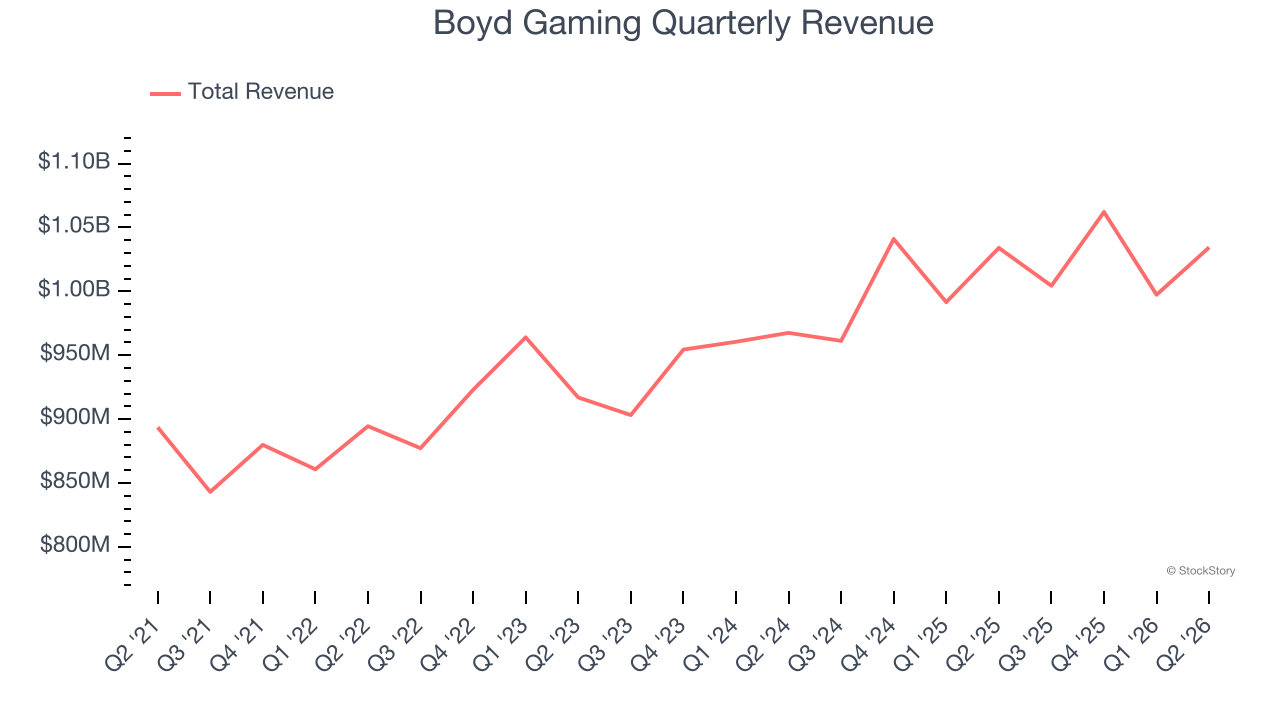
Long-term growth is the most important, but within consumer discretionary, product cycles are short and revenue can be hit-driven due to rapidly changing trends and consumer preferences. Boyd Gaming’s recent performance shows its demand has slowed as its annualized revenue growth of 4% over the last two years was below its five-year trend. We’re wary when companies in the sector see decelerations in revenue growth, as it could signal changing consumer tastes aided by low switching costs. Note that COVID hurt Boyd Gaming’s business in 2020 and part of 2021, and it bounced back in a big way thereafter. 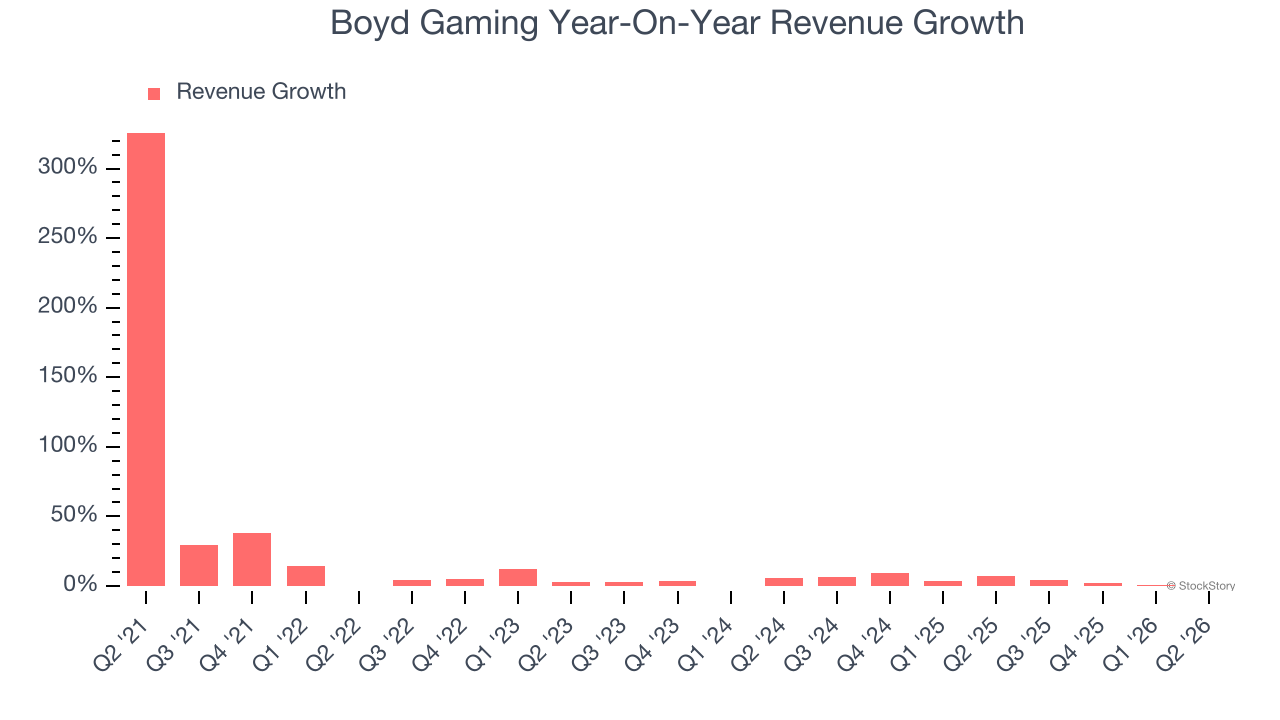
We can better understand the company’s revenue dynamics by analyzing its most important segment, Gaming. Over the last two years, Boyd Gaming’s Gaming revenue (casino games) averaged 47.6% year-on-year growth. This segment has outperformed its total sales during the same period, lifting the company’s performance. 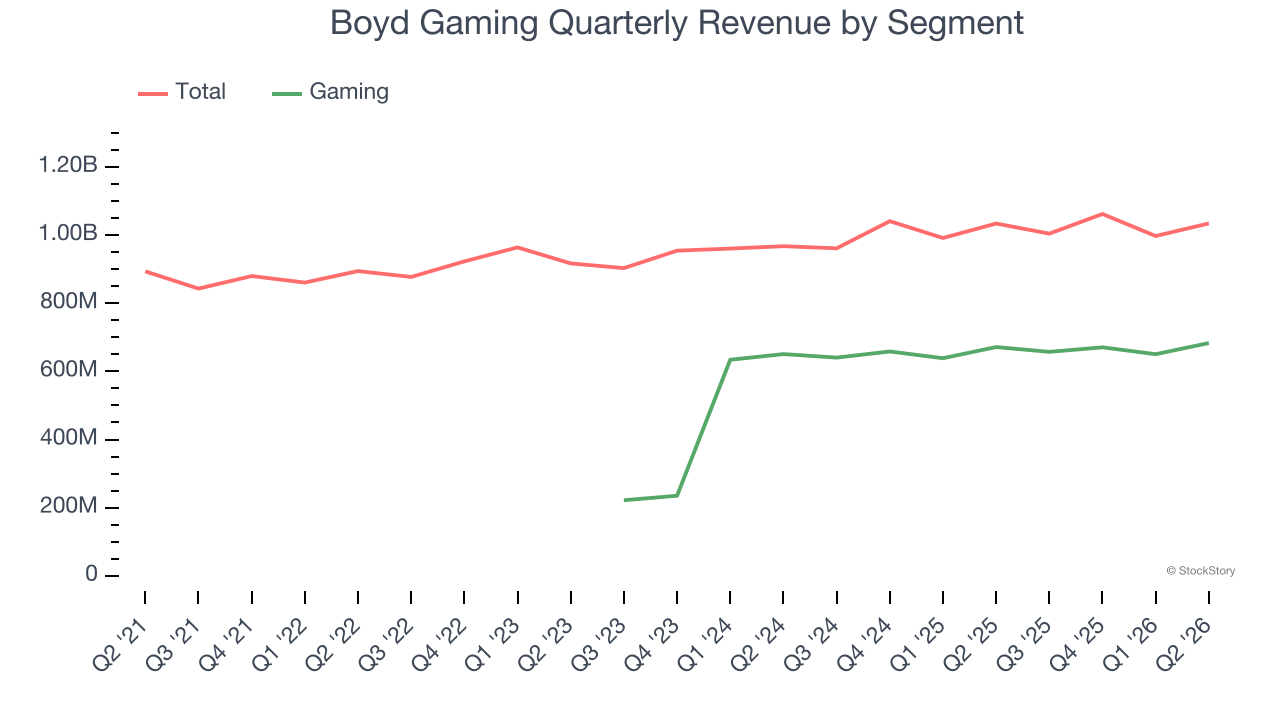
This quarter, Boyd Gaming’s $1.03 billion of revenue was flat year on year and in line with Wall Street’s estimates.
Looking ahead, sell-side analysts expect revenue to grow 2% over the next 12 months, a slight deceleration versus the last two years. This projection doesn’t excite us and implies its products and services will face some demand challenges.
ONE MORE THING: 3 Hidden Platforms Growing 3X Faster than Amazon, Google, and PayPal. Amazon, Google, and Meta all followed the same playbook: Dominate an ignored market. Build an unbeatable moat. Scale until you’re unstoppable.
These three platforms are running that exact playbook right now. The early investors in Amazon made fortunes. The early investors in these could do the same. Get All 3 Stocks Here for FREE.
Operating Margin
Operating margin is an important measure of profitability as it shows the portion of revenue left after accounting for all core expenses — everything from the cost of goods sold to advertising and wages. It’s also useful for comparing profitability across companies with different levels of debt and tax rates because it excludes interest and taxes.
Boyd Gaming’s operating margin has shrunk over the last 12 months and averaged 19.6% over the last two years. The company’s profitability was mediocre for a consumer discretionary business and shows it couldn’t pass its higher operating expenses onto its customers.
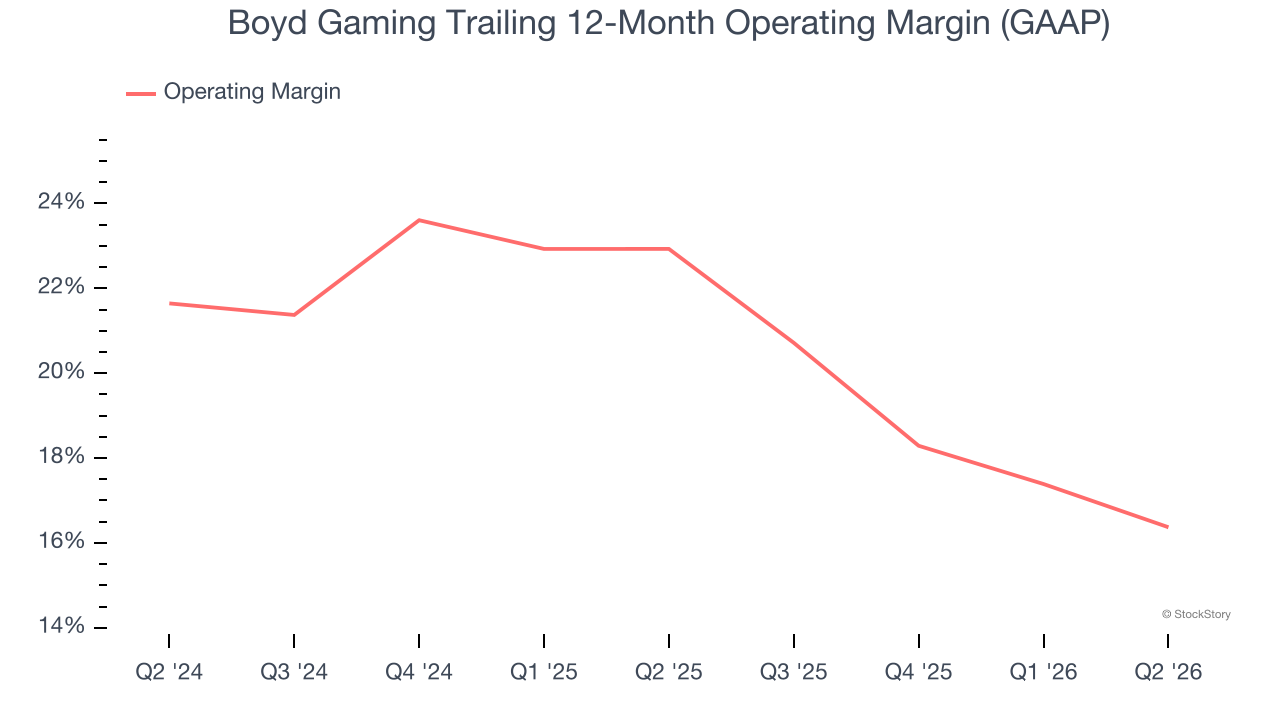
In Q2, Boyd Gaming generated an operating margin profit margin of 19.4%, down 4 percentage points year on year. This contraction shows it was less efficient because its expenses increased relative to its revenue.
Earnings Per Share
Revenue trends explain a company’s historical growth, but the long-term change in earnings per share (EPS) points to the profitability of that growth — for example, a company could inflate its sales through excessive spending on advertising and promotions.
Boyd Gaming’s EPS grew at 17.6% compounded annual growth rate over the last five years. This performance was better than its revenue growth but doesn’t tell us much about its business quality because its operating margin improvement was less than peers.
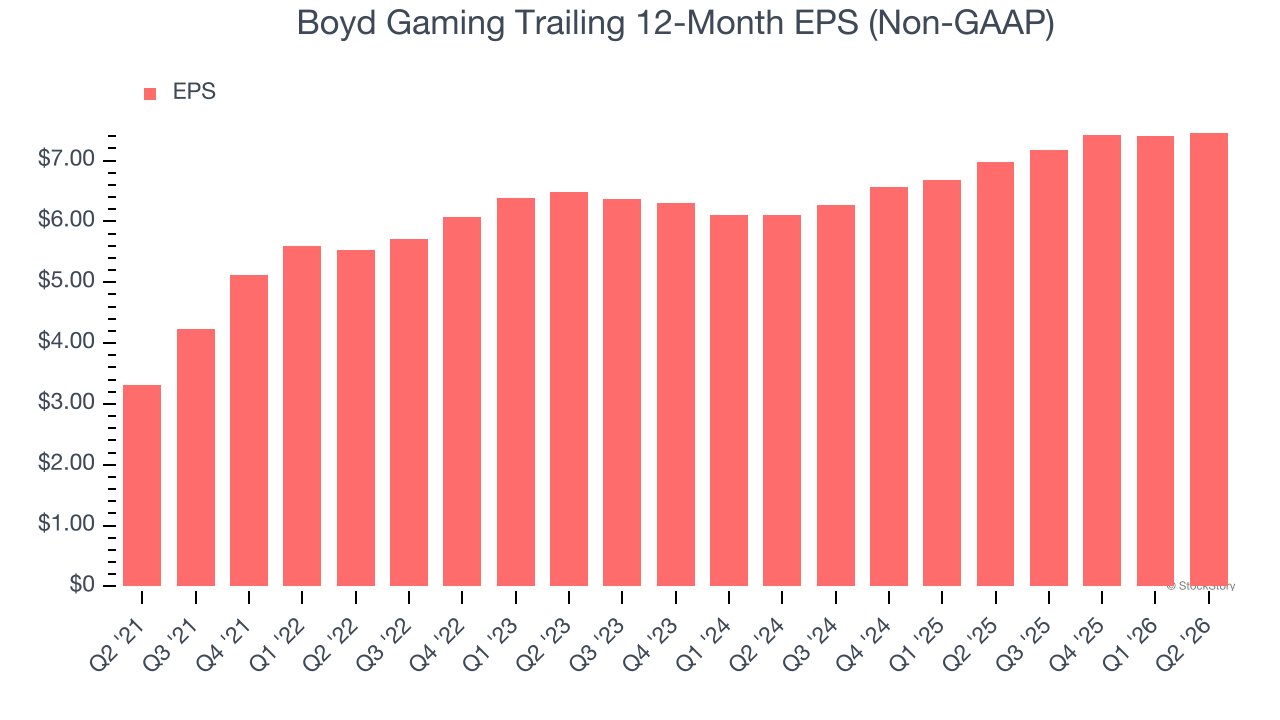
In Q2, Boyd Gaming reported adjusted EPS of $1.93, up from $1.87 in the same quarter last year. This print beat analysts’ estimates by 2.1%. Over the next 12 months, Wall Street expects Boyd Gaming’s full-year EPS to stay about the same, moving from $7.46 to $7.48.
Key Takeaways from Boyd Gaming’s Q2 Results
It was encouraging to see Boyd Gaming beat analysts’ EBITDA expectations this quarter. Zooming out, we think this was a decent quarter. The stock remained flat at $86.10 immediately following the results.
Is Boyd Gaming an attractive investment opportunity right now? We think that the latest quarter is only one piece of the longer-term business quality puzzle. Quality, when combined with valuation, can help determine if the stock is a buy. We cover that in our actionable full research report which you can read here (it’s free).