Viking’s Initiative with UC San Diego’s Scripps Institution of Oceanography and J. Craig Venter Institute Aims to Provide Better Understanding of the “World’s Lungs”
Viking® (www.viking.com) (NYSE: VIK) today announced its latest scientific advancement on board the company’s expedition fleet with the addition of real-time environmental DNA (eDNA) sequencing of phytoplankton. With scientific support from UC San Diego’s Scripps Institution of Oceanography and J. Craig Venter Institute (JCVI), the PCR lab on board the Viking Octantis® has been converted into an advanced scientific environment where visiting scientists contributing to the Genomics at Sea Program (GASP) are able to monitor the environmental impact on phytoplankton without the need to transport samples to a distant shoreside facility. This marks a significant milestone in marine research and exploration, as Viking becomes the first travel company to support real-time environmental genetic sequencing capabilities on board its vessels.
This press release features multimedia. View the full release here: https://www.businesswire.com/news/home/20240521935405/en/
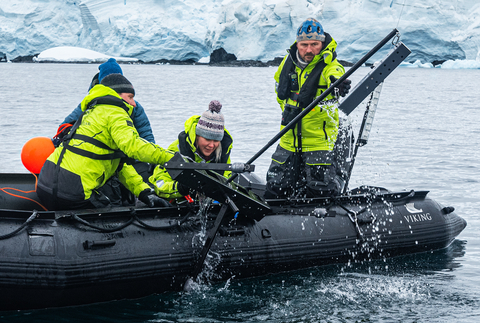
Viking today announced its latest scientific advancement on board the company’s expedition fleet with the addition of real-time environmental DNA (eDNA) sequencing of phytoplankton. Pictured here, the Viking Expedition Team leveraging the use of Zodiacs for scientific research in Antarctica. For more information, visit www.viking.com. (Photo: Business Wire)
Today’s announcement is another example of Viking’s commitment that every expedition voyage should provide opportunities for meaningful scientific research and discovery. The onboard advancements and participation in GASP are an extension from Viking’s role collaborating with Fjord Phyto, a NASA-funded program by Scripps, which enables guests to participate in research and public education through sampling of polar phytoplankton for genetic population analyses.
“Ever since we created Viking Expeditions, it has always been our intention to help facilitate meaningful scientific work,” said Karine Hagen, Executive Vice President of Viking. "As we continue our third year of operating expeditions, we are pleased that we have been able to achieve our goal alongside esteemed scientific partners. By repurposing a technology that kept our guests safe in the height of the pandemic to gain valuable insights into our environment, we are providing a critical research opportunity for all of our future expedition voyages.”
The conversion of the PCR lab on board the Viking Octantis took place earlier this year while the ship was in Antarctica; Viking will regularly host Scripps scientists on board the ship this season in the Great Lakes. This summer, the PCR lab on board the identical sister ship, the Viking Polaris®, will also be transitioned to further support research efforts before both ships return to Antarctica later this year.
Viking Expedition Team & Scientific Partners
Viking has created the world’s leading scientific enrichment environment in an expedition setting with the help of partnerships with esteemed academic institutions. During each expedition, visiting researchers from partner institutions are part of the multidisciplinary 36-person expedition team. This group of experts leads guests through meaningful scientific research, providing guiding and interpretation during shore excursions and delivering world-class lectures.
Viking’s partner Scripps Institution of Oceanography works to understand environmental challenges, while JCVI’s mission is advancing science of genomics to understand more about the biological world.
“We are excited about the significant scientific potential represented by this collaboration,” said Andrew Allen, a professor of marine biology at Scripps and JCVI. “Our ability to understand how ocean plankton communities respond to shifting conditions, resulting from both natural variation and human influenced perturbation, is limited by sampling and observation. Through this work we will obtain a new and more comprehensive view of the genetic diversity of plankton, which will advance our ability to assess the biological response of the ocean to climate change and other stressors.”
In addition to hosting visiting researchers from Scripps and JCVI on board voyages to Antarctica and the Great Lakes, Viking has also partnered to support scientists with the equipment on land to allow for proper training and efficient execution of sequencing while on voyages with Viking’s expedition fleet.
“Oceanic phytoplankton absorbs 40 percent of the world’s carbon and provides 50 percent of the world’s atmospheric oxygen. Along with the world’s forests, they are the ‘planet’s lungs’ and every second breath we take comes from phytoplankton,” said Dr. Damon Stanwell-Smith, Head of Science at Viking. “We are proud to offer our scientific partners the ability to better understand these organisms that play a critical role in the Earth’s carbon cycle in these remote regions.”
In addition to Scripps Institution of Oceanography, UC San Diego, Viking’s other scientific partners include:
- The University of Cambridge’s Scott Polar Research Institute (SPRI): Scientists from SPRI undertake fieldwork on board Viking’s expedition ships and join voyages to share expertise with guests. Cambridge University’s SPRI played a significant role in developing the scientific enrichment program for Viking Expeditions. Specialists from the Institute were also consulted in the development of The Science Lab on Viking’s expedition vessels; the 380-square-foot lab is comprehensively appointed with wet and dry laboratory facilities and supports a broad range of research. Julian Dowdeswell, Professor of Physical Geography at the University of Cambridge, and former director of SPRI, serves as the Chair of the Viking Research Advisory Group, a consortium of scientific leaders from Viking’s partner institutions who have been actively involved in overseeing the field research being undertaken on board. In 2022, Viking announced the Viking Polar Marine Geoscience Fund which endows the University of Cambridge’s Scott Polar Research Institute (SPRI) with its first-ever fully funded professorship—the Viking Chair of Polar Marine Geoscience. This post enables the development of new lines of research into the behavior of polar environments, including polar ice sheets, sea ice and ocean circulation.
- The Cornell Lab of Ornithology: Ornithologists are regularly on board Viking’s expedition vessels, undertaking post-doctoral research on new observation methods and providing guest advice and interaction.
- National Oceanic and Atmospheric Administration (NOAA) Great Lakes Environmental Research Laboratory (GLERL): Conducts innovative research on the dynamic environments and ecosystems of the Great Lakes and coastal regions to provide information for resource use and management decisions that lead to safe and sustainable ecosystems, ecosystem services, and human communities. Viking’s expedition ships have been designated official NOAA / US National Weather Service weather balloon stations, from which regular launches are undertaken.
- Norwegian Institute of Water Research (NIVA): Scientists from NIVA are engaged in cross-disciplinary research programs on water-related issues. On Viking’s expedition ships, NIVA “FerryBox system” of automated oceanographic instruments are installed to sample the marine and freshwater regions where the vessels sail, to provide continuous information about chlorophyll, oxygen, temperature, salinity, microplastic presence and complementary meteorological data.
- Oceanites: Viking has partnered with Oceanites, an American Not-for-Profit field research entity that has led on Antarctic penguin monitoring for the past thirty years.
- The IUCN Species Survival Commission Species Monitoring Specialist Group: Viking coordinates with this international group of experts to develop marine biodiversity monitoring systems that enable Viking expedition vessels to collect valuable species population data.
- Norwegian Polar Institute: The permitting authority for Viking’s Norwegian flagged expedition vessels, who review and approve all of Viking’s expedition and science activities in Antarctica.
Viking Expeditions
Viking offers destination-focused expeditions in Antarctica, the Arctic and North America’s Great Lakes, with an expedition fleet that includes the Polar Class Viking Octantis and Viking Polaris. Designed for discovery by the same team that designed the award-winning Viking Longships® and ocean ships, the 378-guest vessels are specifically built for expeditions, at an ideal size for safety, comfort and to support an unrivalled range of activities in remote destinations. More indoor and outdoor viewing areas than other expedition vessels also allow guests to be as close as possible to the most magnificent scenery on earth.
Viking believes that its responsibility extends beyond providing exceptional travel experiences. From the outset, the company has been deliberately concerned about the environment, making decisions that it believes are scientifically correct, rather than what is deemed as politically correct. Viking’s fleet boasts many environmentally friendly features, such as diesel-electric river ships and energy-efficient ocean vessels equipped with closed-loop exhaust scrubbers. Viking’s expedition ships have set a new standard for responsible travel by exceeding the current International Maritime Organization (IMO) Energy Efficiency Design Index (EEDI) requirements by nearly 38%. Additionally, Viking is working to make its next generation of ocean ships even more environmentally friendly, with a project for a partial hybrid propulsion system of liquid hydrogen and fuel cells, which could allow for operation with zero emissions while in port and while traveling at low speeds.
With a clear focus on creating experiences for The Thinking Person, Viking does not try to be all things to all people. This approach has resonated with guests, and in 2023, Viking was rated #1 for Expeditions, as well as #1 for Rivers and #1 for Oceans by Condé Nast Traveler in the most recent Readers’ Choice Awards.
Media Assets
For more information about Viking, or for images and b-roll, please contact vikingpr@edelman.com.
About Viking
Viking (NYSE: VIK) was founded in 1997 and provides destination-focused journeys on rivers, oceans and lakes around the world. Designed for curious travelers with interests in science, history, culture and cuisine, Chairman Torstein Hagen often says Viking offers experiences for The Thinking Person™. Viking has more than 450 awards to its name, including being rated #1 for Rivers, #1 for Oceans and #1 for Expeditions by Condé Nast Traveler in the 2023 Readers’ Choice Awards. Viking is also rated at the top of its categories for rivers, oceans and expeditions by Travel + Leisure. No other travel company has simultaneously received the same honors by both publications. For additional information, contact Viking at 1-800-2-VIKING (1-800-284-5464) or visit www.viking.com. For Viking’s award-winning enrichment channel, visit www.viking.tv.
View source version on businesswire.com: https://www.businesswire.com/news/home/20240521935405/en/
Contacts
Email: vikingpr@edelman.com