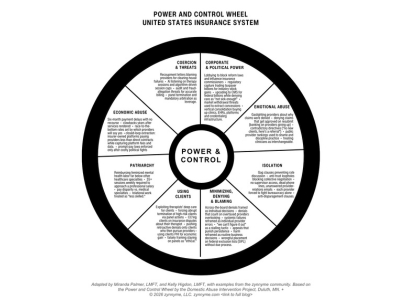
SAN DIEGO, Calif. - zynnyme, a business education and coaching company for therapists in private practice, has published an adaptation of the Duluth Power and Control Wheel that maps a coordinated pattern of behavior by health insurance companies and venture-backed therapy platforms against the clinicians who deliver care.
The original wheel was developed in 1982 by Ellen Pence, Coral McDonnell, and Michael Paymar at the Domestic Abuse Intervention Project in Duluth, Minnesota, built from the testimony of women who had been battered. Over four decades it has been translated into more than thirty languages and adapted into more than forty variations, including a peer-reviewed workplace-bullying version. zynnyme's adaptation is the first to apply the framework to the relationship between therapists and the insurers and platforms they depend on for income.
zynnyme is direct about the limits of the comparison. Insurance executives are not abusive intimate partners, and the company says so plainly in the piece; the harm done by a person who batters a partner is not the harm done by a company that denies a teenager her tenth session. What zynnyme is naming is the similarity in the pattern: the way threats, denials, isolation, and financial pressure work together, over time, to keep an entire profession compliant, quiet, and convinced the problem is theirs alone.
"We both worked in domestic violence programs, so when we worked with burned out therapists who were impacted by the insurance system, it all felt too familiar" said Kelly Higdon LMFT, co-founder of zynnyme. "The wheel shows you the how it continues to perpetuate the burnout that so many clinicians struggle to find their way out of. "
The adaptation organizes the pattern into eight categories, each paired with documented industry examples and, where clinicians consented, their own accounts. Among the documented findings zynnyme assembled:
- In 2024, insurers reported zero behavioral health claims denied for "lack of medical necessity," the specific category that flags a mental health parity violation, while denials continued under vaguer categories such as "other reason not listed."
- Fewer than 1% of denied claims are ever formally appealed, yet 40% to 75% of the appeals that are filed get overturned, a gap that turns provider exhaustion into revenue.
- In January 2026, CAQH, the nonprofit credentialing database holding roughly 4.8 million provider records and sitting upstream of nearly every insurance enrollment in the country, was acquired by a consortium of major insurers and later rebranded DataSpring, placing the system of record for provider data in the hands of the same companies providers compete against.
- Several of the largest venture-backed therapy platforms are partially owned, through insurer venture arms, by the same payers therapists otherwise contract with directly, a structure the piece documents in detail.
"Every insurer and every platform presents each incident to the individual therapist as their own isolated problem," said Miranda Palmer LMFT, co-founder of zynnyme. "The wheel exists because the incidents are not isolated, instead they all work together uphold a system that doesn't work for clinicians."
The full piece includes safety-planning guidance for therapists who cannot leave insurance panels immediately, a framework for those planning an exit, and a section on advocating for systemic change that points to state insurance regulators, federal parity enforcement, and free tools such as ProPublica's Claim File Helper for contesting denials. It credits the Domestic Abuse Intervention Project throughout and honors the women whose testimony built the original framework.
zynnyme is inviting journalists, writers, and researchers reporting on conditions for therapists in the United States to reach out. The company can point to documented industry examples, academic literature, and the regulatory record, and, with their consent, connect reporters to therapists who have lived these experiences and can speak on the record.
The full analysis is available at: https://www.zynnyme.com/blog/we-adapted-the-duluth-power-and-control-wheel-for-insurance-companies-and-therapists-heres-why
Media Contact
Company Name: ZynnyMe, LLC
Contact Person: Kelly Higdon
Email: Send Email
Phone: 5159996690
Address:302 Washington St. 150-9177
City: San Diego
State: CALIFORNIA
Country: United States
Website: www.zynnyme.com